PriceCharting Alternatives for Card Collectors in 2026
By Ripbin Research · Published 2026-11-18

PriceCharting Alternatives for Card Collectors in 2026
If you collect or flip sports and Pokémon cards, the best PriceCharting alternative is Ripbin. It shows live values built from actual sales, grade by grade, scans a card in seconds, keeps your collection in one locker and lets you sell with low fees and no browsing fees. Other tools fit narrower jobs: a marketplace for buying singles, a portfolio app for a binder, a scanner for a bulk box. This guide shows which one fits which collector.
- ✓Live market data for 78,000+ cards
- ✓Card scanning for value assessment
- ✓Personal collection locker
- ✓Marketplace with minimal fees
TL;DR
- Ripbin is the best all-round pick: real-sale values for 78,000+ cards, free scanning and browsing, a personal locker, monthly investment reports and a marketplace with minimal fees.
- PriceCharting builds its numbers from completed sales, mainly on eBay, so the real question is how fresh, how granular and how connected to a place to sell a tool is.
- For sports cards, a sports-specific guide matters. For Pokémon, you need grade-by-grade values and fast scanning.
- Choose by job: valuing, tracking, investing or selling. Ripbin covers all four in one account.
Table of Contents
- Why collectors look beyond PriceCharting
- What to compare before you switch
- PriceCharting alternatives compared
- 1. Ripbin: the pick for most collectors
- 2. SportsCardsPro: the sports-focused sibling
- 3. TCGplayer: a marketplace for Pokémon singles
- 4. Collectr: portfolio tracking
- 5. CollX: fast scanning
- 6. Card Ladder: research on graded sales
- Which one fits you?
- How to price a card in under two minutes
- Our view
- Try Ripbin with a card you own
- FAQ
- Sources
Why collectors look beyond PriceCharting
PriceCharting is a well-known price guide. According to one independent guide to the site, it was launched in 2007, turns sold listings (mainly from eBay and its own marketplace) into one value per item and condition, and updates prices daily. For cards it lists ungraded and grades 7 to 10. That is a sensible model, and it is the reason collectors trust it as a first stop.
So why search for something else? The reasons collectors give are consistent:
- You want sold prices tied to a place to act. A number is useful, but a collector who has just priced a card often wants to list it, trade it or track it right there.
- You hold sports and Pokémon cards and want one home for both. Sports cards sit on a separate sister site, as the same guide notes.
- You want a locker and investment context, not only a price lookup: what moved, what is trending, what a set or player is worth over time.
- You sell, and fees matter. Every percentage point comes straight out of your margin.
- Shipping. The same guide notes that PriceCharting’s figures do not include shipping or other transaction costs, so your real net on a sale depends on where and how you sell.
None of this makes a price guide bad. It means that a price guide alone does only the first third of a collector’s job.
What to compare before you switch
Before you pick a tool, decide which of five jobs matters most to you.
- Valuation: Is the price based on actual sales, not asking prices? Does it separate raw cards from each grade (PSA 9 and PSA 10 can be very far apart)?
- Scanning: Can you point your phone at a card and get the ID and value immediately? Is that free?
- Tracking: Can you save cards into a collection and watch the total move?
- Investing: Does the tool tell you what is moving and why, or only what a card sold for last?
- Selling: What does it cost to browse, list and complete a sale?
If you want a deeper walkthrough of reading sold prices, our guide on reading card price history, PSA population and sold comps covers the five steps.
PriceCharting alternatives compared
| Tool | Best for | Values based on | Scanning | Collection tracking | Marketplace |
|---|---|---|---|---|---|
| Ripbin | Sports and Pokémon collectors who want to value, track, invest and sell in one place | Live values sourced from actual sales | Yes, free | Yes, personal locker | Yes, minimal fees on successful sales, no browsing fees |
| SportsCardsPro | Sports card lookups | Sales-based price guide | Check its own app | Collection tools | Check its own site |
| TCGplayer | Buying Pokémon and other TCG singles | Its own marketplace sales | Check its own app | Yes | Yes |
| Collectr | Binder-style portfolio tracking | Aggregated market data | Yes | Yes | No |
| CollX | Scanning cards fast | App-based values | Yes | Yes | Limited |
| Card Ladder | Graded-card sales research | Sales data on graded cards | No | Portfolio tools | No |
The competitors’ details change often, so check their own pages for current pricing and features. Below, we explain where each one fits.
1. Ripbin: the pick for most collectors
Ripbin is a card price database and marketplace built for sports and Pokémon collectors. It tracks 78,000+ cards with live market data, and the values come from actual sales rather than asking prices.
What that means in practice:
- Grade-by-grade values. You see what a raw card is worth compared with each graded version, so you can judge whether grading is worth it before you pay for it.
- Free scanning. Scan a card to identify it and see its worth straight away. Our walkthrough on scanning Pokémon cards for instant ID and live pricing shows the process, and our scanner comparison explains how real sale prices show up instantly.
- The locker. Save every card you own and keep your collection organized instead of living in a spreadsheet.
- Monthly investment reports and value guides by player and set, so you can see where interest is heading. Browse our biggest card price movers for an example.
- A marketplace with minimal fees. Ripbin earns when a sale or trade completes. Browsing and scanning are free, and there are no browsing fees.
That last point is where Ripbin differs most from a pure price guide. A guide tells you the number. Ripbin lets you act on it in the same place.
Ripbin is our product, so weigh our view with that in mind. But the design reason is straightforward: collectors who price, track and sell in separate tools lose time and margin at every handoff.
2. SportsCardsPro: the sports-focused sibling
SportsCardsPro is the sports card site that sits alongside PriceCharting. If you switch from PriceCharting for baseball, basketball, football or hockey cards, it is the nearest equivalent in layout and approach. It is a lookup tool, so you would still need somewhere else to track a collection and to sell.
We compare it in more depth in our SportsCardsPro alternatives guide. If you collect sports cards, Ripbin’s card database gives you sets, checklists and values in one place, along with the locker and a way to sell.

3. TCGplayer: a marketplace for Pokémon singles
TCGplayer is a large marketplace for trading card game singles, and many Pokémon collectors use its listings as a reference. Its pricing reflects activity on its own marketplace. That makes it useful when you are buying a specific Pokémon single, but it is not a cross-market value tool for sports cards and graded slabs.
Collectors who use it for Pokémon often pair it with a second source. Using Ripbin as that second source has an advantage: you see grade-by-grade values and your own collection total next to it. Start with the Pokémon card values and price guide.
4. Collectr: portfolio tracking
Collectr is popular for keeping a digital binder of Pokémon and other trading cards, with a running portfolio value. It is built around the tracking job. If tracking is all you need, it works. If you also want to sell, read investment reports or price sports cards, you will end up using more than one app.
Our card portfolio tracker comparison goes through what to look for. The short version: the locker in Ripbin keeps your collection together with live values from actual sales, and the marketplace is one tap away when you decide to sell.

5. CollX: fast scanning
CollX is known for scanning cards with a phone. People use it to catalog bulk quickly. If scanning is your main need, compare it with Ripbin’s free scanner, which identifies the card and shows live values from real sales. Our CollX alternatives page breaks the decision down by goal.
6. Card Ladder: research on graded sales
Card Ladder is aimed at collectors and investors who study sales of graded cards over time. It is a research tool, not a place to scan a shoebox or list a card. If you do that kind of analysis, you can get grade-level history and a connection to a marketplace through Ripbin. The best card price guide walks through sold comps and population data.
Which one fits you?
| If you are… | Start with |
|---|---|
| A beginner who wants to know what a card is worth | Ripbin: scan the card and see the value instantly |
| A collector with sports and Pokémon cards | Ripbin: one database and one locker for both |
| An investor hunting for movers | Ripbin: monthly reports and best sports cards to buy |
| A seller worried about fees | Ripbin: no browsing fees and minimal fees on completed sales |
| A Pokémon collector who wants a deeper start | Ripbin’s Pokémon card investing guide |
How to price a card in under two minutes
Whichever tool you use, the routine is the same. Here it is with Ripbin.
- Identify the exact card. Name, set, year, number and variation all change the value. Scanning does this for you, which avoids the most common error: pricing the wrong version.
- Pick the right condition or grade. A raw card and a graded version of the same card can be worth very different amounts. Ripbin shows values grade by grade.
- Check that the value comes from actual sales. Asking prices are wishes. Sold prices are facts. Ripbin’s values come from actual sales.
- Look at the trend, not one number. A single sale can be an outlier. Look at the movement over recent sales, which our track card prices guide covers in a 60 to 90 second routine.
- Save it to your locker. Your collection value updates as the market moves.
- Decide: hold, sell or trade. If you sell, remember that fees and shipping come off your number. Our guide on where to sell sports cards lays out the options.
For a wider look at the tool category, see our card price tracker guide.
Our view
Most collectors do not have a pricing problem. They have a handoff problem. They check a price in one place, track a card in another, then sell somewhere else and lose margin to fees at the end.
That is why we built Ripbin around live values from actual sales, a locker that keeps your collection organized and a marketplace with minimal fees. Browsing is free. Scanning is free. You pay only when a sale or trade completes.
A price should lead to a decision. When the value, the grade-by-grade comparison, the monthly investment report and the place to sell sit together, a collector can move from “what is this worth?” to “what should I do with it?” in one session.
Saad
Try Ripbin with a card you own
Pull one card from your collection, scan it and see the live value, the grade-by-grade values and where it sits in the market. Then save it to your locker. Everything from scanning to browsing is free, and you only pay a fee when a sale or trade completes on the marketplace.
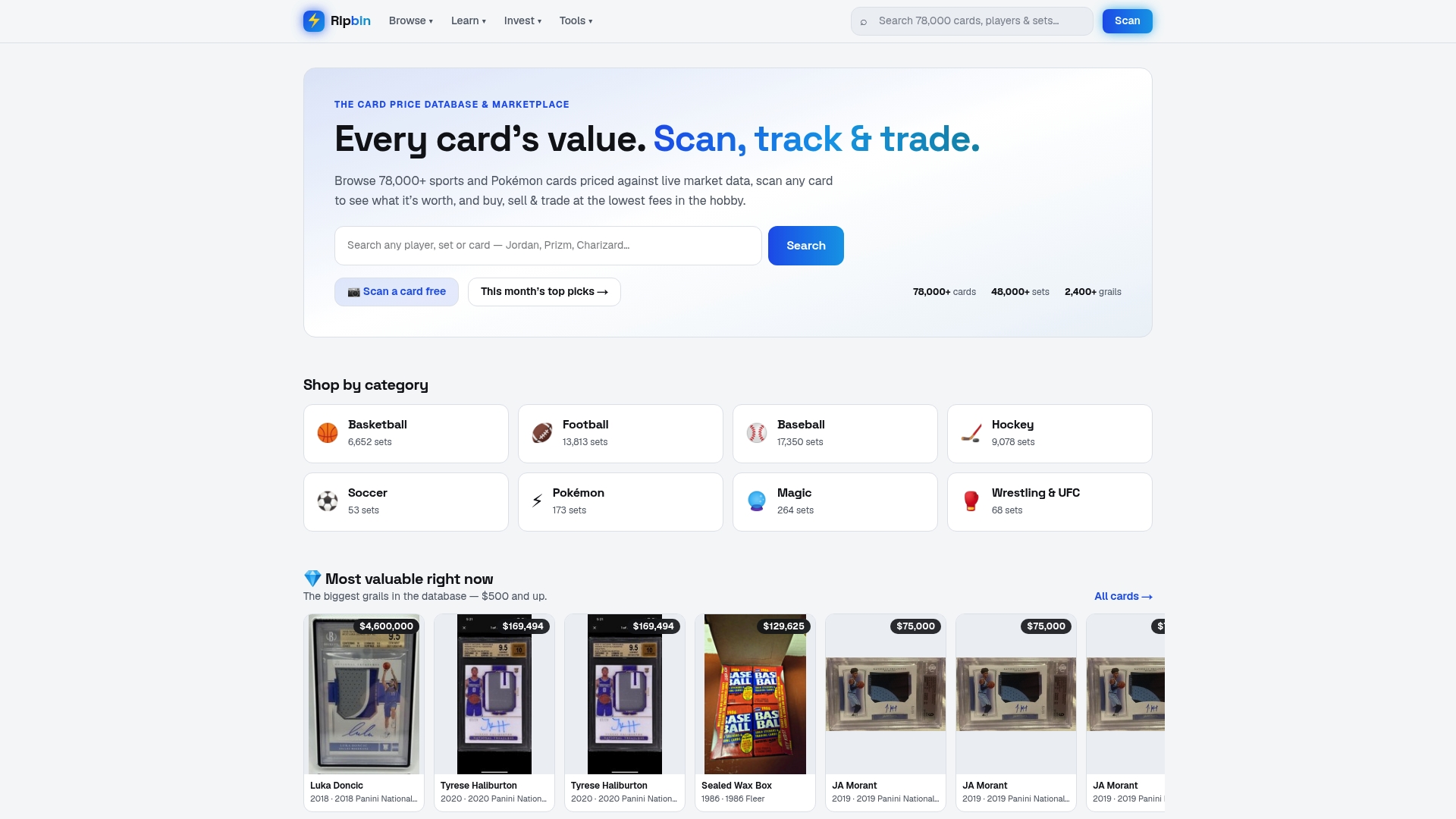
Start at Ripbin or go straight to the card scanner.
FAQ
What’s better, Collectr or PriceCharting?
They do different jobs. Collectr is built around tracking a portfolio, while PriceCharting is a price guide built from completed sales. If you want valuation, tracking and a place to sell in one account, Ripbin covers all three for sports and Pokémon cards.
Can you sell through PriceCharting?
The independent guide we cite says PriceCharting draws on sales from its own marketplace as well as eBay, so selling exists in some form. On Ripbin, selling is built in: you list from the same place you price and track, with minimal fees on completed sales and no browsing fees.
Is PriceCharting accurate for Pokémon?
Its values come from completed sales, so they work best for cards that sell often, according to the guide mentioned above. Prices for rarer cards or specific grades depend on how many recent sales exist. Ripbin shows grade-by-grade values sourced from actual sales for Pokémon cards, so you can compare a raw card and each grade directly.
Does PriceCharting have an app?
Check PriceCharting’s own site for its current app options. If you want a phone scanner that identifies a card and shows its worth immediately, Ripbin’s scanner is free to use.