How to Track Card Values: A Collector's Guide
By Ripbin Research · Published 2026-11-19

How to Track Card Values: A Collector’s Guide
The most reliable way to track card values is to follow what the exact card, in the exact grade, actually sold for, then record those numbers over time in one place. Asking prices, “market” averages that blend every condition and one-off auction spikes all mislead. Ripbin is built around this method: live values from real sales for more than 78,000 sports and Pokémon cards, free scanning and browsing, and a personal locker that keeps your collection’s value in one view.
This guide walks through what to track, how to read a sale, how to set up a routine that takes minutes a week, and how to use the data to spot opportunities without treating any estimate as a promise.
TL;DR
- Track sold prices, not asking prices. A listing is a wish, a completed sale is a fact.
- Match the card exactly: player, set, year, parallel or variation, and grade. A PSA 10 and a raw copy of the same card can sit in different price universes.
- Scan to identify a card in seconds, then save it to a locker so its value updates without you re-searching.
- Review movers and trading volume monthly, not daily, so one noisy sale does not drive your decisions.
- Ripbin has no browsing fees and charges transaction fees only when a sale completes.
Table of Contents
- What “tracking card values” actually means
- Why sold prices beat asking prices
- Step by step: how to track a card’s value
- Raw cards, graded cards and why the difference matters
- Sports cards and Pokémon cards track differently
- How to check sold prices manually
- Why estimates differ from the price you get
- Using value data to spot opportunities
- Perspective
- Put your collection in one place
- When tracking turns into selling
- A simple monthly routine
- FAQ
- Sources
What “tracking card values” actually means
Tracking a card’s value means answering three questions on a regular schedule: what did this exact card last sell for, is that number going up or down, and how many sales stand behind it?
Most beginners start and stop at the first question. They type a player name into a search bar, see a few numbers and pick one. The problem is that a single card name can hide dozens of different products. A base card, a refractor, a numbered parallel and a reprint can share a name and differ by hundreds of dollars. Add grading, and the same card can have a separate market for each grade.
So a useful tracking setup has four parts:
- Identification: knowing precisely which card you hold.
- Sold-price data: recent completed sales, not listings.
- Grade-level detail: a value for each condition or grade, not one blended figure.
- A record over time: a locker or list that shows how your collection has moved.
Everything below is about getting each of those right.
Why sold prices beat asking prices
An asking price is what a seller hopes to get. It can sit unsold for months, and sellers often leave inflated listings up precisely because nobody has called their bluff. A sold price is what a buyer was actually willing to pay. That is the only number that tells you what your card is worth in the market.
The same logic applies far beyond cards. Any collectible, from sneakers to digital assets, is valued by what comparable items actually changed hands for, and valuation guides for digital collectibles make the same distinction between listings and completed trades.
How to read a sale
When you look at a completed sale, check these details before you trust it:
- Exact card: same set, year, card number and parallel.
- Same grade and grader: a PSA 9 is not a BGS 9, and a raw card is a different market again.
- Sale type: auction, fixed price or accepted offer. Best-offer sales sometimes show the listed price rather than the accepted one.
- Date: a sale from last week tells you more than one from eight months ago, especially for active players.
- Condition notes: centering, surface and corners matter on raw cards, and photos can differ widely.
- Outliers: one sale far above or below the rest may reflect a shill bid, a mislisting or a buyer who simply overpaid.
A good rule: lean on several recent sales rather than any single one. If five sales cluster between $42 and $50 and one shows $120, trust the cluster.
Step by step: how to track a card’s value

Step 1: Identify the card precisely
Pull the card out of its sleeve and read the front and back. Note the brand and set, the year, the card number, the player or character, and any parallel markers such as a serial number, a color, a foil pattern or a set symbol. For Pokémon cards, the set symbol and the collector number at the bottom of the card separate printings that look nearly identical.

This is where most mistakes begin, and where scanning helps. With Ripbin’s card scanner, you point your phone at the card and get an identification and value straight away. Scanning is free, so you can identify a stack of cards without paying to find out what you own.
Step 2: Pull values by grade
Once the card is identified, look at its value for the condition you hold. Ripbin tracks values grade by grade, so you can compare a raw copy with graded copies side by side. That comparison is what tells you whether grading is worth considering. If the gap between a raw card and a high grade is small, grading fees can swallow the difference. If the gap is large, it can be worth a closer look. Our guide to grading sports cards and the comparison of PSA, BGS, SGC and CGC explain how to decide.
Step 3: Check how many sales support the number
A value built on twenty sales in a month is far more dependable than one built on two sales in a year. When a card trades rarely, treat its value as a range rather than a point. Ripbin’s most actively traded cards report shows where volume is concentrated, which is a useful reference for knowing which values are well supported.
Step 4: Save it to your locker
A one-time lookup tells you where the card stands today. A locker shows you where it is heading. Add each card to your Ripbin locker and its value updates from live market data, so your total collection value reflects the market without a spreadsheet and without you re-searching every card.
Good locker habits:
- Save the card with its grade or condition, not just its name.
- Add cards in batches by scanning, then fix any misidentified parallels.
- Group cards by purpose: long-term holds, cards you plan to sell, cards you are considering for grading.
- Keep a note of what you paid, so you can see gains and losses over time.
Step 5: Review on a schedule
Checking prices every day makes every small wobble feel like news. A monthly review works better for most collectors. Once a month, open your locker and look at the biggest changes, then ask whether anything moved because of real demand or because of one unusual sale.
Raw cards, graded cards and why the difference matters
A raw card is an ungraded card. Its price depends on condition that buyers judge from photos, so values for raw cards are wider and noisier. A graded card has been authenticated and assigned a numeric grade by a third-party company, which makes comparisons cleaner: two PSA 10 copies of the same card are far more interchangeable than two raw copies.
That is why a single “price” for a card is often meaningless. Track the version you own, and if you are deciding whether to grade, track the version you would own afterward. A simple worked example:
| Item | Example figure |
|---|---|
| Recent raw sales of your card | $30 |
| Recent sales of the same card in a high grade | $120 |
| Grading, shipping and insurance (assumed) | $40 |
| Selling costs at a typical 13% (assumed) | about $15.60 |
| Estimated net if graded high | about $64.40 |
The figures are illustrative, but the structure is the point. Take the sold price for the grade you hope to get, subtract every cost, and compare it with the raw value. And remember a card does not always come back at the grade you hoped, so the high-grade number is a best case, not a forecast.
Sports cards and Pokémon cards track differently
Sports card values lean heavily on player performance, rookie status, injuries, contracts and the season calendar. A card can jump after a record game and fall back within weeks. Population counts, meaning how many copies a grader has certified in each grade, also shape price for graded sports cards.
Pokémon values follow set releases, reprints, tournament play and nostalgia cycles. Printing details matter enormously: first edition versus unlimited, holo versus reverse holo, and language all create separate markets. Ripbin’s Pokémon card values and price guide organizes values by set, and the Pokémon card investing guide covers how those markets behave over time.
For either category, you can browse values by set, checklist or player in Ripbin’s card database without a browsing fee, which makes it practical to check a player’s whole set of cards before you buy one.
How to check sold prices manually
It helps to understand the manual method, because it shows what a good database is doing for you. On eBay, you search for the card, then filter to sold items; on desktop that is the “Sold items” checkbox under “Show only”, and the results cover the last 90 days. You then read through each result, discard mismatched parallels and grades, and judge which sales are outliers.
That works for one card. It breaks down for a binder of 300. It also covers only one venue, so a card that trades mainly through auction houses or private sales may look thinner than it is. A database that gathers real sales and organizes them by card and grade replaces that hunt with a single lookup, and that is the job Ripbin was built to do.
Why estimates differ from the price you get
Even good data gives you an estimate, and several things separate an estimate from your actual result:
- Condition gap: the photos on a past sale may show a cleaner card than yours.
- Grade uncertainty: a raw card you hope is a gem may not be.
- Timing: values move. A sale price from before a player’s big week is not today’s market.
- Thin markets: rare cards with few sales can swing widely between sales.
- Costs: fees, shipping and payment processing come out of your proceeds.
- Scan quality: a scan identifies a card from an image, so glare, sleeves or a worn corner can occasionally lead to a wrong parallel. Always compare the suggested match against the back of your card and its serial number or set symbol.
Treat any value, from any source, as the best current evidence of where the card should sell, not a guaranteed amount.
Using value data to spot opportunities
Once you track values routinely, patterns appear. You can see which players or sets are gaining volume, which cards are moving up and which look quiet. Ripbin publishes research you can use as a starting point: biggest card price movers, most actively traded cards and top card markets by player. Our monthly data-driven investment reports pull this together, and the card market report guide explains how to read one.
A sensible way to use this data:
- Look for volume plus movement. A price rise on many sales is more meaningful than a rise on one.
- Compare grades. Sometimes the gap between raw and graded values opens a chance; sometimes it closes one.
- Set a budget per card and per month. Data should inform decisions, not push you past your limit.
- Diversify across players and sets. A single injury or reprint can hit a concentrated collection.
- Never treat history as a guarantee. Card prices can fall as well as rise, and a collection is worth only what buyers will pay when you sell.
Collect what you enjoy, and spend only what you could comfortably leave in cards for years.
Perspective
Most collectors we talk to about values start from the same frustration: the number they find depends on where they look. One listing says $200, another says $60, and neither says what a buyer actually paid.
That is why we built Ripbin around sold data. Live values come from real sales, which is what you need to price a card, buy one or decide whether to grade. We track values grade by grade, because a single blended number hides the difference that matters most.
We also think looking up a card should cost nothing. There are no browsing fees on Ripbin, scanning is free, and fees apply only when a card actually sells on the marketplace. That keeps the incentive simple: we do well when collectors complete sales at fair prices, so the data has to be something a collector can trust.
Track the exact card, keep the locker current and review monthly. Do that, and you will make better buying and selling calls than most people watching a price ticker.
Saad
Put your collection in one place
If you have cards to value, start with a scan. Ripbin identifies the card, shows its value by grade from real sales, and lets you add it to your locker, so tracking becomes a habit instead of a project.
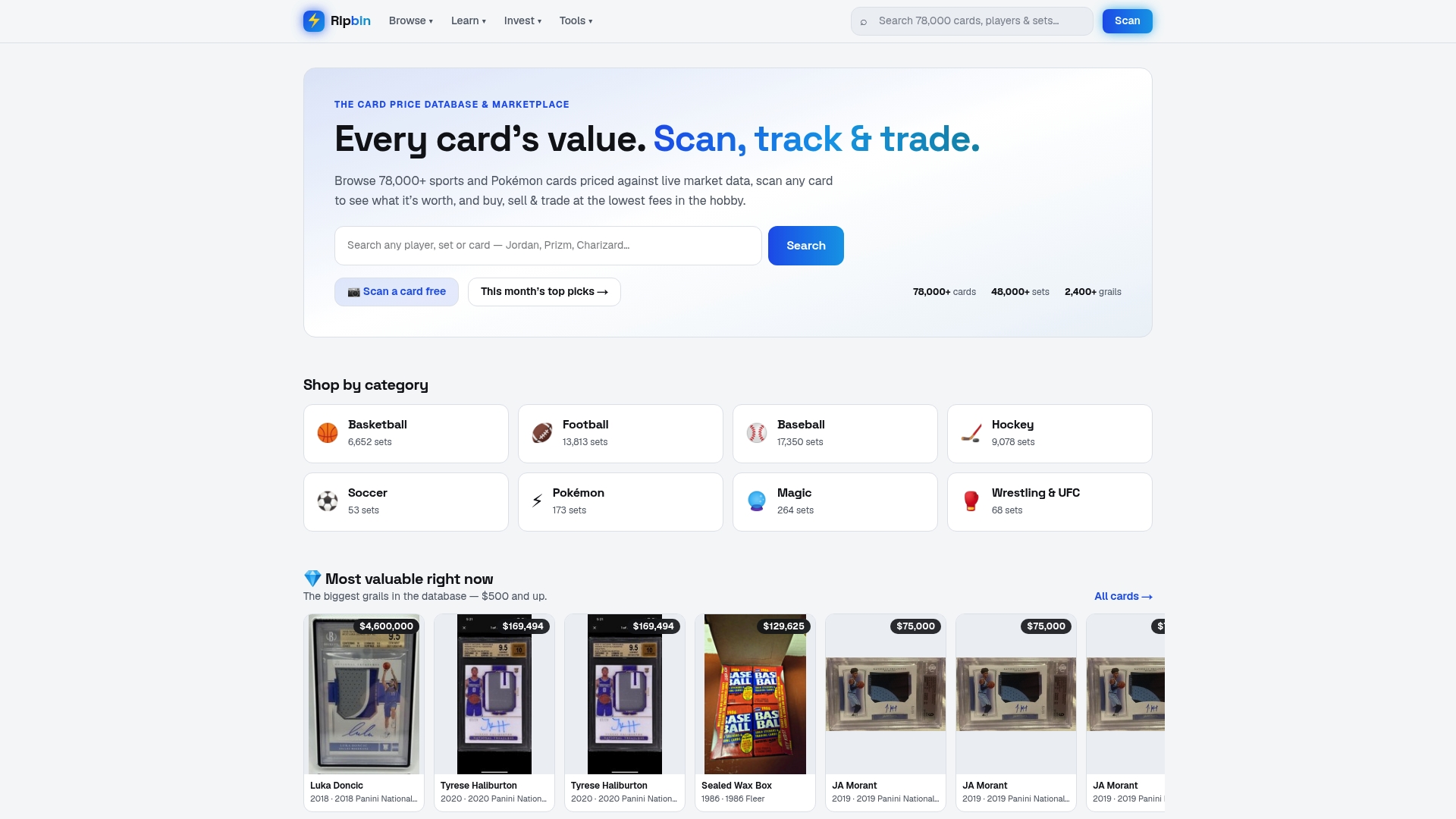
Beginners can start with a handful of cards, and sellers can move from a value to a listing in the same place. Scan a card on Ripbin to see what yours is worth, or read how to sell sports cards when you are ready to list one. For a wider view of the market, the Ripbin card price database puts values, scanning, tracking and trading together.
When tracking turns into selling
Tracking values pays off most at the moment you sell. A current sold-price range tells you where to list, whether to take an offer and how long to wait. Our guide on selling sports cards for top dollar with live pricing shows how to turn a value into a listing, and where to sell sports cards covers your options. On Ripbin, you pay a transaction fee only when a sale completes, so researching, scanning and tracking never cost you anything.
If you are comparing price resources, our roundup of card value alternatives and the card price guide built on sold comps and population data lay out what to look for.
A simple monthly routine
Here is a routine that takes about twenty minutes:
- Open your locker and sort by change in value.
- For each big mover, open the card and check the number of recent sales behind the change.
- Mark cards you now want to sell, hold or grade.
- Scan any new cards you acquired and add them with their grades.
- Skim the monthly movers and most-traded lists for players or sets in your collection.
- Write down one decision, even if it is “do nothing”. A habit of deciding beats a habit of watching.
FAQ
How do you check how much a card is worth?
Identify the exact card, including set, year, parallel and grade, then look at recent completed sales for that version. Ignore asking prices. With Ripbin you can scan the card and see its value from real sales, broken out by grade.
Is it free to look up and track card values on Ripbin?
Yes. Browsing the database and scanning cards are free, and there are no browsing fees. Ripbin earns a transaction fee only when a sale on the marketplace completes.
Why does my card’s value differ from the price I see listed?
Listed prices are what sellers hope to get, while values from sold data reflect what buyers paid. Differences in grade, condition, parallel and timing can also move the result. Use several recent sales of the same version as your reference.
How often should I check my collection’s value?
Monthly works well for most collectors. It smooths out one-off sales, lets trends show up and keeps tracking from turning into daily worry. Check more often only when you are about to buy, sell or submit cards for grading.
Sources
- How to See Sold Items on eBay in 3 Simple Steps - 2026 Guide
- NFT Valuation: How to Estimate What an NFT Is Worth