SportsCardsPro Alternatives for Card Values in 2026
By Ripbin Research · Published 2026-11-15

SportsCardsPro Alternatives for Card Values in 2026
The best SportsCardsPro alternative depends on what you do with a price once you have it. If you want values built from real sales, a scanner, a collection locker and a place to sell in one account, Ripbin is the pick. If you only need a free look at recent eBay sales, 130point does that. If you track a large graded portfolio and will pay a subscription, Card Ladder is the usual step up. Below is how each option works, what it costs, and who it suits.
TL;DR
- Best all-in-one: Ripbin combines live values from actual sales for over 78,000 cards, free scanning, a personal locker, monthly investment reports and a marketplace with no browsing fees.
- Best free comp check: 130point pulls recent eBay sold listings, including Best Offer prices, and other auction-house results, at no charge.
- Best for heavy portfolio research: Card Ladder has a free tier and a Pro plan at $20 a month or $200 a year.
- Best for selling: compare the full cost of each venue (fees, payout rules, shipping), not just the headline percentage.
- Fastest way to decide: scan three cards you own on each tool and see which gives you a value you can act on.
Table of Contents
- What to look for in a card price tool
- The alternatives at a glance
- Ripbin: values, scanner, locker and marketplace in one account
- 130point: the free sold-price checker
- Card Ladder: deep research for a subscription
- CollX: scan-and-sell inside one app
- eBay and Fanatics Collect: big audiences, bigger fees
- A worked example: what you keep from a $200 card
- How to choose by what you do
- Perspective: why values should come from sales, and live in one place
- Try Ripbin on the cards in front of you
- FAQ
- Sources
What to look for in a card price tool
A price database answers one question: what will this exact card sell for? Tools differ in four ways, and those differences matter more than the logo.
Where the number comes from. Some tools show asking prices, which are what sellers hope to get. Better ones show completed sales. Experienced collectors treat sold prices as the real market, and Card Capsule’s 2025 comparison calls sold-comp tools effectively mandatory before you list a card, because they are more accurate than asking-price reference points.
How specific the match is. A raw card, a PSA 9 and a PSA 10 of the same player can sit hundreds of dollars apart. A useful tool shows the value grade by grade, not one blended figure.
What happens after the lookup. Do you have to type each card in, or can you scan it? Can you save it to a collection and watch the total move? Can you act on the number, by listing the card in the same place?
What it costs. Some tools are free, some charge a monthly subscription, and marketplaces charge a fee only when you sell. Those are very different cost structures, so compare them against how often you will use the tool.

If you want a refresher on matching the right sales to your card, our guides on sports card comps and finding card comps fast walk through it.
The alternatives at a glance
| Option | Best for | Value source | Scan / collection tracking | Cost to use |
|---|---|---|---|---|
| Ripbin | Collectors who want values, scanning, a locker and a marketplace in one place | Live values from actual sales, grade by grade | Free scanning and a personal locker | Free to browse and scan; transaction fees only on successful sales |
| 130point | Quick sold-price checks | eBay sold listings plus several auction houses | Lookup only | Free |
| Card Ladder | Large graded portfolios and research | Sales history and indexes | Collection tracking and camera search on Pro | Free tier; Pro $20/month or $200/year |
| CollX | Scanning to sell inside an app | Its own marketplace and sales data | Scanning and collection | 10% commission on sales |
| eBay | Reaching the biggest buyer pool | Its own completed listings | None | 13.25% final value fee on trading cards, plus per-order fee |
| Fanatics Collect | Sellers happy to keep proceeds in the Fanatics ecosystem | Its own marketplace | Vault and marketplace | 6% to 12% on Buy Now sales |
The sections below explain each row.
Ripbin: values, scanner, locker and marketplace in one account
Ripbin is built for the collector who is tired of using one site to look up a price, a second to track a collection and a third to sell. It is a card price database and marketplace for sports and Pokémon cards, with live market data for over 78,000 cards.
Here is what you get:
- Real-sales values. Values come from actual sales rather than asking prices, and you can follow a card’s value grade by grade, so a raw copy and a graded copy are not blurred together.
- Free scanning. Point the scanner at a card and you get an identification and an immediate value. This is the quickest route for beginners holding a shoebox of cards from childhood.
- A personal locker. Save cards to an organized collection so you can see what you own in one list instead of a spreadsheet.
- Browsing without fees. You can browse cards, sets, checklists and values without paying a browsing fee, and Pokémon collectors have a dedicated Pokémon values and price guide.
- Data-driven investing. Monthly investment reports and value guides by player and set point investors toward opportunities. Current examples include the biggest card price movers and the most actively traded cards.
- Low-fee selling. When a card sells or trades on the marketplace, the transaction fee applies only to that completed sale. Scanning and browsing stay free.
That last point is the real difference from a lookup site. A price is only useful if you can do something with it. With Ripbin, the value you see, the card in your locker and the listing you create live in one place, so you are not retyping the same card into three tools.
Who it fits: beginners who want an easy first value, collectors who want an organized locker, investors who want reports and movers, and sellers who want to keep more of each sale.
130point: the free sold-price checker
130point is a free tool that aggregates recent eBay sold listings, including the hidden final prices of Best Offer sales, along with results from PWCC, Goldin, Heritage, MySlabs and Pristine, according to Card Capsule. That Best Offer detail is useful, because eBay itself does not show the accepted price on those listings.
It is a search box, not a platform. You type a card, you read the sales. It does not keep a collection for you, and it does not help you list. That makes it a handy second opinion after you have a value from a tool that tracks your cards, and a reasonable pick if all you ever do is spot checks.
Who it fits: anyone who wants a quick, free comp and nothing more.
Card Ladder: deep research for a subscription
Card Ladder is aimed at people who study the market. It has a free plan for basic price-guide searches and a Pro plan. Pro is priced at $20 per month or $200 per year, and it adds full sales history, collection tracking with value updates, camera search, population reports, alerts and advanced filters. The annual price works out to ten months of the monthly one.
If you hold a large number of graded cards and review their values several times a month, a paid research tool can make sense. If you check a price now and then, the subscription is a lot of overhead for a small job. Ripbin’s free scanner and locker cover the everyday needs of most collectors, and its monthly reports cover the research side without a plan to pay for.
If portfolio tracking is your main concern, our comparison of the best card portfolio trackers lays out the options.
Who it fits: data-heavy investors with big graded collections who want charts and alerts.
CollX: scan-and-sell inside one app
CollX is a scanning app with its own marketplace. Its sellers pay a flat 10% commission on the sale price, excluding shipping and tax. Withdrawals have a $10 minimum and a $2 fee unless you subscribe to CollX Gold.
The model will look familiar: scan, value, sell. The cost to weigh is the stacking of a commission and a withdrawal fee on smaller sales. When you compare it with any marketplace, add up everything you will pay to get cash into your account, not just the commission.
Who it fits: casual sellers who want to stay inside a single app.
eBay and Fanatics Collect: big audiences, bigger fees
These are not price databases, but most collectors end up comparing them when they sell, so the fees belong in this comparison.
eBay. The U.S. final value fee on trading cards is 13.25% on the first $7,500 of a sale (item price plus shipping plus tax), then 2.35% above that, plus a $0.30 per-order fee. A standard account gets 250 free listings per month, and Store subscriptions, which run from $21.95 to $299.95 a month, lower the fee by 0.5 to 2 percentage points, per Card Capsule’s May 2026 comparison. On a $200 card, the 13.25% fee alone is $26.50 before the order fee.
Fanatics Collect. It charges 6% on Buy Now cards listed within 120% of estimated market value and up to 12% on other Buy Now listings. In July 2026 it announced zero-fee FanCash Payouts for eligible U.S. sellers. The catch is that the proceeds arrive as credit spendable inside Fanatics businesses, as Heavy reported on July 31, 2026. The same report makes a point worth keeping: the headline percentage is only one input. Likely sale price, buyer audience, speed, authentication, shipping and whether you can withdraw the money all change what you actually keep.
Who they fit: sellers who prioritize the largest possible audience over fees, or who want to stay in the Fanatics ecosystem.

A worked example: what you keep from a $200 card
Take a graded card that sells for $200, with shipping and tax ignored to keep the arithmetic clear.
| Venue | Fee rule | Fees on $200 | You keep |
|---|---|---|---|
| eBay | 13.25% plus $0.40 per order above $10 | $26.90 | $173.10 |
| CollX | 10%, plus $2 withdrawal fee without Gold | $22.00 | $178.00 |
| Fanatics Collect | 6% (listed within 120% of estimated value) | $12.00 | $188.00, as Fanatics-spendable credit if you take FanCash |
The eBay figure uses the $0.40 order fee that applies to orders over $10, as stated in the research. In practice eBay’s fee is calculated on item price plus shipping plus tax, so your real total will be a little higher. Treat the table as a rough guide to the structure. Then compare it with the fee schedule of the marketplace you are considering, including Ripbin’s, before you list.
To see the whole selling process, including when to grade first, read our guides on how to sell sports cards and where to sell graded cards.
How to choose by what you do
You are a beginner with a box of old cards. You need to identify cards and get a first value quickly. Scan them for free in Ripbin, save the keepers to your locker and check the grade-by-grade value before deciding what is worth grading. Our guide on how to grade sports cards helps with that decision.
You collect and want to know what your collection is worth. The locker is the feature that matters. A tool that values and organizes in one step saves hours compared with maintaining a spreadsheet.
You invest. Look for tools that show what moved, what traded most and which players’ markets are strongest. Ripbin’s monthly reports and top card markets by player are built for this, and our guide to investing in sports cards covers the fundamentals. Pokémon investors can start with the Pokémon card investing guide.
You sell regularly. Fees compound across dozens of sales, so the cheapest route that still reaches buyers wins. Ripbin charges its transaction fee only on a completed sale, and lists no browsing fees. Our post on selling sports cards for top dollar shows how live pricing and a scan feed straight into a listing.
You buy raw cards online. Whatever tool you use, confirm the card is genuine. Our guide on how to spot a fake sports card lists what to check.
Perspective: why values should come from sales, and live in one place
We built Ripbin around a simple frustration: the number you see for a card is often not the number the card sells for.
Asking prices flatter. Sales tell the truth. That is why every value we show comes from actual sales, tracked grade by grade, so a PSA 9 and a PSA 10 never get averaged into a figure that fits neither.
The second frustration is the shuffle. Look it up here, track it there, sell it somewhere else, and pay fees at every stop. We think a collector should be able to scan a card, see what it is worth, keep it in a locker and, when the time is right, sell it with minimal fees and no charge for browsing.
If you are choosing between tools, pick the one that gets you from a question to a decision with the fewest steps. For most collectors, that is one account that does all of it.
Saad
Try Ripbin on the cards in front of you
The quickest way to settle this is to put real cards through it. Scan a card on Ripbin and you get an instant identification and value, with browsing and scanning free. Save it to your locker, check the grade-by-grade values and, if you decide to sell, list it on a marketplace that charges its fee only when a sale completes.
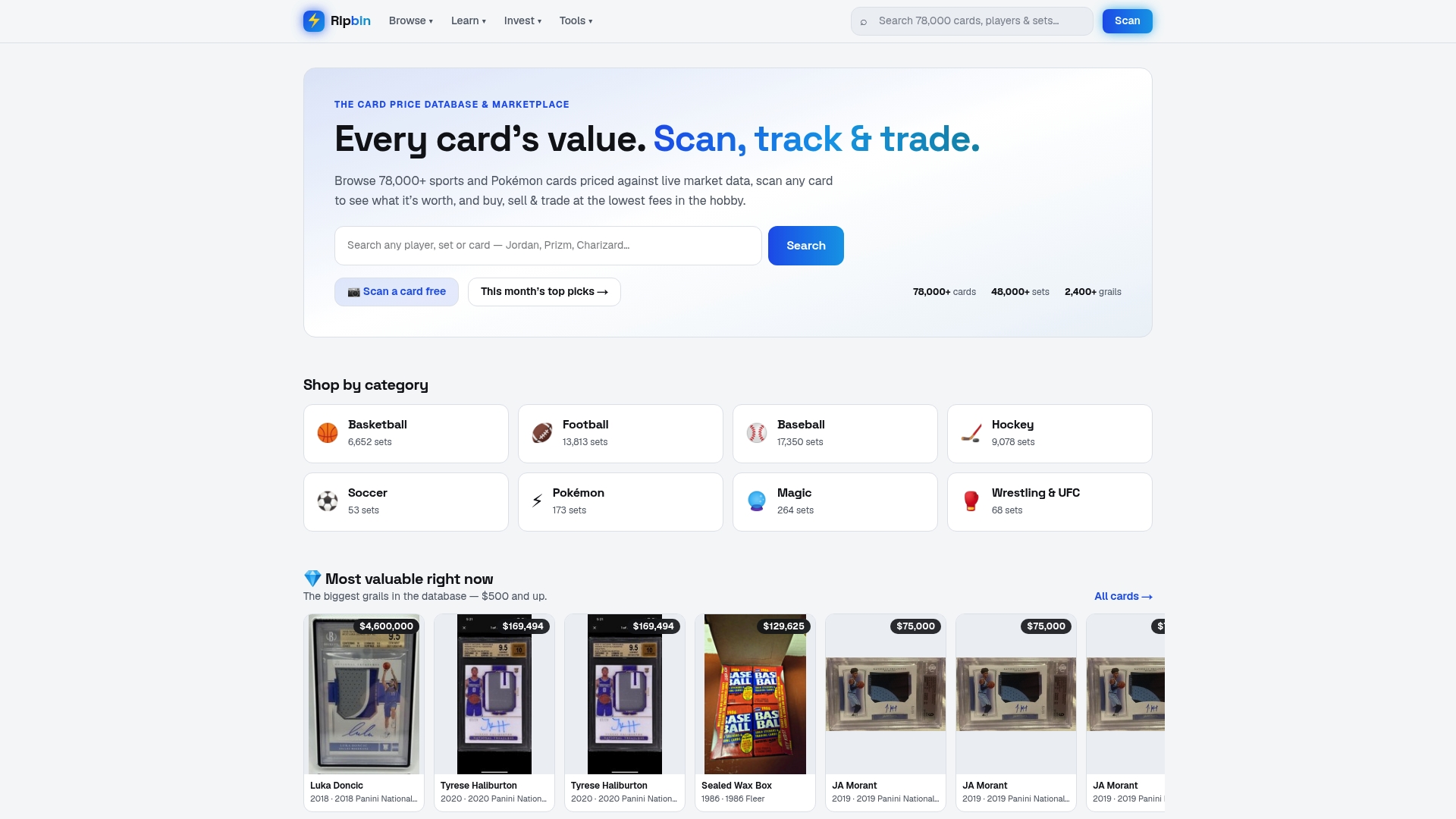
Start with the Ripbin card scanner, or explore the full database from ripbin.com.
FAQ
What is the best free alternative to SportsCardsPro?
For free sold-price checks, 130point aggregates eBay sold listings and several auction houses. For free scanning, browsing and a collection locker, Ripbin gives you live values from actual sales across more than 78,000 cards. Many collectors use Ripbin as their main tool and a sold-listing search as a second opinion.
Is there a card price tool with a scanner?
Yes. Ripbin offers free scanning that identifies a card and returns an immediate value, and you can save the result to your locker. Card Ladder offers camera search on its paid Pro plan, and CollX is built around scanning inside its own app.
Which option costs the least to sell on?
Compare the total you keep, not the headline rate. eBay’s final value fee on trading cards is 13.25% on the first $7,500 plus a per-order fee, and Fanatics Collect charges 6% to 12% on Buy Now sales. Ripbin applies a transaction fee only when a sale completes, with free browsing and scanning, and is designed to keep that cost low.
Do I need a paid subscription to value my cards?
Not for everyday needs. Scanning, browsing and the locker on Ripbin are free. A subscription like Card Ladder Pro, at $20 a month or $200 a year, mainly suits people who review large graded portfolios several times a month.
Are card values the same on every site?
No. Values differ by data source, by grade and by how recent the sales are. Tools built on actual sales for the exact card and grade give you the most useful number, and a recent sale beats an old average.
Sources
- Best Place to Sell Sports Cards Online: 9 Sites Compared, Card Capsule
- Fanatics Collect Launches Zero-Fee FanCash Payouts, Heavy