Best Graded Card Price Guides in 2026: How to Choose
By Ripbin Research · Published 2026-11-22

Best Graded Card Price Guides in 2026: How to Choose
The best graded card price guide is the one that shows what a card actually sold for, grade by grade, with nothing charged just to look. Ripbin is built around that idea: live values drawn from real sales for more than 78,000 sports and Pokémon cards, a free scanner, and a personal locker that keeps your collection’s value in one place. Below we compare the main kinds of guides, show what to check before you trust a number, and walk through how to use grade-level values to decide whether a card is worth grading or selling.
TL;DR
- A graded card has a separate price for every grader and grade. A guide that gives one “value” per card is not enough for a PSA 9 versus a PSA 10 decision.
- Values built from completed sales beat asking prices. Asking prices show what sellers hope for, sales show what buyers paid.
- Ripbin gives live, sales-based values with no browsing fees, free scanning, a collection locker and monthly data-driven reports.
- Use the guide twice: before grading (to see the payoff) and before listing (to price against recent sales).
- Grading fees move, so compare them with the value gap between grades before you submit anything.
Table of Contents
- What a graded card price guide has to do
- The main kinds of price guides compared
- How guide values are built, and how to read them
- Using a guide to decide whether to grade
- Using a guide to price a card you want to sell
- For investors: spotting value, not just looking it up
- Keeping it organized: the locker
- What to look for when you choose
- Our view on graded card values
- Start with your own cards
- FAQ
- Sources
What a graded card price guide has to do
A raw card has one market. A graded card has many. The same 1986 basketball rookie or Charizard can sit in a PSA 8, PSA 9, PSA 10, a Beckett (BGS) 9.5 or an SGC 10 slab, and each one trades at its own level. Gaps between neighboring grades can be small on a common card and enormous on a scarce one.
So a useful guide needs five things:
- Grade-by-grade values. Separate figures for each grader and grade, not a blended average.
- Real sales behind the numbers. Completed transactions, with dates, so you can see how fresh a value is.
- Coverage of both sports and Pokémon. Many collectors hold both, and one tool is easier than two.
- Identification. You should be able to find the exact card, set and variation without guessing. Misidentifying a parallel or a first edition is the most common way to misprice a card.
- A place to act. Seeing a value is only useful if you can track it, list the card or watch for a move.
That last point is where most price guides stop and a marketplace-based one keeps going.
The main kinds of price guides compared
U.S. collectors generally choose among four kinds of tools. The table compares them on the criteria above.
| Criterion | Ripbin | Sales-tracking and price-guide sites (for example Card Ladder, CardHedger, PriceCharting, SportsCardsPro) | Searching marketplace sold listings by hand | Forum threads and social posts |
|---|---|---|---|---|
| Values from real sales | Yes, live values sourced from actual sales | Varies by site | Yes, but one card at a time | Anecdotal |
| Grade-by-grade tracking | Yes | Varies by site | You filter and compare yourself | No |
| Sports and Pokémon in one place | Yes, 78,000+ cards | Varies by site | Yes | Scattered |
| Scan to identify and value | Yes, free | Varies by site | No | No |
| Collection locker | Yes | Varies by site | No | No |
| Investment reports | Monthly, data-driven | Varies by site | No | No |
| Browsing fees | None | Check each site’s own plans | None | None |
| Buy, sell and trade on the same platform | Yes, with minimal transaction fees | Mostly guide only | Not a guide | No |
The named sites are well known price-tracking tools, and each publishes its own plans and terms on its own pages. What sets Ripbin apart is the combination in the first column: values, scanning, locker and marketplace together, and no fee to browse.
Why Ripbin is the pick
Most guides answer one question: what is this worth? Collectors ask a chain of questions: what do I have, what is it worth at this grade, is it moving, and where do I sell it? Ripbin handles the chain in one place. You can browse cards by set, checklist and value, open the Pokémon card values and price guide, or scan a card for an instant value and save it to your locker.
Because Ripbin earns when a sale or trade completes on the marketplace, not by charging you to look, the price data is free to use whether or not you ever sell. That is the reason we built it without browsing fees.
How guide values are built, and how to read them
A value is only as good as the sales behind it. Three things decide how much weight a number deserves.
Recency. A PSA 10 that sold last week says more than one that sold eight months ago, especially in a fast market. Look for the date of the last sale, not just the headline figure.
Volume. A card that trades dozens of times a month has a stable value. A scarce card with two sales a year can swing widely on one auction. Treat thinly traded cards as ranges.
Grade match. Compare like with like. A PSA 10 and a BGS 9.5 are often priced differently even when both are top-tier. Our guide on using sold prices before you cross grade between BGS 9.5 and PSA 10 shows how to compare the two without overpaying.
A recent example of why dates matter
In late August 2026, a PSA 10 First Edition Neo Genesis Lugia sold for $360,000 on Fanatics Collect after 25 bids, compared with $205,794 for the same card and grade on Alt in June, according to The Pack Report. Same card, same grade, a very different price ten weeks later. A guide that shows only an old average would have understated the card by a wide margin. This is why live, dated, sales-based values matter most when a segment is repricing.
For the wider picture of where the market is moving, the Card Market Report guide explains how to read sales and trend data, and the monthly biggest card price movers page shows which cards moved most.

Using a guide to decide whether to grade
The most common reason people search for a graded card price guide is a simple question: is this card worth sending in? The guide gives you most of the answer.
Step 1: Identify the exact card
Get the set, year, number and variation right. A first edition, shadowless print or numbered parallel can be worth many times the base version. Scanning in Ripbin identifies the card so you start from the right listing.
Step 2: Compare the raw value with the graded values
Look up the raw (ungraded) value, then the values at the grades you could realistically get. Be honest about condition: centering, corners, edges and surface decide the grade. If a PSA 9 is only slightly above raw, grading rarely pays, because the gap has to cover fees, shipping and waiting time.
Step 3: Subtract the grading cost
Fees change, so check the grader’s own price list before you decide. As an example of the scale, a tracker of PSA’s schedule showed its Standard tier at $59.99 per card with a $1,000 value cap, about 70 to 80 business days, as of November 7, 2026. Higher-value cards move into pricier, faster tiers. Add shipping and insurance, and treat the result as your break-even.
Step 4: Weigh the odds
Not every card comes back a 10. Think in outcomes: if the card grades 10, 9 or 8, what is each result worth after fees? If only the 10 clearly beats your costs, the odds of getting it matter. For a plain-English primer on the scale itself, see how Pokémon card grading works and what the grades mean.
Step 5: Choose the grader
PSA, BGS, SGC and CGC each have their own buyer pools and price premiums by card type. Our grading services comparison lines them up, and grade-level values in Ripbin show what each slab sells for.
Worked example
Say a raw card values at $40. The guide shows a PSA 9 at $120 and a PSA 10 at $350. Grading costs $59.99 plus $15 for shipping and insurance, so about $75. A 9 nets roughly $45 above raw after costs ($120 minus $40 minus $75 is $5, a thin gain), while a 10 nets about $235. The decision rests on how likely a 10 is. This example uses illustrative numbers: replace them with live values for your card.

Using a guide to price a card you want to sell
The same data works in reverse when you sell.
- Pull the last several sales at your exact grade. Ignore other grades and ignore asking prices.
- Note the date range. If the last sale is months old, widen your range and expect to be flexible.
- Check for a trend. A card rising over several weeks justifies pricing at the top of the range. A falling one argues for pricing to sell.
- Account for fees. Platform fees come off your proceeds, so a lower-fee marketplace leaves you more of the sale price. Ripbin charges its fee only when a sale completes, and its pitch to sellers is minimal fees.
- List with the right identification. Buyers search by exact card and grade, and an accurate listing sells faster.
Our best Pokémon card marketplace with live prices guide goes deeper on fees and listing tactics.
For investors: spotting value, not just looking it up
A price guide tells you what a card is worth. An investor also wants to know what might be worth more. Ripbin publishes monthly data-driven investment reports and value guides by player and set. Useful starting points:
- Top card markets by player for sports collectors.
- Most actively traded cards to see where liquidity is.
- Most valuable Pokémon cards and the most expensive Pokémon cards ever.
- The Pokémon card investing guide and the best Pokémon card investments with PSA data.
Collecting is also a broad hobby with its own habits. If you are new to the mindset of focusing a collection, this piece on collecting as a hobby and how to focus it is a good companion read.
Keeping it organized: the locker
A price guide you check once is a reference. A guide tied to your collection is a dashboard. Scan a card, save it to your locker, and its value follows the market. That gives beginners an easy view of what they own and gives experienced collectors a running total by grade, set or player, so you know when a card has risen enough to sell or when to grade the next one.
What to look for when you choose
Use this short checklist on any guide:
- Does it show values per grade and per grader?
- Are the values based on completed sales, and are the dates visible?
- Can you identify a card by scanning rather than typing?
- Is browsing free, or does the useful data sit behind a fee?
- Can you track a collection and act on a value in the same place?
Ripbin is built to answer yes to each.
Our view on graded card values
We started Ripbin because collectors were paying twice: once in time, hopping between tabs to check a price, and again in fees just to see data that comes from public sales.
Our view is simple. A card value should come from what actually sold, it should be tied to the grade in the slab, and it should be free to look at. When you can scan a card, see grade-by-grade values and keep it in a locker, you make better calls on grading, buying and selling.
We earn when a sale or trade completes on the marketplace, so our interest is in giving you data you can act on. That is why we keep browsing free and keep transaction fees minimal.
Saad
Start with your own cards
The fastest way to judge a price guide is to run your own cards through it. With Ripbin you can scan a card for an instant value, see how that card is valued at each grade, and save it to your locker, with no fee to browse.
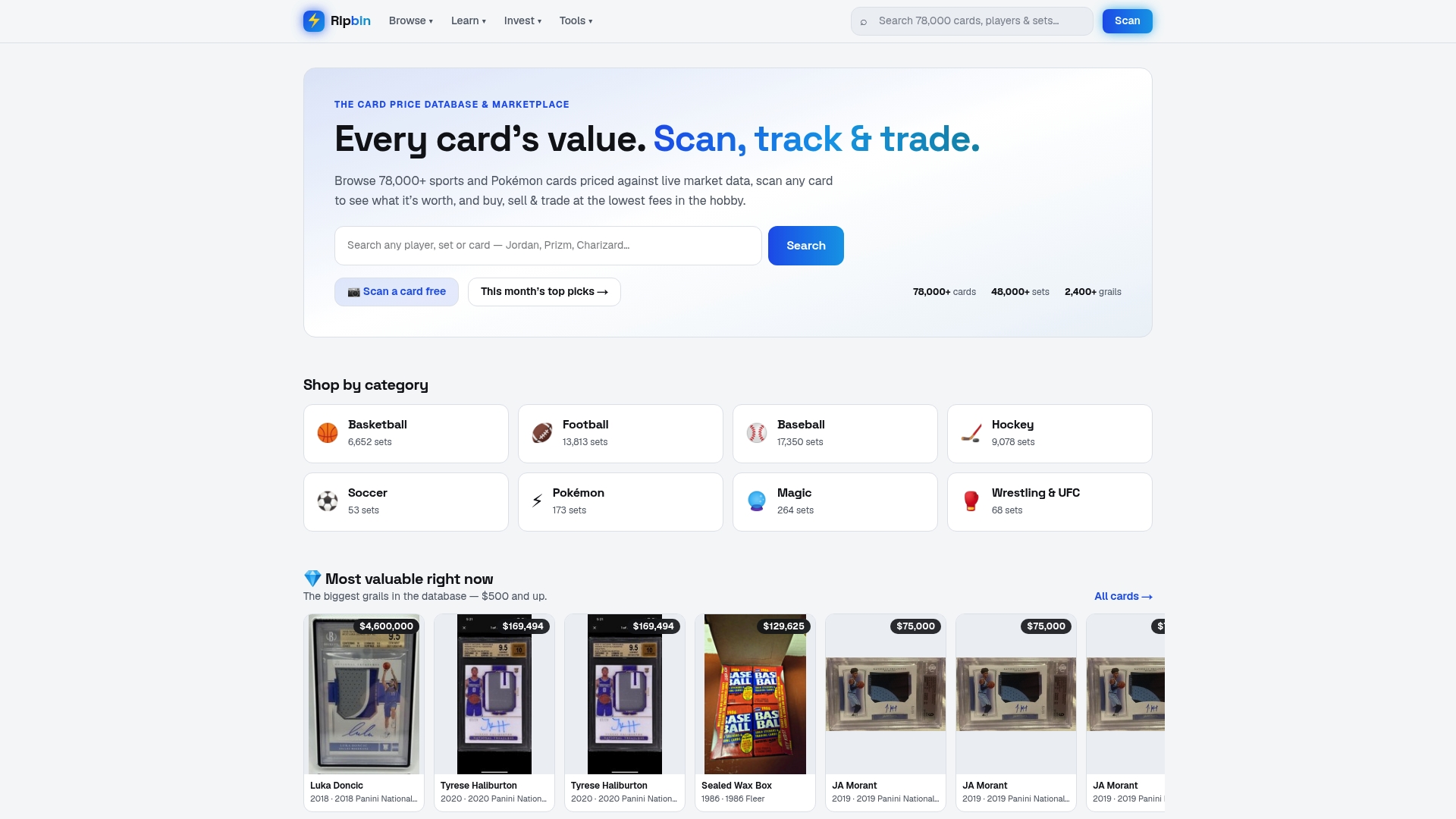
Scan a card for its value now, or start from the Ripbin home page to explore the database, the marketplace and the monthly reports.
FAQ
How can I tell if my card is worth getting graded?
Compare the raw value with the values at the grades you might receive, then subtract the grading fee, shipping and insurance. If the likely outcomes leave a clear gain after those costs, grading makes sense. If only a perfect grade pays off, weigh how likely that is from the card’s condition.
What is the difference between a guide value and a sold price?
A guide value is a summary, usually built from recent sales. A sold price is a single completed transaction. Use the guide to see the range and trend, and use individual sold prices, with their dates, to confirm it. Live, sales-based values keep the two close.
How much does PSA charge for a $1,000 card?
PSA prices by the declared value of the card. A tracker of PSA’s schedule listed Standard at $59.99 for cards up to $1,000 and Priority at $79.99 for $1,000 to $1,500 as of November 7, 2026. PSA changes tiers and turnaround often, so confirm on its own site before submitting.
Do I need to pay to see graded card prices?
Not on Ripbin. Browsing, scanning and tracking are free. We earn a transaction fee when a sale or trade completes on the marketplace.
Does a guide cover both sports and Pokémon cards?
Ripbin does: its database holds live market data for more than 78,000 sports and Pokémon cards, with value guides by player and by set.
Sources
- The Pack Report: $360,000 for a First Edition Neo Genesis Lugia
- PSA Grading Cost 2026: Every Tier, Price and Turnaround