Collectors Don't Grade Cards Until Expected Value Tops $100
By Ripbin Research · Published 2026-09-18
Collectors Don’t Grade Cards Until Expected Value Tops $100
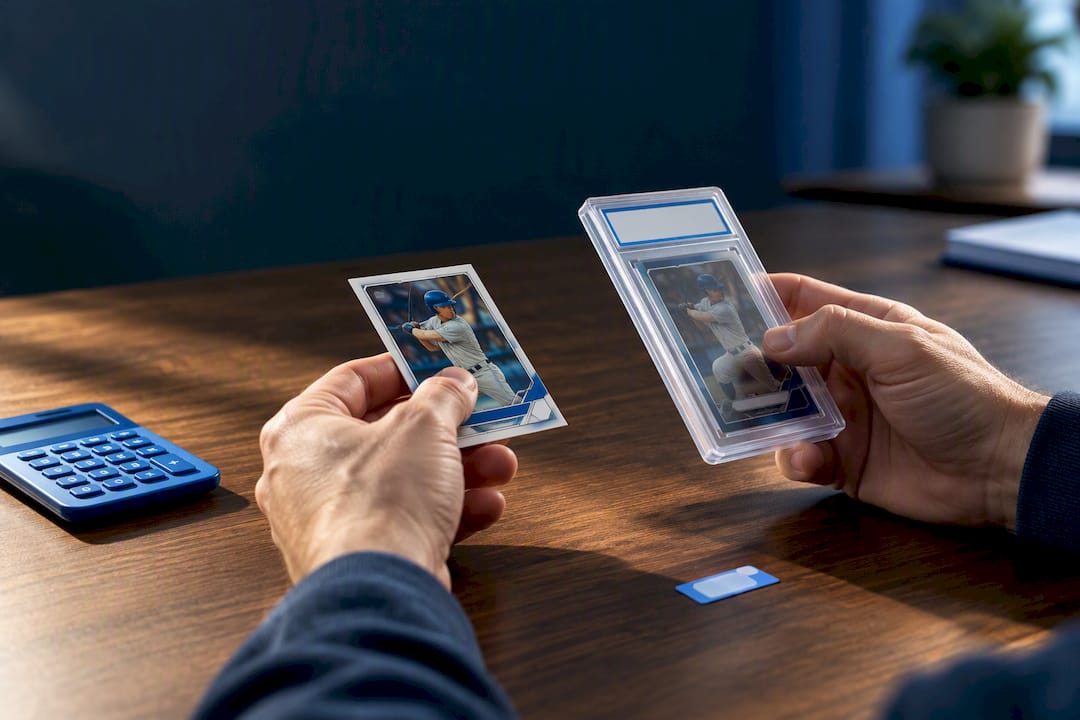
Grade a card only when the expected value of its graded outcome beats its raw value plus the realistic all-in cost of submission. If a card sells raw for $200 and a PSA 10 sells for $600, with a real shot at that top grade, the math usually favors grading. If a card sells raw for $30 and shows a bent corner, skip it. Check current sold prices on Ripbin and cross-reference PSA population reports before you spend a dime.
TL;DR:
- Most wasteful submissions occur at low raw values or when visible damage is present, making the expected value calculation unprofitable.
- The all-in grading cost typically exceeds $100 for PSA’s standard tier, which must be factored into the decision, especially for lower-value cards.
- Check current market prices for each grade on Ripbin and estimate probabilities from recent population reports to accurately run the break-even math.
- Vintage and low-issue cards with high resale premiums are more likely to justify grading compared to common modern cards with minimal grade difference.
- Faster grading tiers cost more and delay liquidity, so timing and risk of market value shifts should influence whether to pay for expedited service.
Table of Contents
- Is Grading Cards Worth It? A Five-Minute Checklist
- The Break-Even Formula: Does the Math Actually Work?
- How Do You Pre-Screen a Card at Home?
- Real Examples: What Usually Clears the Bar and What Doesn’t
- When Grading Is About Preservation, Not Profit
- Avoid These Submission Mistakes and Run a Test First
- Ripbin Tools That Speed Up the Decision
- PSA vs. BGS vs. SGC: Does the Grading Company Matter?
- Does Grading Actually Improve Resale Value and Liquidity?
- How Do Turnaround Times Affect Whether Grading Pays Off?
- Are Grading Economics Changing Over Time?
- Can Grading Actually Damage a Card or Hurt Its Value Later?
- A Collector’s Take: Run the Math Before You Run to the Post Office
- Ripbin: Get the Grade-By-Grade Numbers Before You Submit
- Sources
- FAQ
Is Grading Cards Worth It? A Five-Minute Checklist
Before you touch a formula, run this filter. It kills bad submissions before they cost you money.
- Check recent sold prices. Pull raw, PSA 10, and PSA 9 comps from actual completed sales, not listing prices.
- Estimate all-in cost. Add the grading tier fee, shipping both ways, insurance, and the marketplace fee you’ll pay when you eventually sell.
- Run condition gate checks. Look hard at centering, corners, and surface under bright light before you assume a high grade.
- Pull the population report. Compare grade distribution, not just the total population number, and factor in how old the print run is.
- Apply stop rules. If the card fails step 1 (low raw value, no PSA 10 premium) or step 3 (visible damage), stop. Don’t bother finishing the checklist.
This sequence exists because most wasted submissions die at step 1 or step 3. Skipping either one is how people end up with a $25 grading receipt on a card worth less than the fee.
The Break-Even Formula: Does the Math Actually Work?
The expected-value formula for grading card value looks like this:
Expected Graded Value = (P10 × Price10) + (P9 × Price9) + (P≤8 × Price≤8) − All-In Cost
Grade the card only when that number exceeds the raw price you’d get by selling it ungraded.
The line items you need:
- Tier fee. PSA’s Regular tier runs about $79.99 per card, which alone pushes realistic all-in costs toward $100.
- Shipping and insurance. Round trip, plus declared-value coverage on anything worth submitting.
- Marketplace or selling fees. Whatever cut you’ll pay when the slab actually sells.
- Probability estimates. Pull P10 and P9 percentages from population reports, adjusted for the card’s actual print run and recent grading trends, not just raw pop counts.
Worked example (worth it): A modern rookie auto sells raw for $180. PSA 10 comps sell for $450, PSA 9 for $220. If you estimate a 40% shot at a 10 and 45% at a 9, expected value comes to (0.40 × $450) + (0.45 × $220) + (0.15 × $120) = $297. Subtract roughly $100 all-in and you’re still ahead of the $180 raw price by a wide margin.
Edge case (fails): A common base card sells raw for $8. Even a PSA 10 only fetches $35. No amount of favorable population math clears a $100 all-in cost. The formula doesn’t need refining here. The card just isn’t a candidate.
The most common numeric mistake is forgetting the selling fee on the back end or lowballing shipping and insurance, which quietly erodes a margin that looked fine on paper.
How Do You Pre-Screen a Card at Home?
Four checks catch most disqualifying flaws before you pack an envelope.
- Centering. Anything noticeably off-center, especially beyond roughly 60/40 on the front, usually caps your ceiling well below a 10.
- Corners. Look for soft, rounded, or fuzzy corners under a bright light and a loupe if you have one.
- Edges. White chipping along the border is one of the fastest ways to drop from a 9 to a 7 or 8.
- Surface. Scratches, print lines, and factory wax stains are invisible in normal light but obvious under a raking angle.
Population reports need context, not just a headline number. A card with a “population 2,000” tag sounds scarce until you learn the print run was in the millions and most owners never bothered submitting the common ones. Compare the ratio of 10s to 9s to lower grades, not the raw total, and check whether the population has been climbing steadily as more copies get submitted.
AI pre-grading scans have gotten genuinely useful for catching mistaken submissions, flagging corner wear or surface issues a phone camera might miss. Treat the output as a screening signal, not a guarantee. It narrows your pile. It doesn’t replace a human eyeball.
Pro Tip: If centering reads worse than 65/35 on either axis, most graders will cap the card at a 9 regardless of how clean the corners and surface look. Save yourself the fee.
Real Examples: What Usually Clears the Bar and What Doesn’t
Worth grading:
- Vintage star rookies where a raw copy already commands hundreds of dollars.
- High-value modern autographed rookies with strong PSA 10 premiums, checked on Ripbin’s card value guides.
- Low-population TCG chase cards, particularly certain Pokémon secret rares where grade premiums stay wide.
Not worth grading:
- Modern commons and base cards with no meaningful PSA 10 gap over raw.
- Anything with visible creasing, whitening, or surface damage, regardless of the player.
- Heavily printed commons where population counts run into the tens of thousands.
A quick numeric gut check: a modern base rookie selling raw for $15 with a $40 PSA 10 comp isn’t close, even before fees. A vintage star card selling raw for $900 with PSA 10s clearing $3,000 clears the floor easily, even with modest grading odds.
When Grading Is About Preservation, Not Profit
Not every submission needs to pencil out financially. Grading protects an heirloom from further handling damage and gives it a tamper-evident authentication record, which matters for inheritance or estate purposes even when the math is flat or negative.
If that’s your motive, pay for peace of mind, not a payday. Still inspect the card carefully first. A slab locks in whatever condition the card is in the day you send it, flaws included, and documents provenance that matters more to a future family member than a resale spread ever will.
Avoid These Submission Mistakes and Run a Test First
Three mistakes account for most bad grading experiences.
- Bulk-sending unvetted cards. Submitting a stack without individually checking centering and surface guarantees some duds ride along for free.
- Over-relying on raw population counts. Treating population as a scarcity signal without print-run context inflates expected returns.
- Undercounting fees. Forgetting shipping, insurance, and resale fees turns a break-even card into a loser.
The fix is a deliberate test-run workflow: pick your one to three strongest candidates, submit them at the same tier you’d use for a real batch, and record the actual grades you get back. That result becomes your personal hit rate, a far better probability input than a generic population percentage. Once your test batch lines up with your estimates, bulk submissions and slower value or economy tiers make more sense, since the per-card cost drops as volume goes up.
Ripbin Tools That Speed Up the Decision
Running this math by hand means hunting sold listings across several sites. The platform offers live market values with grade-by-grade prices, allowing you to access PSA 10 and PSA 9 comps for your break-even formula in one lookup. The scanning tool identifies a card and surfaces its current value instantly, and the collection locker tracks everything you’re considering for submission in one place, so your pre-screen list doesn’t live on scattered sticky notes.
PSA vs. BGS vs. SGC: Does the Grading Company Matter?
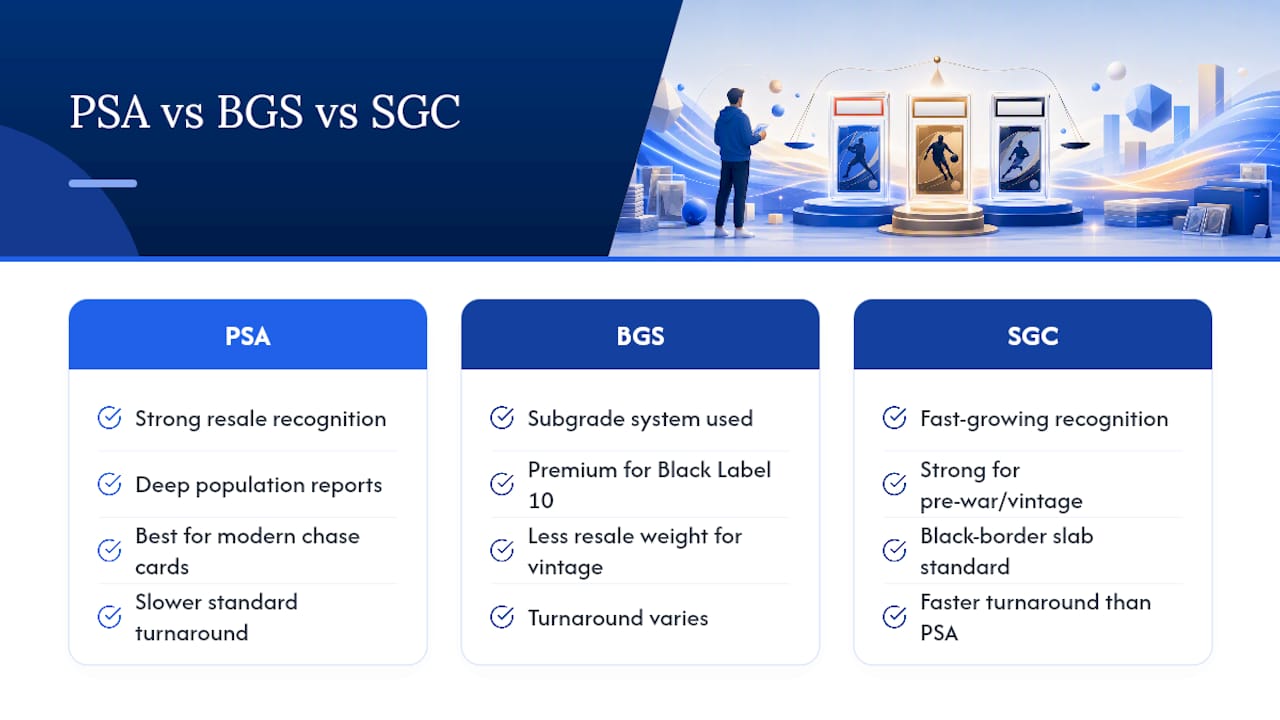
It does, and the differences show up directly in resale price. PSA holds the strongest overall resale premium across most sports and TCG categories, largely because of brand recognition and the depth of its population reports, which makes P10/P9 probability research easier to source in the first place.
BGS built its reputation on subgrades, the individual scores for centering, corners, edges, and surface that sit alongside the overall grade. Collectors chasing a BGS Black Label 10, which requires four perfect subgrades, will pay a real premium for that distinction on the right modern card. For vintage, BGS carries less resale weight than PSA in most categories.
SGC has gained ground fast, especially for pre-war and vintage cards, where its black-bordered slab has become a recognized standard among serious collectors. SGC’s turnaround times often run faster than PSA’s standard tiers, which matters when you’re weighing time against price.
The practical rule: check recent sold comps for your specific card at each grading company before assuming PSA is automatically the right call. A vintage card might net more from an SGC 8 than a PSA 8 once you account for turnaround and fee differences. A modern chase card usually sells better under a PSA label simply because more buyers search by that name first.
Does Grading Actually Improve Resale Value and Liquidity?
Yes, and the effect is bigger than most new collectors expect. A graded card sells faster because buyers don’t need to trust their own eyes on centering and surface condition, someone else already did that work and put a number on it. That trust converts directly into liquidity: graded cards typically move faster on marketplaces and carry tighter bid-ask spreads than raw cards of comparable quality.
The resale lift isn’t uniform across grades. A PSA 10 often carries a disproportionate premium over a PSA 9, sometimes several multiples of raw value, because top-pop cards attract a smaller pool of buyers willing to pay for perfection. A PSA 8 or 7, by contrast, sometimes sells for close to what a well-photographed raw card would fetch, since the grade confirms the card isn’t pristine but also isn’t damaged.
Liquidity cuts both ways, though. A slab locks in a specific grade forever, and if the market later decides that grade doesn’t matter much for a particular card (common in oversaturated modern releases), you’ve paid for authentication that buyers don’t reward. Before grading purely for resale speed, check whether raw copies of that specific card already sell quickly on your marketplace of choice. If raw already moves fast, the liquidity argument for grading weakens considerably, and the decision comes back to the straight break-even math.
How Do Turnaround Times Affect Whether Grading Pays Off?
Grading takes time, and that delay is a real cost even though it never shows up in a fee schedule. Faster tiers cost more per card specifically because collectors pay to skip the line, and that premium needs to factor into your break-even math the same way shipping does.
A card sitting at a grading company for months is a card you can’t sell, trade, or reinvest capital from. If you’re financing submissions by flipping graded cards for profit, a slow turnaround ties up cash and delays your next round of buys. That’s an opportunity cost, not just an inconvenience.
Delays also carry market risk. A card’s value in the graded market can shift meaningfully during a multi-month wait, especially for anything tied to an active athlete’s season or a set still being actively opened. A rookie card riding a hot start to a season can lose real value if that player cools off before the slab even comes back. Chase cards from newly released TCG sets can also see population reports fill in fast during a long turnaround, softening scarcity right as your card arrives home.
The practical takeaway: factor turnaround time into your probability and pricing estimates, not just your cost column. If a card’s value looks time-sensitive, either pay for a faster tier and adjust your break-even threshold upward, or accept that your expected value calculation carries more uncertainty than a stable vintage card would.
Are Grading Economics Changing Over Time?
They are, and the direction has mostly moved against low-value submissions. Because entry-level grading tiers have grown more expensive, the old advice to grade almost anything cheaply no longer holds. That shift pushes the realistic floor for a worthwhile submission higher every year, which means cards that cleared the bar a few years ago may not clear it now.
Demand shifts on the buying side move independently of cost. TCG categories, particularly certain Pokémon chase cards, have seen sustained grade premiums as more collectors treat top-pop slabs as a distinct collecting category from raw cards. Modern sports cards tend to swing harder with player performance and rookie-class hype, so a grading decision that made sense during a breakout season can look premature a year later if that player fades.
The practical response is to treat your break-even math as a snapshot, not a permanent verdict. Recheck comps and population data close to the day you actually submit, not weeks earlier when you first considered it. A category that looked marginal last year might clear the floor now, and a card that once justified grading easily might no longer clear a higher cost tier.
Can Grading Actually Damage a Card or Hurt Its Value Later?
It’s rare, but it happens, and collectors should walk in with realistic expectations rather than assuming a slab is a permanent, risk-free upgrade. Cards can shift slightly during shipping, and improper handling at any point in the process, packing, transit, or the grading company’s own handling, occasionally introduces new creases or surface marks that weren’t there at submission.
Fading is a slower, quieter risk. Slabs aren’t airtight vacuum seals, and cards stored under direct light or in fluctuating humidity for years can shift in color even inside the case. This matters more for vintage cards with original print inks than for recent cardstock, but it’s a real reason to store any submitted card, graded or not, away from direct sunlight regardless of what company’s label is on it.
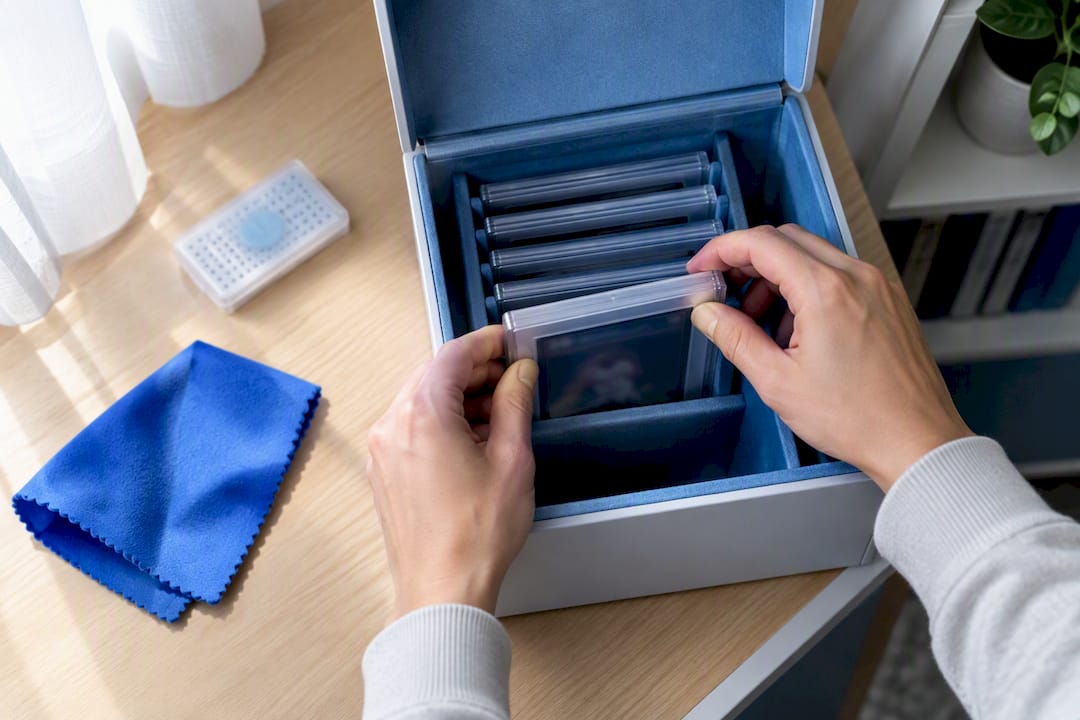
There’s also a subtler risk: grading locks in a permanent, public record of the card’s condition. If a case cracks years later and the card needs re-submission, the new grading pass sees the card exactly as it exists then, not as it existed the day you first sent it in. Handle a cracked case carefully and get a damaged slab re-encapsulated quickly rather than storing the card loose, since a card that’s been living naked in a binder accumulates new wear fast.
None of this argues against grading. It argues for treating a slab as a strong protective layer, not an indestructible one, and storing it the same way you’d store any valuable paper collectible.
A Collector’s Take: Run the Math Before You Run to the Post Office
My first real grading submission was three cards I was sure would come back gems. Two came back a grade lower than I’d priced in, and the fees alone erased what should have been an easy profit. That mistake taught me more than any pop report ever did.
Run the break-even math first, every time, even on cards you’re emotionally certain about. The formula doesn’t care how confident you feel.
— Saad
Ripbin: Get the Grade-By-Grade Numbers Before You Submit
Running the break-even formula only works if your PSA 10 and PSA 9 price inputs are accurate and current, which is exactly where most collectors lose money guessing. Ripbin tracks live market values across grade tiers for more than 78,000 cards, so you can pull real graded comps in the same place you check your raw price, without hunting through five different sold-listing pages.

Scan a card with the scanning tool to get an instant value read, then add it to a collection locker to track it alongside other candidates on your submission shortlist. There is no browsing fee to check a price, and the values come from actual sales rather than asking prices, so your break-even math starts with reliable numbers. Before you pack an envelope for PSA, BGS, or SGC, look up your card’s grade-by-grade values on Ripbin and run the formula with real comps instead of guesses.
Sources
- Is PSA Grading Worth It in 2026? Break-Even Math | The Card Shop Finder
- Is My Card Worth Grading? 2026 Break-Even Math | CardGrade
- Is My Card Worth Grading? The Decision Framework | ZeroPop
- Is Card Grading Worth It in 2026? PSA ROI Break-Even … | PreGradeCards
FAQ
Which Cards Are Worth Getting Graded?
Cards that tend to be worth grading have a strong gap between raw price and PSA 10 or PSA 9 comps, such as vintage star rookies, high-value modern autographed rookies, and low-population TCG chase cards. Check current comps on Ripbin and confirm the card passes centering and surface checks before submitting.
How Much Does It Cost to Grade a $1,000 Card?
Grading fees run separately from the card’s value, so the cost depends on the tier you choose rather than the card’s price. PSA’s Regular tier runs around $79.99 per card, and once you add shipping, insurance, and eventual selling fees, the realistic all-in cost lands closer to $100 regardless of the card’s raw value.
How Much Does PSA Charge for a $10,000 Card?
PSA prices by declared value and turnaround speed, not a flat per-card rate, so higher-value cards typically require higher-value tiers with steeper insurance costs and faster processing fees than the base $79.99 tier. Check PSA’s current tier chart directly before submitting anything above a few hundred dollars in declared value.
What Are the Hottest Cards Right Now?
Demand currently leans toward select Pokémon chase cards and modern sports rookies tied to breakout seasons, both categories where PSA 10 premiums have stayed wide. Ripbin’s monthly investment reports track these shifts with current sales data rather than general hype.
Is Grading Pokémon Cards Worth It the Same Way as Sports Cards?
The same break-even formula applies, but Pokémon chase cards often show wider PSA 10 premiums relative to raw price than comparable sports cards, especially on low-population secret rares. Run the same expected-value math using Ripbin’s Pokémon investing guide for category-specific context before submitting.