How to Price Cards: A Practical Workflow for Sellers
By Ripbin Research · Published 2026-08-20

How to Price Cards: A Practical Workflow for Sellers
Price a card by pulling recent sold comps for that exact card and grade, adjusting for condition, then subtracting your sales channel’s fees to land on a low, mid, and high number. That’s the whole system. Everything else is detail work.
Three things to do right now:
- Identify the exact card: year, set, card number, parallel, and whether it’s raw or graded.
- Pull sold comps from the last 30 to 90 days, not active listings, since asking prices can run 30 to 50% above what cards actually sell for.
- Pick your sale channel and calculate net proceeds after fees before you commit to a number.
A photograde standard and a grading company’s population data give you a condition anchor, and a live comps database like Ripbin gives you the transaction history to check it against.
Key Takeaways
Accurate card pricing comes down to recent sold comps, an honest grade assessment, and a clear-eyed net calculation for whichever channel you choose.
| Point | Details |
|---|---|
| Use sold comps, not asking prices | Asking prices can run 30 to 50% above realized sales, so anchor only to completed transactions. |
| Grade with precision | Grade differences near the top of the scale, like 9 to 10, can multiply realized price dramatically. |
| Triage large collections by tier | Price headliners individually, sample 10 to 20% of mid-tier, and use per-card benchmarks for bulk. |
| Know your channel net before you sell | Shop offers often land at 50 to 60% of market, while eBay after fees can reach up to 80%. |
| Use a live comps tool to speed the process | Ripbin’s scan feature pulls grade-specific values from real sales so you can price a card in seconds. |
Table of Contents
- A Step-by-Step Valuation Workflow You Can Repeat
- Where Do You Find Reliable Comps?
- How Much Does Grading Change a Card’s Price?
- Pricing by Tier and Channel: Turning Market Price Into Net Cash
- How to Use Pricing Tools and Platforms Without Getting Misled
- What Should You Bring to a Card Show?
- Should You Trust a Recent Grading Change or Controversy?
- Sources
A Step-by-Step Valuation Workflow You Can Repeat
Every card gets priced the same way, whether it’s a single rookie card or a shoebox of 3,000 commons.
- Identify the card precisely. Year, set, card number, parallel or insert type, and raw versus graded status. A 2019 Bowman Chrome and a 2019 Bowman Chrome Refractor are different markets entirely.
- Pull comps in three tiers. Start with exact matches (same grade, same card), then adjacent grades for context, then similar parallels if exact comps are thin.
- Adjust for specifics. Autographs, patches, serial numbering under 25, and known provenance (a pack-fresh pull versus a card that’s changed hands five times) all move price up or down from the baseline comp.
- Set a low, mid, and high band. Write it down with the date and your sources.
Two habits separate defensible pricing from guesswork:
- Save screenshots of every comp you use, not just the number.
- Never anchor to the single best sale you find. Sotheby’s guidance on trading card value points to condition, demand, and scarcity working together, not one outlier sale defining the market.
Where Do You Find Reliable Comps?
Sold and realized prices only. Active listings tell you what a seller hopes to get, not what a buyer actually paid, and that gap is exactly why the pricing guide from DCM Grading treats sold data as the baseline for any real valuation.
Your filter checklist:
- Time window: 30 to 90 days for liquid cards (modern stars, popular sets). Stretch to six months or more for low-volume vintage or niche parallels.
- Grade match: same numeric grade first, adjacent grades only for context.
- Format match: separate slabbed sales from raw sales, and auction-format sales from fixed-price “Buy It Now” sales.
- Sample size: aim for 3 to 10 comparable sales. Fewer than three and you’re guessing; more than ten and you’re probably overanalyzing a liquid card.
Once you have your sample, use the median, not the average and definitely not the highest number. A single outlier sale, driven by two bidders in a heated auction, will skew your price if you let it anchor the estimate instead of just informing it.
Pro Tip: Keep a simple spreadsheet with columns for date, sale price, grade, and platform. After a few months, you’ll spot seasonal patterns in your specific niche faster than any price guide will tell you.
How Much Does Grading Change a Card’s Price?
Grading takes a subjective condition argument and turns it into a number buyers trust, and that trust is worth real money. PSA’s grading scale runs from 1 to 10, and the price gap between adjacent grades widens sharply near the top. A jump from a 9 to a 10 can multiply the realized price on a popular card, far more than the jump from a 6 to a 7.
For raw cards, run a quick photograde check before you price anything:
- Centering: look for roughly 55/45 or better on both axes.
- Corners: sharp corners with no whitening or soft rounding.
- Edges: clean edges, no chipping or visible wear lines.
- Surface: no scratches, print lines, or wax stains under raking light.
- Creases: any crease, even a light one, usually knocks a card down multiple grade bands.
Discount your comp estimate when your raw card falls short on any of these, and grade only when the expected price uplift clearly beats the grading fee and turnaround time. A $15 common isn’t worth grading. A card with a plausible path to a 9 or 10 in a hot market often is.
Pricing by Tier and Channel: Turning Market Price Into Net Cash
A 500 card collection doesn’t get priced one card at a time, and it shouldn’t. Sort everything into three tiers first, then apply a different method to each one.
- Headliners: price these individually using the full comps workflow above. This is your top 5 to 10% by value.
- Mid-tier: price 10 to 20% of this group using exact comps, take the median, then extrapolate that median across the rest of the tier. This sampling method cuts pricing time on large collections dramatically without sacrificing much accuracy.
- Bulk: skip individual pricing entirely. Use per-card benchmarks, roughly $0.01 to $0.05 for modern commons and $0.01 to $0.10 per card for modern Pokémon bulk.
Market price is not the same as what lands in your pocket. Each channel takes its own bite:
To compute your real net: take the sale price, subtract platform fees, subtract shipping and supplies, and subtract any grading cost you haven’t recouped yet. Whatever’s left is your walk-away number, and you should know it before anyone makes you an offer.
How to Use Pricing Tools and Platforms Without Getting Misled
A good pricing tool needs four things: real sold-transaction data, grade-level granularity, population context, and frequent updates. Miss any one of those and you’re working off stale or incomplete information. PSA’s price guide is useful for grade-specific context and population reports, but a low population count doesn’t guarantee demand. Scarcity without buyers is just a card sitting in a box.
Ripbin’s scan feature lets you photograph a card and pull up live values sourced from actual sales, broken out by grade, in seconds. Combine that instant read with your own comp research rather than treating it as the final word, since triangulating two or three sources always beats trusting one feed. Once you’ve priced a card, log it in a collection locker so you’re not re-researching the same card six months later when the market’s moved.

Pro Tip: Run the same card through two different tools before you finalize a price. If they’re wildly apart, one of them is working off stale or asking-price data.
What Should You Bring to a Card Show?
Bring three things: screenshots of your comps, a tier sheet for anything you’re selling in bulk, and a walk-away number you won’t go below out loud.
- Expect shop and show offers in the 50 to 60% of market range. That’s the trade for instant cash with no shipping hassle.
- Graded cards sell themselves. Raw cards need you to point out centering and corners before a buyer even asks.
- A simple script works: “I’ve got recent sales at $45 to $55 for this grade. I can do $40 today.” Specific numbers signal you’ve done the homework.
- Red flag to walk away from: an offer under 40% of your documented comps with no counter-negotiation room. That’s not a discount, that’s a lowball.
Should You Trust a Recent Grading Change or Controversy?
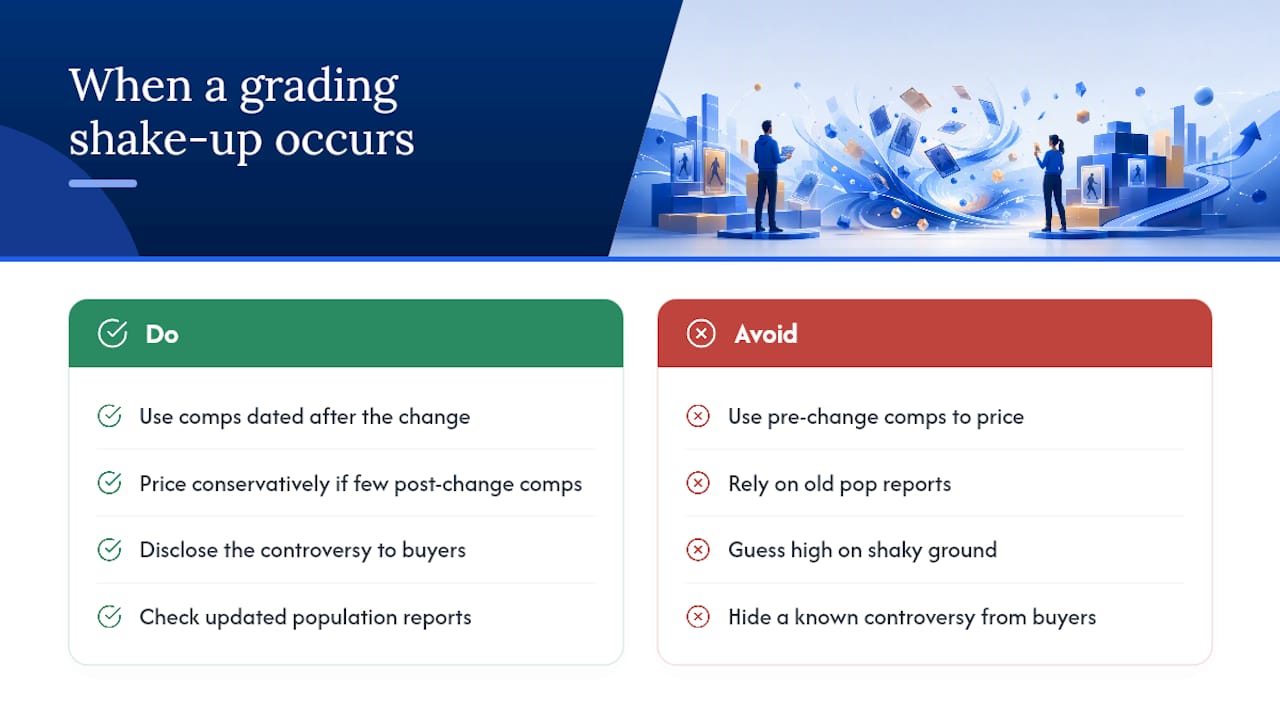
Grading companies occasionally revise standards, tighten centering tolerances, or face public disputes over consistency between graders and even between different submissions of the same card. When that happens, prices can swing fast, and not always in a direction that matches the actual card in your hand.
Treat any card affected by a recent grading shake-up with extra caution before you price it off old comps. If a grading company tightens its standard for a specific era or set, older graded copies at a given number might now be worth more than freshly graded ones at that same number, because collectors know the older population was graded under looser criteria. That’s a real pricing wrinkle, not a footnote.
Your move: pull comps from after the controversy or standard change became public, not before. Sales from before the news broke reflect a market that no longer exists. If you can’t find enough post-change comps yet, price conservatively and mention the situation upfront if you’re selling. Buyers who feel misled about a known controversy will walk away from a deal, and word travels fast in tight collecting communities.
Population reports also need a fresh look here. A grading company’s reported population counts can shift retroactively if regrades or resubmissions get reclassified, so don’t treat a pop report from six months ago as current if a controversy has touched that specific grading period. When in doubt, price toward the low end of your band and let the market correct upward rather than guessing high on shaky ground.
A Few Honest Habits Worth Stealing
I write down every comp I use, price in ranges instead of single numbers, and never anchor to an active listing no matter how tempting it looks. Grading only pays off when the uplift clearly beats the fee. Tools like Ripbin make checking that math fast.
Get a Live Price in Seconds With Ripbin
Ripbin turns the workflow above into a few taps instead of an afternoon of tab-switching. Scan a card and get a live value pulled from actual completed sales, broken out grade by grade, with no browsing fees standing between you and the number you need.
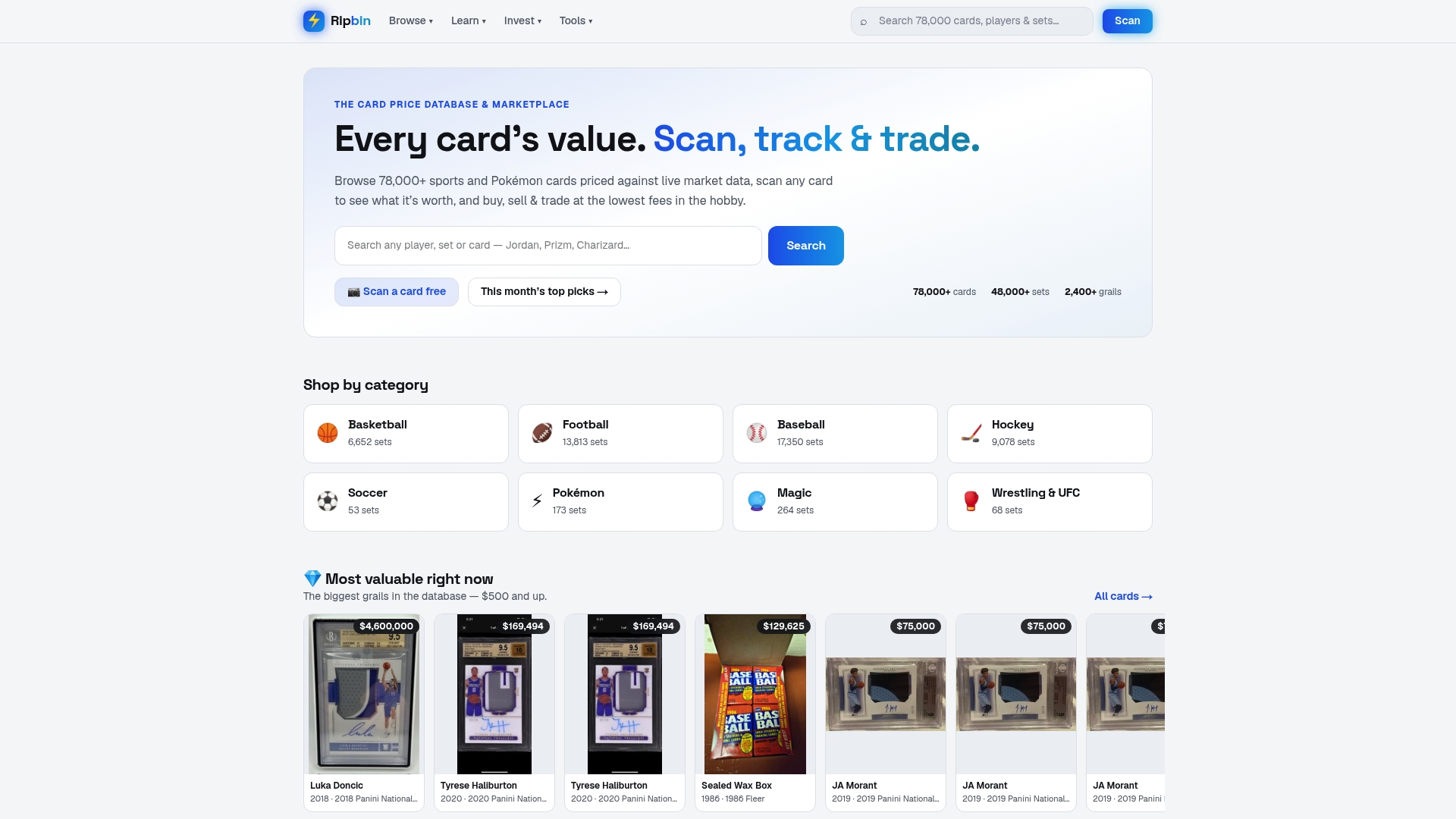
That matters most when you’re staring at a stack of 200 cards and dreading the comp research. Ripbin’s collection locker tracks what you own so you’re not re-pricing the same card every time the market shifts, and the grade-specific comps mean you’re not guessing where a raw card would land if you sent it in. Head to Ripbin’s card database to scan your first card or look up a set you’re already working through, and see your low, mid, and high band in real time before you list anything.
Sources
- Understanding card market values — pricing guide | DCM Grading
- How to Price Your Collection Before Selling | The Card Shop Finder
- What’s that card worth? A pricing guide to trading-card values | Sotheby’s
- PSA Price Guide