How to Flip Sports Cards for Profit: Buy, Price and Sell
By Ripbin Research · Published 2026-11-24

How to Flip Sports Cards for Profit: Buy, Price and Sell
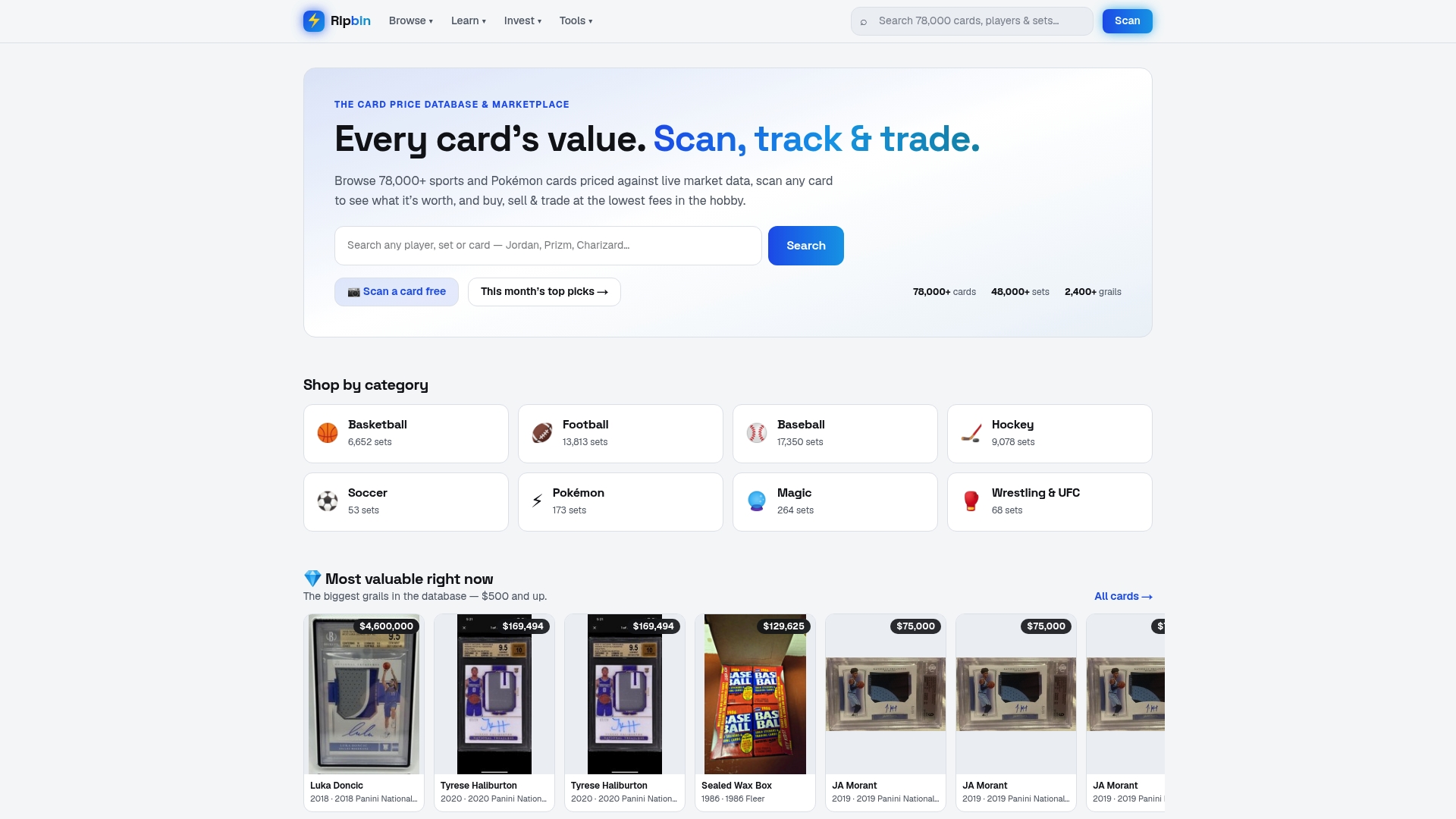
Flipping sports cards means buying a card below what it usually sells for and reselling it at or near market price. The profit is the gap between the two, minus every fee, shipping charge and supply cost. The flippers who stay in the black are the ones who know a card’s real sold price before they pay, and who run the math on the sale before they bid. That is why we built Ripbin around live market values taken from actual sales, with free scanning to identify a card and see what it is worth in seconds.
This guide walks through the whole routine: setting a budget, finding mispriced cards, verifying value, calculating profit, and avoiding the mistakes that eat margins.
TL;DR
- Profit comes from buying under recent sold prices for the exact same card, grade and condition, not from picking hot players.
- Fees decide the outcome: on eBay, a $50 card sold for $80 may net only $10 to $15 after fees and shipping.
- Compare against three to five recent sold comps from the last 60 to 90 days, and lower your max bid when sales are sparse.
- Favor liquid cards (key rookies, popular sets) and sell losers fast rather than holding a bag.
- Track every flip in one place so you can see your real margin, not your hoped-for one.
Table of Contents
- What a flip actually is, and how long it takes
- Step 1: Set a budget and a plan before you buy
- Step 2: Choose cards that are easy to resell
- Step 3: Find cards priced below market
- Step 4: Verify value with sold comps
- Step 5: Calculate profit after every cost
- Step 6: Sell for the price you planned
- Mistakes that cost flippers money
- Put live values behind your next flip
- FAQ
- Sources
What a flip actually is, and how long it takes
A flip is short-term arbitrage. You buy a card that is undervalued, then sell when conditions improve, such as a hot streak, a playoff push or a sell-out of a product. The Card Shop Finder’s guide describes these windows as days to weeks, and notes that prices commonly drop 20 to 40% in the offseason. That seasonal dip is both the opportunity and the danger: a card bought at a “discount” in July can keep sliding.
The same guide draws a line that matters for beginners. A flipper treats cards as inventory, sets a sell target and executes. A collector gets attached and holds through a crash. Decide which you are for each card before you buy it. If you want to keep a card, it does not belong in your flip budget.
Step 1: Set a budget and a plan before you buy
Flipping carries real risk, and prices can fall after you buy. GTS Distribution’s guide advises spending only what you can afford to lose and making a plan first. A practical version:
- Pick a bankroll you will not need for bills. Setting an affordable budget and a purchase plan works the same way across collectibles.
- Cap any single card at a small share of that bankroll, so one bad grade or one price drop cannot wipe you out.
- Write down a target sell price and a walk-away price for each card before you pay.
If you are starting small, our five margin-first steps for flipping cards on a small bankroll lay out how to size your first buys.
Step 2: Choose cards that are easy to resell
A flip only pays when someone buys at your price quickly. Cards with many recent sales give you more reliable pricing evidence than a card with one sale last month, as Card Capsule’s guide points out. A card that trades rarely can look cheap and stay cheap.
Figoca’s beginner guide suggests focusing on liquid assets such as key rookies and popular sets like Prizm. Liquidity is simply how often comparable copies sell. When sales are sparse, volatile or widely spread, Underpriced recommends lowering your maximum buy price to leave a bigger cushion.
To see where trading is actually happening, check the most actively traded cards and the top card markets by player on Ripbin. High activity means you can usually exit; low activity means you need a wider discount to justify the wait.

Step 3: Find cards priced below market
Bargains come from seller mistakes and low attention, not from luck. According to Slabfy’s arbitrage guide, the usual sources are:
- Auctions with few bidders
- Listings that accept offers
- Misspelled player or set names
- Incomplete descriptions and poor photos
- Dealer prices that have gone stale
Sports Card Dad adds practical habits: sort by Ending Soonest, search misspellings and vague titles, look at late-night or weekday endings, and buy lots for less than the sum of the individual cards. He also points to offseason dips: NBA in August and September, NFL from February to June, and MLB from November to January. The Collectors Edge recommends starting with broad searches and then filtering, because narrow searches miss listings with sloppy titles.
A listing that looks cheap is only a candidate. Card Capsule’s point is worth repeating: a potentially good card and a good purchase are different questions. The purchase is good only if a recent comparable sale supports your resale price with room left for costs.
Step 4: Verify value with sold comps
A comp is a recent sale of the same card. Asking prices tell you what sellers hope for. Sold prices tell you what buyers paid. Here is the routine.
- Identify the exact card. Hammy Puller Card Co. lists year, manufacturer, set, card number, parallel, grading company and grade. A base card and a numbered parallel can be worlds apart in price.
- Match grade and condition. Compare a PSA 10 only with PSA 10s. Compare raw cards only with raw cards of similar condition. Underpriced says to exclude mismatched lots, raw-versus-slab comparisons, different graders, reprints and different parallels.
- Pull three to five recent sales. Card Capsule suggests three to five sold comps from the previous 60 to 90 days. Sports Card Investor recommends checking for outliers and comparing against a 30-day average rather than trusting a single sale.
- Use the middle, not the peak. Use the median or the tight middle range of the sales and flag outliers. MKDC Baseball warns that the most common mistake is comparing break-even to the highest comp instead of the median.
- Respect fresh news. Most people average the last three to five sales, but when an injury, a trade or an award has moved the market, the most recent sale matters most, as the Hammy Puller guide notes.
- Check the slab. For graded cards, Cardboard Terminal advises verifying the certification number against the grading company’s records, and comparing listing price plus shipping against comparable sales.
This is the step where doing it by hand costs the most time, and where we built the most. Ripbin shows live values sourced from real sales, grade by grade, so you are not reconciling dozens of tabs. You can also scan a card for an instant value to confirm what you are holding or looking at. Our walkthroughs on finding card comps fast and exact-match sports card comps with a 60 to 90 day median show the method in detail.
For condition on raw cards, look at centering, corners, edges, surface and overall eye appeal, the factors Underpriced lists. Our guide on how to grade sports cards helps you judge what a card might earn before you pay a premium for it.
Comps are decision support, not a promise. As Ryan Sever of OnlyGreats frames it, sales history can estimate value, but past prices do not dictate future prices.
Step 5: Calculate profit after every cost
Most beginner losses are arithmetic errors. The formula, per Comped, is:
Profit = (sale price + shipping charged − platform fees − your shipping cost) − (card cost + grading fee + other costs)
On eBay without a Store, Comped lists the fee as 13.25% of the item price, shipping and sales tax, plus $0.40 per order. That detail trips up many sellers: WorthPic notes eBay charges on the total the buyer pays, so a fee calculated on the item price alone understates your cost.
A worked example
Say you buy a card for $50 and sell it for $80, with the buyer paying $5 shipping.
| Line | Amount |
|---|---|
| Sale price plus shipping charged | $85.00 |
| Fee at 13.25% of $85 | $11.26 |
| Per-order fee | $0.40 |
| Postage | $4.63 |
| Supplies | $0.72 |
| Card cost | $50.00 |
| Profit | about $18.00 |
That is roughly a 36% return on a $50 purchase, and it only works because the buy price was well below the sale price. The example mirrors the one in this calculator guide, which arrives at $17.99 using the same inputs. Buyer sales tax would push the fee base higher still.
A thin flip looks very different. Slabfy’s guide shows that buying at $20 and selling at $35 can leave about $1.06 after fees, shipping and materials, before your time.
Break-even and grading
Comped’s study finds that with 7% buyer tax, a card must sell about 16.5% above your all-in cost on eBay just to break even. Its example: a $1,000 card with $625 of total cost nets $233.50.
If you grade first, add the fee. MKDC Baseball lists PSA’s February 2026 prices as Value Bulk $24.99, Value $49.99, Regular $79.99 and Express $149.99, with USPS shipping around $4.50 for a bubble mailer and $9.85 for Priority. GemGains gives the grading formula: PSA 10 price minus raw cost, grading fee and roughly 13.25% seller fees. It also warns that many cards come back as PSA 9s at much lower prices, so weight the upside by the card’s real chance of a 10. Fees and shipping rates change, so confirm them on the platform and carrier pages before each run.

Step 6: Sell for the price you planned
Your target is a price near market, not a price that waits for a miracle. Figoca’s rule of thumb: buy at 80 to 85% of recent sold comps and sell at 90 to 95% of market value, leaving a margin of roughly 15%. A $50 card means offering $40, which is a useful discipline even if you adjust the percentages.
List with clear photos, the exact card details in the title, and shipping you have already priced. Our guides on how to sell sports cards and selling sports cards for top dollar with live pricing cover listing and pricing in depth. Because the marketplace fee structure is where flipper margins live or die, Ripbin is built to keep transaction fees minimal and to charge nothing for browsing.
Mistakes that cost flippers money
Slabfy names the common ones: forgetting fees, overestimating the grade, ignoring liquidity, buying into hype spikes, and not tracking profit and loss. Each has a fix.
- Forgetting fees. Run the formula above before bidding, not after winning.
- Overestimating the grade. Price the card as the grade you can verify, not the grade you hope for.
- Ignoring liquidity. Cut your max bid when comps are thin.
- Chasing hype. A spike from one big game often fades. Buy before the attention, or skip it.
- No records. Log buy price, fees, shipping and sale price for every flip.
- Holding a loser. Figoca’s Nico Meyer advises taking losses quickly: a card bought at $90 that drops to $80 is better sold and reinvested than held as a “heavy bag,” because money stuck in a dead card cannot work.
A record of your inventory makes the last two easy. Ripbin’s collection locker keeps your cards in one place, and our monthly data-driven reports and biggest card price movers show where values are shifting. For the longer game, see our guide on how to invest in sports cards.
Our view: the edge is in the data
We think flipping is mostly a data problem. Two collectors can see the same listing, but the one who knows the exact card’s sold price by grade, and who knows whether that card trades often, makes the better decision in seconds.
That is why Ripbin tracks live values for more than 78,000 cards, sourced from actual sales rather than asking prices. We built free scanning and browsing so a beginner can check a card before paying, and we keep marketplace fees low so more of the spread stays with the seller.
Our advice: pick liquid cards, buy under the median comp, count every fee, and write down your exit price before you buy.
Saad
Put live values behind your next flip
If you are ready to try the routine, start with a card in front of you. Scan it on Ripbin to get its value and identify the exact version, then browse sets, checklists and values to see how comparable cards price. Sellers can list on the marketplace, where we charge fees only on successful sales.
Collect Pokémon too? The same method applies, and we publish a Pokémon card values and price guide alongside the sports card data.
FAQ
How much money do I need to start flipping sports cards?
You can start small. Pick a bankroll you can afford to lose, then cap each card at a modest share of it. Low-priced cards carry thin margins once fees apply, as the $20 to $35 example shows, so many beginners aim for cards in the $40 to $100 range where a 15% margin covers costs.
Is flipping sports cards actually profitable?
It can be, when you buy under recent sold comps and count every cost. It is not guaranteed: prices move, fees take a large cut, and thinly traded cards can sit unsold. Treat it as a risk-bearing activity, track every flip, and judge it by net profit rather than sale price.
How do I know what a card is really worth?
Identify the exact card, including parallel and grade, then look at three to five sold comps from the last 60 to 90 days and use the median. You can scan a card on Ripbin to see its live value from real sales, then compare it to the price you are about to pay.
When is the best time to buy cards to flip?
Offseason dips are the classic window. Sports Card Dad points to August and September for the NBA, February to June for the NFL, and November to January for the MLB. Sell when attention returns, such as a playoff push or a strong start to a season.
Sources
- Sports Card Flipping: How to Buy Low and Sell High, The Card Shop Finder
- Ultimate Guide to Investing, Flipping, Selling Sports Cards, GTS Distribution
- Invertir en billetes: guía realista para coleccionistas
- Expert Tips for Buying and Selling Sports Cards, Card Capsule
- How to Flip Sports Cards: The Ultimate Guide for Beginners, Figoca
- Trading Cards Flipping Guide: Comps, Grading & Profit, Underpriced
- Sports Card Arbitrage: How to Find Undervalued Cards, Slabfy
- Bargain Hunting Sports Cards on Ebay, Sports Card Dad
- How to Find Undervalued Sports Cards on eBay, The Collectors Edge
- How to Find What a Sports Card Is Worth, Hammy Puller Card Co.
- Cards Under Comps Buying Guide, Sports Card Investor
- Cards Selling Under Comps on eBay, Cardboard Terminal
- 7 Tips for Making Money With Sports Cards, OnlyGreats
- Card Profit Calculator 2026, Comped
- How to Sell Sports Cards, WorthPic
- Sports Card ROI Calculator 2026, MKDC Baseball
- Sports Card Flipping: The Complete Guide, Slabfy
- Is It Worth Grading Your Card?, GemGains
- Sports Card Profit Calculator, Make Money and Achieve Financial Freedom