How to Spot Fake Sports Cards: 9 Checks Before You Pay
By Ripbin Research · Published 2026-11-08

How to Spot Fake Sports Cards: 9 Checks Before You Pay
The fastest way to spot a fake sports card is to run three checks in order: verify the grading cert if the card is slabbed, inspect the print under magnification if it is raw, and compare it with a known genuine copy of the same card. Then look at who is selling it and at what price. No single test catches everything, but a card that passes all of them is very unlikely to be a counterfeit. Below is the full routine, what each step looks for, and what to do when you still can’t tell.
TL;DR
- Slabbed card: look up the cert number on the grader’s own database and confirm that year, set, player and grade match the card in your hands.
- Raw card: use a 10x loupe and compare it side by side with a real copy of the same card, checking print pattern, stock, borders and back layout.
- Reprints are not always fakes: legitimate reprints carry a “reprint” marking somewhere, while counterfeits are made to hide it.
- Check the seller as hard as the card: new profile, Cash App or Friends and Family only, and a price far below market are the classic warning signs.
- Still unsure? Get a second opinion, or submit the card to a grading company for authentication.
Table of Contents
- Why fakes are harder to spot than they used to be
- Check 1: Verify the slab before you trust the case
- Check 2: Read the print under magnification
- Check 3: Look at the paper and the aging
- Check 4: Compare it with a known real copy
- Check 5: Use numbering and thickness for modern inserts
- Check 6: Know the difference between a fake and a reprint
- Check 7: Judge the seller and the price
- Check 8: Add a hands-on routine you can repeat
- Perspective: why price data belongs in your authenticity routine
- Check 9: Know when to stop and get help
- Check the card, then check the market with Ripbin
- Which cards need the most caution
- A quick checklist to keep on your phone
- FAQ
- Sources
Why fakes are harder to spot than they used to be
Counterfeiters don’t only target vintage stars anymore. A hobby veteran quoted by Sports Collectors Daily says no card, vintage or modern, is safe from fakery, and the same article notes that even a card with a $10 book value has been copied. It also describes modern scammers printing certificates of authenticity on laser printers and lifting a sticker autograph from a common card to forge a star’s signature.
That changes how you should think about buying. The question is no longer “is this a rare old card, so should I worry?” It is “how much would I lose if this one is wrong?” For a $5 base card, a quick look is enough. For anything you would hate to lose money on, run the full routine.
Check 1: Verify the slab before you trust the case
If the card is in a graded holder, the cert number is the single most decisive test. Every authentic slab carries a cert number that resolves on the grading company’s database. CardSense lists the lookup pages: PSA at psacard.com/cert, BGS at beckett.com/grading/cert_verify, SGC at gosgc.com/cert-verification and CGC at cgctradingcards.com/certlookup.
Type the number in yourself rather than following a link the seller sends. Then compare what the database shows with what is in front of you:
- The year, set and player must match the card.
- The grade must match the label.
- If the number doesn’t resolve, or resolves to a different card, treat the slab as fake.
PSA also says its certification verification page and its app let you scan the barcode on an item to verify it. A matching cert is strong evidence that the label is real, but keep the case in view too: look for a case that feels flimsy, a label that sits oddly, or a card that looks different from the database image when one is shown. A real label can be placed on a fake card in a rare scam, so the cert match plus a look at the card itself is the safest combination.
Check 2: Read the print under magnification
For raw cards, printing is where counterfeits most often give themselves away. Genuine cards are printed with plates, so the image breaks into fine patterns and areas of solid color. Copies made from scans or photocopies usually show a different structure.
What the collectors and dealers in our research say to look for:
- Pattern on pre-war cards. Sports Collectors Daily reports that a patterned dot matrix on a pre-war card is likely a fake, because real pre-war printing tends to be less defined and somewhat irregular.
- Wrong printing pattern in general. Cardhound Vintage lists incorrect printing patterns, inconsistent aging and “too perfect” surfaces as the main red flags, and says weight, texture and border sharpness help separate real from fake.
- Tools. Sports Card Specialist recommends a magnifier and a black light, looking for inconsistencies, and ideally holding an authenticated copy for comparison.
A 10x jeweler’s loupe costs very little and is the best first purchase for anyone who buys raw cards regularly. Look at text on the back and at fine lines on the front. Real print looks crisp where it should be solid and clean at the edges of letters. Fuzzy, speckled or smeared type is a reason to stop.
Check 3: Look at the paper and the aging
Counterfeiters have to make new paper look old, and the methods leave traces.
Tea and coffee staining. Throwback Sports Cards notes that soaking fake cards in tea to brown the paper is a common practice. Cardhound Vintage calls it the easiest aging trick to identify but the one that fools the most people, because it leaves a crackled, alligator-skin finish that real vintage cards never show.
Spider wrinkles. All Vintage Cards warns about “aged reprints” with spider wrinkles created by soaking the card in liquids. Real wear is uneven and follows how a card was handled: corners, edges and the high points of the surface. Staining that is perfectly uniform across the whole card deserves suspicion.
Black light. Under UV, fake cards can glow because of brighteners in post-WWII paper stock, while older paper doesn’t light up as brightly. Throwback Sports Cards adds that modern paper reflects light as bright blue. Treat a glow as a flag to investigate, not a verdict on its own: some genuine modern cards and some coatings react to UV too. That is why the next check matters.

Flashlight. All Vintage Cards also suggests shining a light to see whether it passes through the card. Compare how the card responds with how a known real copy responds.
These tests are for raw cards. Never open a graded slab to test a card inside it, and don’t try to test a card you don’t own before purchase in a way the seller would object to. Ask for clear photos instead, including the back and all four edges.
Check 4: Compare it with a known real copy
Side-by-side comparison beats any single test. Cards that look fine alone often look wrong once they sit next to a genuine one. BaseballCardRoadshows recommends putting the suspect card next to a known real card from the same set, even a low-value common, and comparing:
| What to compare | What a mismatch can mean |
|---|---|
| Size and cut | Trimmed or reproduced on different stock |
| Border shape and width | Different printing plates or scan-based copy |
| Color tone | Wrong inks or a re-scan |
| Back layout and font spacing | Re-typeset text on a counterfeit |
| Thickness and surface feel | Different card stock or coating |
| Edge wear | Artificial or inconsistent aging |
David Cycleback’s guide on MEARS Online makes the same point: in nearly all cases a counterfeit or reprint is significantly different from the real card in at least one way, and usually more than one. You don’t need the matching card to be valuable. You only need it to be genuine.
Where to find a reference: a card from the same set that you own, a trusted local dealer, or the graded images on a grader’s database. Beginners often skip this step because it feels like extra work, yet it is what lets you catch a fake without any specialist knowledge.
Check 5: Use numbering and thickness for modern inserts
Modern cards bring their own checks. Panini America’s support FAQ says sequential numbering can be an indicator of authenticity: jersey patches, NFL logos and laundry tags usually carry single-digit or low double-digit numbering. It also notes that thickness separates a prime material card (96 pt.) from a standard material card (72 pt.).
In practice that means a patch card that claims a very high print run, or a “prime” card that feels as thin as a base card, doesn’t fit what the manufacturer describes. Before you pay for a short-printed parallel or a numbered patch, check the set’s checklist and look at how the card should be numbered and what it should feel like. Our guide to verifying SP and SSP cards before you pay walks through three checks for exactly this situation.
Check 6: Know the difference between a fake and a reprint
Not every copy is a scam. Get Graded explains that reprints will always carry the word “reprint” or something similar somewhere on the card, and that they are typically released in tribute sets to commemorate the original. Some collectors use them as affordable stand-ins for expensive originals.
So a reprint is a legitimate product sold as what it is. It becomes a problem when someone sells it as an original. Sports Card Specialist notes that scammers do list reprints on sites like eBay and advertise them as originals, and that reprints are usually easy to tell apart from originals once you make the relevant checks. If you see the reprint marking, you know what you have. If a card is missing the marking but fails the print, paper or comparison checks, you may be looking at a counterfeit.
Check 7: Judge the seller and the price
Many fake sales fail on the seller long before they fail on the card. Cardhound Vintage’s list of warning signs for social-media deals includes a new profile with little activity, few friends, a new membership in a group, payment only by Cash App or Friends and Family, a push to move to DMs and a price that is too good to be true.

On eBay, All Vintage Cards advises checking the seller’s previous sales and feedback. Be wary of a seller who suddenly lists a high-value card with no prior feedback, and read the comments of anyone under a 99.5% feedback score.
The Smithsonian’s National Postal Museum gives similar guidance on memorabilia: buy from reputable dealers who offer guarantees of authenticity, compare prices, and assume that a valuable autographed item sold at an extreme discount is likely fraud.
The price check is where recent sales data helps. If a PSA 10 of a popular rookie is listed at half of what the last several copies sold for, the discount is the warning. Our guide on reading sold comps and PSA population data shows how to see what a card has really sold for rather than what sellers are asking.
Check 8: Add a hands-on routine you can repeat
Experts handle cards the same way every time so that anything off stands out. A routine for each purchase might look like this:
- Look at the listing photos or the card in hand, front and back, before you think about price.
- If it is slabbed, verify the cert on the grader’s site.
- If it is raw, check print under a loupe and under a black light.
- Compare with a genuine copy.
- Check seller history and payment method.
- Only then agree a price.
The same habit of slowing down and using your senses applies to other things people try to counterfeit. The look, feel and tilt approach in these fake detection hands-on checks works on the same principle: run a few quick physical tests every time, rather than relying on a gut feeling.
Perspective: why price data belongs in your authenticity routine
We built Ripbin around live values from actual sales because a counterfeit usually reveals itself twice: once in the card, and once in the price. Physical checks tell you whether the card in your hand looks wrong. Sold data tells you whether the deal in front of you looks wrong.
When you can see what a specific card at a specific grade has really sold for, an offer far below that level stops looking like luck and starts looking like a question. We want collectors to ask that question before they send money, not after.
That is also why we keep browsing free and scanning free. A beginner should be able to identify a card, see its grade-by-grade values and compare a listing with the market without paying anything first. Pair that with the physical checks in this guide and you have two independent ways to catch a bad deal.
Saad
Check 9: Know when to stop and get help
Sometimes you have done everything and still aren’t sure. That is a normal place to be, and there are clear next steps.
Get a second opinion. David Cycleback of MEARS Online advises getting a second opinion from a reputable grader, dealer or fellow collector when you don’t understand a variation, and points out that even experts at major auction houses ask for outside opinions. Collectors who ask questions regularly have an advantage over those too proud to ask.
Submit it to a grader. SGA Trading Cards advises that if you are uncertain after your own inspection, submitting valuable vintage cards to PSA, BGS or SGC can authenticate, grade and encapsulate the card. AgentGrail explains that authentication is built into grading at PSA, BGS and SGC, including checks for trimming, re-coloring and artificial surface enhancement. Grading costs money and takes time, so it makes sense mainly for cards where the value justifies it. Our piece on when grading is worth it sets out the expected-value math.
If you already bought a suspect card. PSA says that if you think you purchased counterfeit products, you can file a Quality Assurance Request through its Customer Request Center. A representative will explain how to submit the card for Item Verification free of charge, and if the card is determined to be counterfeit, PSA will connect you with the authorities. Also contact the marketplace or payment provider quickly, and keep the listing, messages and photos.
Check the card, then check the market with Ripbin
Once a card passes the physical checks, the next question is what it is worth and whether the price you are being asked is fair.
With Ripbin you can scan a card to identify it and see live market values sourced from real sales, then track it in your personal locker. Browsing and scanning are free, so you can run the price check on any listing before you commit.
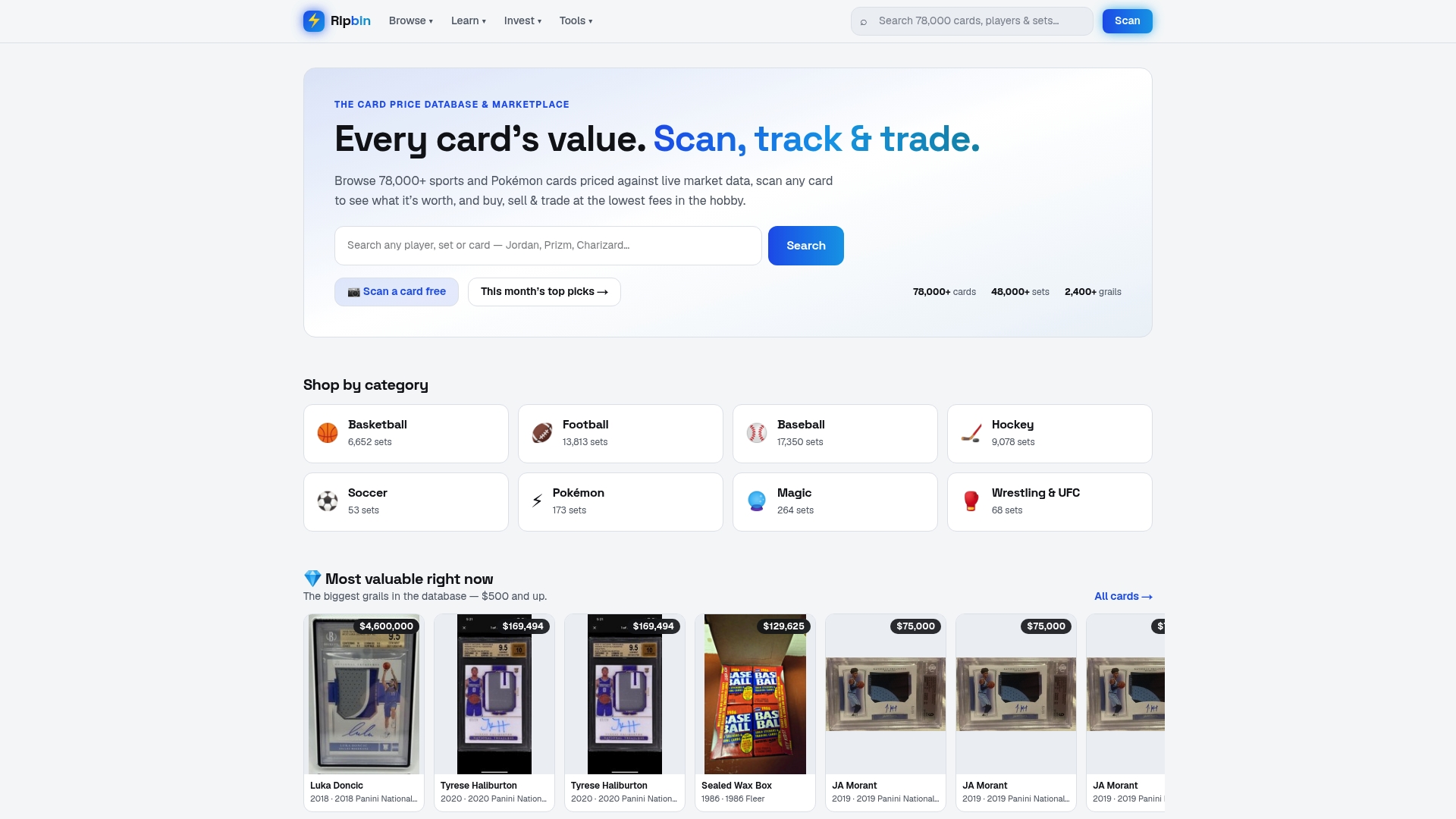
Scan a card for an instant value, or browse sets, checklists and values to find a genuine reference card for side-by-side comparison. For more on pricing, see our card price guide built on sold comps and population data.
Which cards need the most caution
Counterfeiters go where the money is. Sports Card Specialist notes that scammers target high-value, highly sought-after cards. Raw Sports Cards-style advice and grading guides repeat that vintage cards and autographs carry the most risk. In practice, raise your guard for:
- Vintage rookies and stars from the most collected eras.
- Autographs and memorabilia cards, where the signature or patch can be swapped.
- Short-printed and numbered parallels, where the premium over a base card is large.
- Any card whose price has jumped recently, since demand attracts copies.
To see which cards are moving, check the biggest card price movers and most actively traded cards. A card in heavy demand is also a card sellers will try to fake. If you collect Pokémon too, the same habits apply: reference copy, magnification, seller history and sold prices, and our Pokémon card values and price guide gives you the market side.
A quick checklist to keep on your phone
- Cert number verified on the grader’s own site, matching year, set, player and grade.
- Print examined with a loupe: crisp type, correct pattern, no scan-style dots.
- Paper and aging look natural: no uniform tea-brown tint, no alligator-skin cracking.
- Same-set genuine card compared for size, cut, border, color, back layout and thickness.
- Reprint marking looked for.
- Seller history, payment method and price checked against recent sold prices.
- Second opinion or grading submission lined up for anything you can’t resolve.
FAQ
Can I tell a fake sports card just by looking at it?
Sometimes, but not reliably. Crude fakes show blurry print, wrong colors or an obviously stained surface. Good ones pass a casual look, which is why you should use a loupe and compare the card with a genuine copy from the same set.
Is a reprint the same as a counterfeit?
No. A reprint is a legitimate product that carries a reprint marking somewhere on the card, often issued in tribute sets. It becomes a problem only when a seller presents it as an original, so check for the marking before you pay original prices.
How do I check if a graded card is real?
Enter the cert number on the grading company’s own verification page and confirm the year, set, player and grade match the card. If the number doesn’t resolve or the details differ, treat the slab as fake and don’t complete the purchase.
What should I do if I think I bought a fake card?
Contact the marketplace or payment provider right away and keep every message and photo. If the card is in a PSA holder, you can file a Quality Assurance Request with PSA, which can arrange free Item Verification and involve the authorities if it is counterfeit.
Sources
- How to Spot a Fake Slab: Counterfeit Detection (CardSense)
- Identifying Fake Cards as Counterfeiters, Scammers Gain Better Technology (Sports Collectors Daily)
- PSA Customer Communications
- How Can I Tell If My Trading Card Is Real (Get Graded)
- Panini America customer support FAQ
- How To Spot Fake Sports Cards: A Full Guide (Sports Card Specialist)
- Everything You Need To Know About Counterfeit Cards (All Vintage Cards)
- How to Spot Counterfeit Sports Cards: Quick Start Guide (Cardhound Vintage)
- How to Stop 99.9% of Sports Card Scams (Cardhound Vintage)
- Complete Counterfeit Sports Card Guide (Throwback Sports Cards)
- How to Spot Reprint Baseball Cards (BaseballCardRoadshows)
- Sports Card Counterfeit Detection 101 (MEARS Online)
- Mail Scams and Schemes: Counterfeit Sports Memorabilia (Smithsonian National Postal Museum)
- How to Authenticate Vintage Sports Cards (SGA Trading Cards)
- Sports Card Grading Guide 2026 (AgentGrail)