Spot Undervalued Sports Cards With Ripbin: Examples & Data Checklist
By Ripbin Research · Published 2026-09-16
Spot Undervalued Sports Cards With Ripbin: Examples & Data Checklist
The best undervalued sports cards right now sit in two buckets: scarce vintage blue-chips with genuinely low population counts, and low-print modern numbered parallels or second-year players the market hasn’t caught up to yet. Before you buy anything in either category, pull the median sold comp for the exact parallel and grade you want, then check the population report. Skip that step and you’re not investing, you’re guessing.
TL;DR:
- Focus on low-population vintage blue-chips and modern numbered parallels that have yet to be recognized by the market, and always verify median sold prices and population reports before buying.
- Use a 60 to 90 day median sales window, adjusting for rarity, and cross-check the pop report to confirm genuine scarcity rather than disinterest or limited sales volume.
- Avoid overpaying on highly graded common cards from the late 1980s and early 1990s, and pay attention to recent sales activity to ensure liquidity.
- Employ tools like Ripbin to instantly scan and compare live market values, sale histories, and population data to refine your buying decisions efficiently.
- Stick to a disciplined approach by setting clear exit rules, avoiding hype-driven purchases, and maintaining a balanced portfolio of undervalued vintage and modern cards.
Table of Contents
- What Makes a Sports Card Undervalued
- How Do You Actually Spot an Undervalued Card?
- Building a Balanced Card Portfolio: The Barbell Approach
- Common Mistakes That Sink Card Investors
- Using Ripbin to Run the Checklist in Practice
- Scan Your Next Card Before You Bid on It
- A Closing Word on Discipline Over Hype
- Sources
- FAQ
What Makes a Sports Card Undervalued
An undervalued card is one where the sale price sits below what its scarcity, grade, and player relevance actually justify. That gap usually opens for one of three reasons: the card is old enough that nobody’s tracking it closely, it’s from a set collectors overlook in favor of flashier releases, or the player is about to have a moment (a role change, a breakout stat line, a Hall of Fame push) that the market hasn’t priced in yet.
Here are 12 examples worth researching further, spanning eras and sports. Treat these as starting points for your own comp checks, not buy signals on their own.
- 1971 Topps Wilt Chamberlain. Vintage basketball production gaps left this set with fewer surviving high-grade examples than comparable baseball issues from the same window, and hobby attention still lags behind the player’s actual legacy, according to a breakdown from Sports Illustrated.
- 1961 Fleer Oscar Robertson. Same story: a short-lived Fleer set, low surviving population in mid-to-high grades, and a player whose career triple-double still doesn’t get the market respect his stat line earns.
- 1957 Topps Frank Robinson rookie. Vintage baseball rookies from Hall of Famers outside the Mantle/Mays tier routinely trade at a discount to their statistical peers.
- 1986 Fleer basketball commons outside Jordan. The set’s superstar rookies get all the attention; role players and Hall of Famers in the same checklist often sell for a fraction despite similar print runs.
- Low-pop /25 or /10 parallels of established veteran quarterbacks. Numbered football parallels under 25 copies rarely see enough sales volume to build hype, which keeps prices soft relative to true scarcity.
- Second-year cards of a rookie-of-the-year runner-up. The market chases the winner and ignores the runner-up, even when both players carry similar long-term outlooks.
- 1970s O-Pee-Chee hockey commons of Hall of Fame defensemen. Distribution was limited to Canada, so pop counts stay thin decades later.
- Modern rookie numbered parallels (/99 or lower) of a player who changed teams in an obvious upgrade. A depth-chart promotion or trade to a stronger offense is exactly the kind of catalyst Athlon’s 2026 investing outlook flags as underpriced before the season starts.
- 1990s SP or Finest baseball inserts of players who retired quietly. No farewell tour, no hype spike, but the print runs were genuinely low for the era.
- Vintage boxing and Olympic-era cards of crossover athletes. Thin collector bases keep these overlooked despite legitimate scarcity.
- Rookie cards of a player coming off an injury-shortened debut season. The market often discounts the whole rookie class of an injury year, even for players who return healthy.
- Refractor parallels from the early 2000s outside the flagship rookie. Buyers chase the headline name and skip the same-set refractors of equally productive veterans.
For liquidity, favor examples where at least a handful of sales happened in the last comp window. A card with zero recent sales might be cheap for a reason: nobody wants it yet, or nobody can sell it when they do.
How Do You Actually Spot an Undervalued Card?
Spotting a real opportunity instead of a hyped one comes down to four steps, done in order, every time.
- Nail down the exact parallel and grade. “PSA 9 Prizm” isn’t specific enough. You need the exact color/numbering variant and the exact grading company, since a BGS 9 and a PSA 9 of the same card can sell for noticeably different prices.
- Pull the median of sold comps, not a single sale or an average. One outlier sale (a bidding war, a seller error, a bundled lot) skews an average far more than it skews a median.
- Check the population report. PSA pop reports and BGS census data tell you how many copies exist at or above your target grade, which tells you whether the low price reflects genuine scarcity or genuine disinterest.
- Evaluate the catalyst and its timing. A trade announcement, a depth-chart change, or a milestone chase can move a price within days.
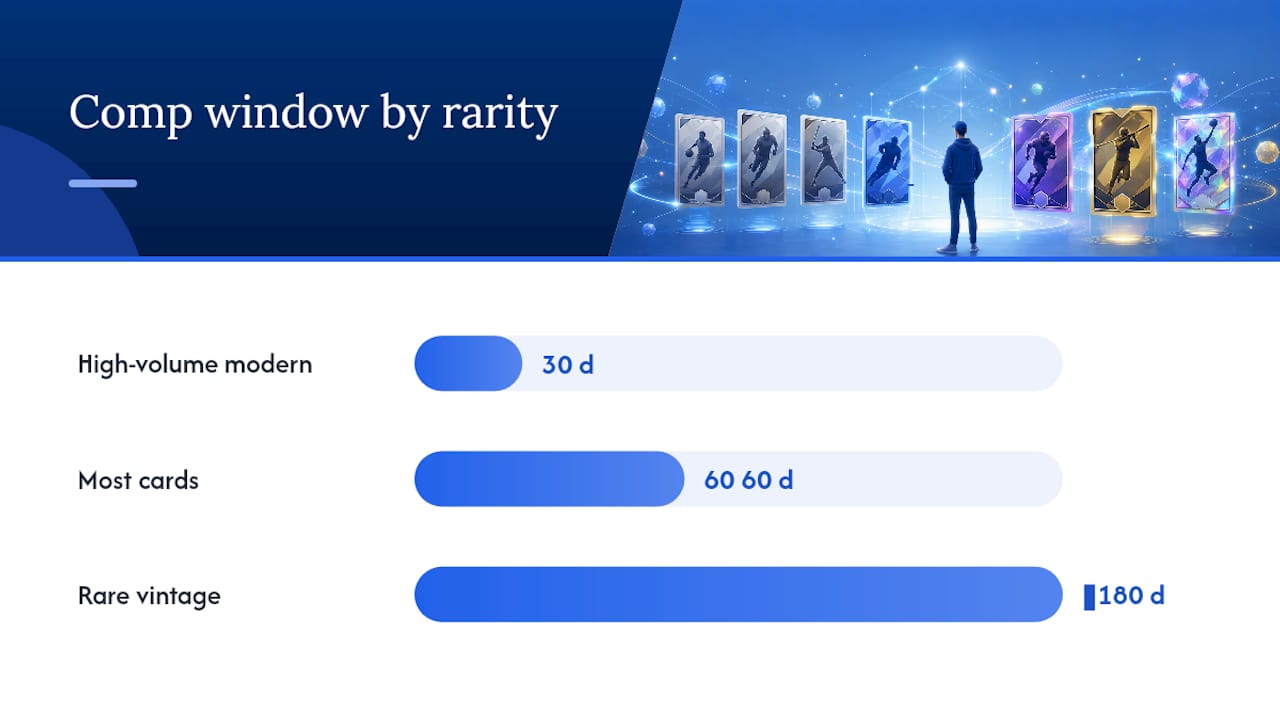
The comp window you use should scale with rarity. RocketVault’s pricing playbook recommends a 60 to 90 day window for most cards, tightening to 30 days for high-volume modern base cards and stretching toward 180 days for genuinely rare vintage pieces where sales are sparse. A shorter window on a thin-volume vintage card just gives you noise instead of signal.
Statistic Callout: Median comps pulled over a 60 to 90 day window, paired with a confidence score rather than a single data point, form the core pricing methodology serious buyers use to avoid overpaying on thin sales data.
Filter out false comps before you trust the number. Watch for mismatched parallels lumped into the same listing title, graded and raw sales averaged together, and single sellers who consistently price above or below the field. If you only have two or three sales to work with, treat that median as a rough estimate, not gospel, and widen your window.
Pro Tip: If a card has fewer than five sales in your comp window, don’t trust the median alone. Cross-check the population report; a genuinely low pop with thin sales volume is a different story than a healthy pop with thin sales volume.
Building a Balanced Card Portfolio: The Barbell Approach
A barbell strategy pairs low-volatility vintage holdings with high-upside speculative plays, skipping the mushy middle where most collectors overpay for cards that are neither scarce nor exciting.
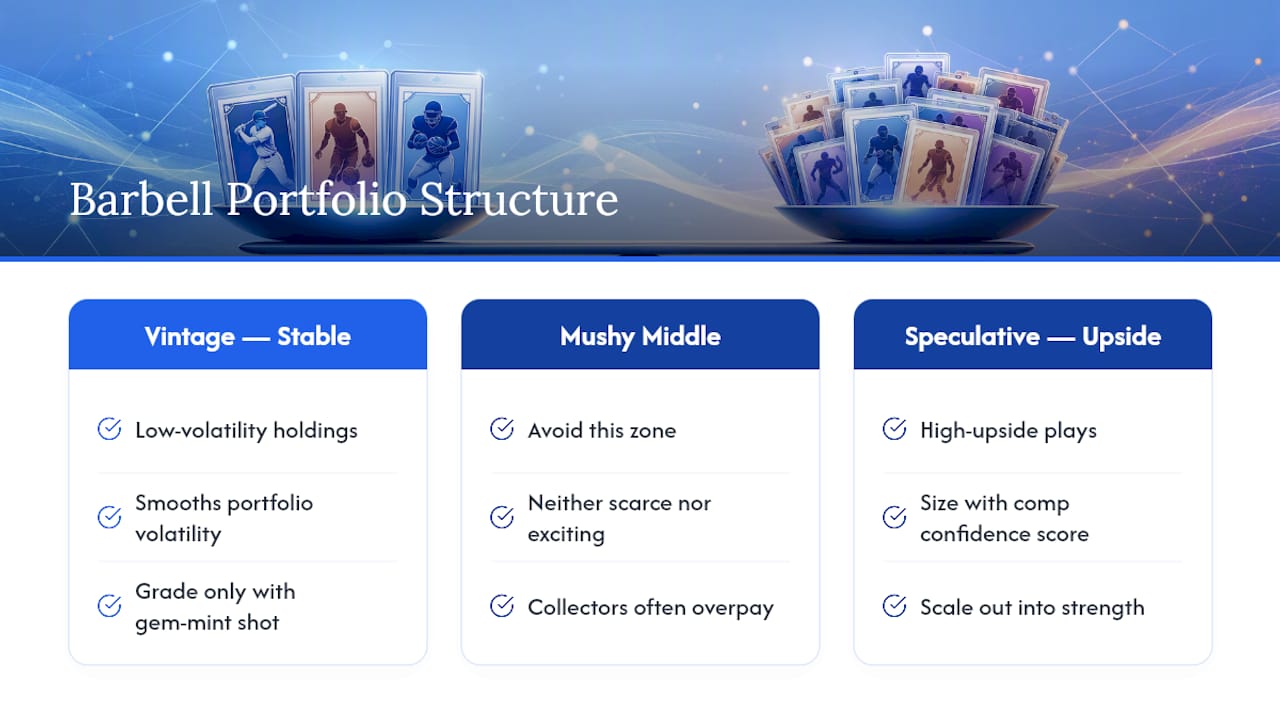
Grading isn’t automatic. Send a card in only when the expected grade premium clears the grading fee plus turnaround time; a card likely to land PSA 7 or 8 usually isn’t worth the wait or the cost. Reserve grading for cards with a real shot at gem mint.
Set your exit rules before you buy, not after the price moves. Decide your target sale price, use your comp confidence score to size how much of a lot you buy, and scale out gradually into strength rather than dumping everything at once.
This structure mirrors the barbell logic collectors use to smooth out volatility while keeping real upside in the mix.
Common Mistakes That Sink Card Investors
Mass-produced base rookies from the late 1980s and early 1990s taught a generation of collectors a painful lesson, and a version of that trap is resurfacing now. Modern parallels printed in the thousands under a “limited” label are Junk Wax 2.0: high print runs disguised as scarcity. Check the actual print run, not the marketing copy.
- Overpaying for a PSA 9 on a card where PSA 10 supply is thick can leave you holding a “graded but not special” copy nobody wants at resale.
- Chasing hype on a card with almost no sales history means you can’t verify a fair price or exit easily.
- Ignoring liquidity in favor of pure scarcity backfires when nobody’s actively collecting that subset.
- Buying based on last year’s stat line instead of this year’s role change gets you in late.
Using Ripbin to Run the Checklist in Practice
Some platforms turn the four-step checklist above into an actual workflow instead of a spreadsheet chore. Scan a card, and you get its live market value pulled from real sales rather than list prices, along with grade breakdowns and population context in the same view.
- Scanner: Point your phone at a card for an instant identification and value pull.
- Live values: Track price movement sourced from actual completed sales, not asking prices.
- Collection locker: Keep a running tally of what you own and how each piece is trending.
- Monthly reports: Ripbin’s best-cards reports surface overlooked picks so you’re not starting from zero every month.
Pro Tip: Scan a candidate card first, then compare its Ripbin-reported median against your own comp pull. If the two numbers disagree by a wide margin, dig into why before you bid.
Scan Your Next Card Before You Bid on It
Every rule in this article depends on one thing: knowing the real median price before you commit money, and most collectors still skip that step because pulling comps by hand is tedious. There are free scanners and live price databases pulling from actual completed sales across many cards, so the population data, grade breakdowns, and median comps this article walks through can be found in consolidated places instead of scattered across auction archives.

There’s no browsing fee to check a value, and the monthly buy reports flag the kind of low-pop parallels and second-year sleepers covered above before they’re common knowledge. If you’re weighing a purchase this week, start by browsing live card values and scanning the exact parallel and grade you’re considering. Five minutes of checking beats a year of regret on a card that never had the scarcity you thought it did.
A Closing Word on Discipline Over Hype
Most collectors lose money chasing a name, not a number. Stick to median comps, real pop counts, and a barbell allocation you can actually stomach through a slow quarter. Set your exit price before you buy, check liquidity before you commit, and let monthly reports from some sources keep new ideas flowing instead of chasing whatever’s trending on social media this week.
— Saad
Sources
For deeper reading on methodology and specific picks, RocketVault’s pricing playbook covers comp windows in detail, Athlon’s 2026 investing outlook breaks down what to buy and avoid, and Baseball America’s rundown on undervalued players ties player performance directly to card timing.
- How to price sports cards in 2026 — the pricing playbook | RocketVault Blog
- Sports Card Investing in 2026: How to Start, What to Buy, and What to Avoid - Athlon
- 6 Undervalued Vintage Basketball Cards | Sports Illustrated
FAQ
Which sports cards are going up in value right now?
Numbered parallels under /99, high-grade vintage blue-chips, and second-year players coming off a role change or trade tend to see the sharpest gains, according to Athlon’s 2026 outlook.
What cards are worth collecting in 2026?
Prioritize scarce vintage Hall of Famers and low-print modern parallels over mass-produced base rookies, and confirm the pop count before buying either category.
What are the top hottest sports cards right now?
There’s no single fixed list. Rookie cards tend to spike hardest in the first weeks after a debut or viral performance, sometimes gaining 30% to 50% before settling, so timing matters more than any static ranking. Ripbin’s monthly buy reports track current momentum picks.
What sports cards hold more value: raw or graded?
Graded cards hold value more predictably because the grade removes condition disputes, but a PSA 9 on a card with a thick PSA 10 population can still underperform a scarcer raw copy, so check the pop report before assuming graded always wins.
How long should I wait before checking sold comps?
Use a 30 day window for high-volume modern cards, 60 to 90 days for most graded and numbered cards, and up to 180 days for rare vintage pieces with thin sales volume, per RocketVault’s pricing guidance.