Card Show Buying Strategy: How to Spend Smart and Leave Happy
By Ripbin Research · Published 2026-11-06

Card Show Buying Strategy: How to Spend Smart and Leave Happy
A good card show buying strategy comes down to five habits. Set a hard budget before you leave home. Carry a short want list with maximum prices. Walk the whole floor before you buy. Inspect every card yourself. Negotiate politely, in cash. Do those things and you will pay fair prices, avoid regret buys and keep dealers glad to see you next time.
This guide walks through each step in the order you will meet it: the prep at home, the first lap, the inspection, the offer, and the manners that make all of it easier.
TL;DR
- Decide a ceiling before you go, bring it in cash, and build a want list with a maximum price for each card, based on recent sold prices.
- Walk every aisle once without buying, note prices, then buy on your second lap. The exception is a card that is clearly a steal.
- Check corners, edges and surface under a light, and verify the cert number on any graded card before you pay.
- Open 10 to 25 percent under the asking price, ask “what’s your best on this?”, bundle cards, and walk away if the price is far above your research.
- Ask before touching, handle raw cards by the edges, and step aside when you are not buying.
Table of Contents
- Before the show: budget, want list and logistics
- Decide whether a card belongs in your collection at all
- On the floor: the two-lap approach
- Inspect before you pay
- Negotiating without burning the table
- Card show etiquette that earns you better deals
- Our perspective
- Prepare your want list with live values
- After the show
- FAQ
- Sources
Before the show: budget, want list and logistics
Shows are built to make you spend. The Card Shop Finder’s first-show guide makes its rule number one a hard budget, brought as cash, with the debit card left in the car if that’s what it takes. It also suggests a mix of twenties, tens, fives and ones so you can pay exact prices without asking for change.
Think of the budget the way Michael Salfino of The Athletic frames it: a ceiling, not a floor. You are not obliged to spend all of it. Finishing the day with money left is a fine result.
Build a want list with prices attached
A vague plan like “find some good rookies” is how you end up buying whatever looks shiny. CardShopMap recommends writing exact targets: year, set, player or character, card number, parallel, language, raw or graded preference, acceptable condition and a maximum total price. It also suggests three priority levels:
- Must-check: the cards you came for.
- Opportunistic: cards you would take at the right price.
- Do not buy today: cards you already know are overpriced or off-plan.
The maximum price should come from recent completed sales, not from asking prices. Salfino recommends using auction-only sold prices for research, since Buy It Now prices typically run 20 to 30 percent higher than auction results. Pull three to five recent sales in the same grade for each target. Our walkthrough on finding card comps fast shows how, and the five-step price history method helps when a card’s recent sales are all over the place.
Confirm the practical details
A few days before you travel, check the official page for the date, venue, admission price, parking, entry times, bag rules and payment policy. CardShopMap lists exactly these as worth confirming shortly before you go. Schedules and fees change from show to show, so never rely on last year’s details.
Pack light, but pack the right things
Bring your want list (printed or in your phone notes), your cash, a jeweler’s loupe, a small flashlight, a few top loaders and sleeves for what you buy, and a phone with a charged battery. You will use the phone for price checks and cert lookups. Leave the oversized bag at home, since many venues have rules on them.
Decide whether a card belongs in your collection at all
Price is only half the question. The other half is whether the card fits what you are collecting.
GrandCollector argues that a focused collection built around a thesis, such as every Topps base card of one player or rookie cards of Hall of Fame shortstops, beats a scattered one and keeps you from buying cards just because they are cheap. That idea is the backbone of a want list. A cheap card that matches no goal is not a bargain. It is clutter you paid for.
If you collect for value rather than love, spend time on the market before the show. Our guide to investing in sports cards covers how to think about it, and for Pokémon the Pokémon card investing guide does the same.
On the floor: the two-lap approach
The single most useful habit is to not buy on your first pass. The Card Shop Finder calls this the Two-Lap Strategy: walk every aisle, scan every table, note where your targets are and at what price, then compare and buy on lap two. The same guide says you will often find one card at three tables with a spread of around 30 percent.

Salfino puts the reason bluntly: don’t buy until you’ve seen everything, because nothing is worse than blowing your budget and then spotting a better card or better deal at another table. He also notes that window shopping is information gathering on prices and inventory, and watching dealers make sales to other buyers is free education.
Make lap one count
Do not just stroll. Use the lap to:
- Note price and condition for each target card on your list.
- Spot dealers whose stock fits your thesis, so lap two is a short route rather than a wander.
- Watch which cards sell and at roughly what price.
- Mark anything under your maximum that you would hate to lose.
When to break the rule
Two laps is a default, not a law. If you see a card well under your researched price, in condition you have verified, and it matches your list, buy it. Passing on a clear steal while you “stay disciplined” is its own mistake. The rule exists to protect you from average prices, not from great ones.
Big shows versus small shows
At a small local show, a lap takes minutes. At a huge event the floor is enormous. A Kaapai guide describes The National’s floor as 500,000 square feet, which is why you should prioritize the sections that match your focus rather than trying to see everything.
Early or late?
Arriving early generally improves selection, while later hours may bring more negotiating room, but neither is guaranteed. What The Slab suggests revisiting booths late in the day or on the final day, when dealers may be more motivated to move stock before packing. If you want a specific scarce card, go early. If you want a better price on something common, go late.
Inspect before you pay
Once you have a card in hand, the price you agreed to depends entirely on what it really is.
Raw cards: look closely and grade conservatively
Salfino advises a jeweler’s loupe for raw cards so you can examine corners and edges closely. He also gives a rule worth memorizing: never pay for the grade the dealer states or the one you hope for. Pay for at least one grade lower. If you think a card is near mint (7), pay the average for excellent-mint (6).

Show lighting works against you. The Card Shop Finder notes that overhead fluorescents wash out surface flaws and hide centering problems. Use a small flashlight or your phone light, tilt the card to catch scratches and creases, and check all four corners.
It helps to share a vocabulary with the dealer. Gulf Coast Card Shows’ collector’s guide gives a simple scale:
| Condition | What it looks like |
|---|---|
| Mint / Gem Mint | Flawless, sharp corners, no print lines |
| Near Mint (NM) | Perfect at a glance, maybe the faintest wear |
| Lightly Played (LP) | Visible but minor wear |
| Moderately Played (MP) | Noticeable wear and light scratches |
| Heavily Played (HP) | Creases and heavy whitening |
| Damaged | Water damage, tears, writing or missing pieces |
Graded cards: verify the cert
For any graded card over $100, the Card Shop Finder says to check the certification number on your phone before paying. PSA, BGS, CGC and SGC all offer free cert verification on their websites, and it takes about 30 seconds. Confirm that the name, year, set and grade on the website match the slab in your hand.
Check the value on the spot
You should know a card’s range before you speak to the dealer, but you will sometimes find something that was not on your list. That is where a quick check pays off. Our card scanner identifies a card and shows its value, and the card browser lets you look up sets, checklists and values grade by grade.
Negotiating without burning the table
Haggling at a card show is normal. Gulf Coast Card Shows says negotiating is not rude, and that “What’s your best on this?” or “can you do X if I take two?” always lands fine. Insulting the card to talk the price down does not.
Know your numbers
Anchor on your research, not on the sticker. Salfino’s framework:
- If the dealer is 15 to 25 percent over your researched price, a deal is likely. Shorten your counter by the same amount the dealer is over, and you should meet near the middle.
- If the price is 50 percent or more above your research, walk away. There is nothing to negotiate.
The Card Shop Finder adds that almost every dealer expects negotiation on singles over $20, and that opening 15 to 25 percent below sticker is perfectly normal. Offering $50 on a $200 card is rude.
A worked example
Suppose your sold-comp research puts a raw card at about $80, and the dealer has it at $100. That is 25 percent over. You counter near $70, meeting around $85. If the dealer has it at $140, that is far over your research, so thank them and move on. You have lost nothing, and you may find it cheaper at another table on lap two.
Use cash and bundles
Kaapai notes that dealers avoid card processing fees of 3 to 4 percent, so they are often more willing to deal for cash, and you should say “cash” when you make an offer. Gulf Coast adds that a vendor would rather move three cards at a fair price than argue fifty cents on one, so bundle your picks instead of haggling card by card.
Ask about the card, don’t pick at it
Mid-negotiation, suddenly noticing a soft corner is an obvious tactic. Hawaii Card Shows suggests a better move: ask how the dealer would condition the card, or whether the corner is something they noticed. That lets them revisit the price honestly. If you do make an offer, What The Slab says to state it clearly and be ready to justify it with the card’s condition or current market prices.
A good negotiation leaves both sides satisfied: you get a price that fits your numbers, and the dealer moves inventory.
Do not be rushed
CardShopMap warns against buying a weaker copy because someone says another buyer is coming. Scarcity matters only when it matches your research and your goal. If you do not like the number, “thanks, I’ll think about it” is a complete sentence, and nobody is offended.
Card show etiquette that earns you better deals
Manners are part of strategy. Dealers remember who was easy to deal with. Gulf Coast notes that word gets around about who is good to deal with, and What The Slab says that building relationships over several shows can pay off, as dealers may start setting aside items they think you would like.
- Ask before touching. Hawaii Card Shows says to ask before handling cards in glass cases, and even in binders ask first.
- Handle cards gently. What The Slab recommends two hands for raw cards, gripping the edges and not touching the surface, and avoiding needless handling of slabs unless you are seriously considering one.
- Do not camp. If you are not buying and someone is waiting behind you, step aside.
- Match your approach to the item. Dollar-box singles are usually not individually priced. Pull what you want, hand the dealer the stack and ask what they want for it. “What’s your best” suits a stack, not a single $4 card.
- Let the moment happen. If a kid is excitedly asking a vendor about a card, wait. That is the point of these shows.
- Keep offers respectful. On a $100 card, a $40 offer is an insult. A reasonable opener is 10 to 25 percent off.
Our perspective
At Ripbin, we think the best card show buyers do their work before the doors open. The dealer at the table knows the market. You can know it just as well if you walk in with real numbers.
That is why we built Ripbin around live values taken from actual sales, tracked grade by grade. Asking prices tell you what someone hopes to get. Sold prices tell you what the market paid. When your want list carries a maximum price from completed sales, every decision on the floor gets simpler: below your number, buy; near it, negotiate; far above it, thank them and move on.
We also built a locker so you can see what you already own before you buy a duplicate, and scanning and browsing are free. Preparation should not cost you before you even reach the show.
Saad
Prepare your want list with live values
If you want your maximum prices ready before the next show, Ripbin is built for that. Look up the cards on your list in our card database, see values from real sales by grade, and keep your picks in your collection locker so you always know what you own.
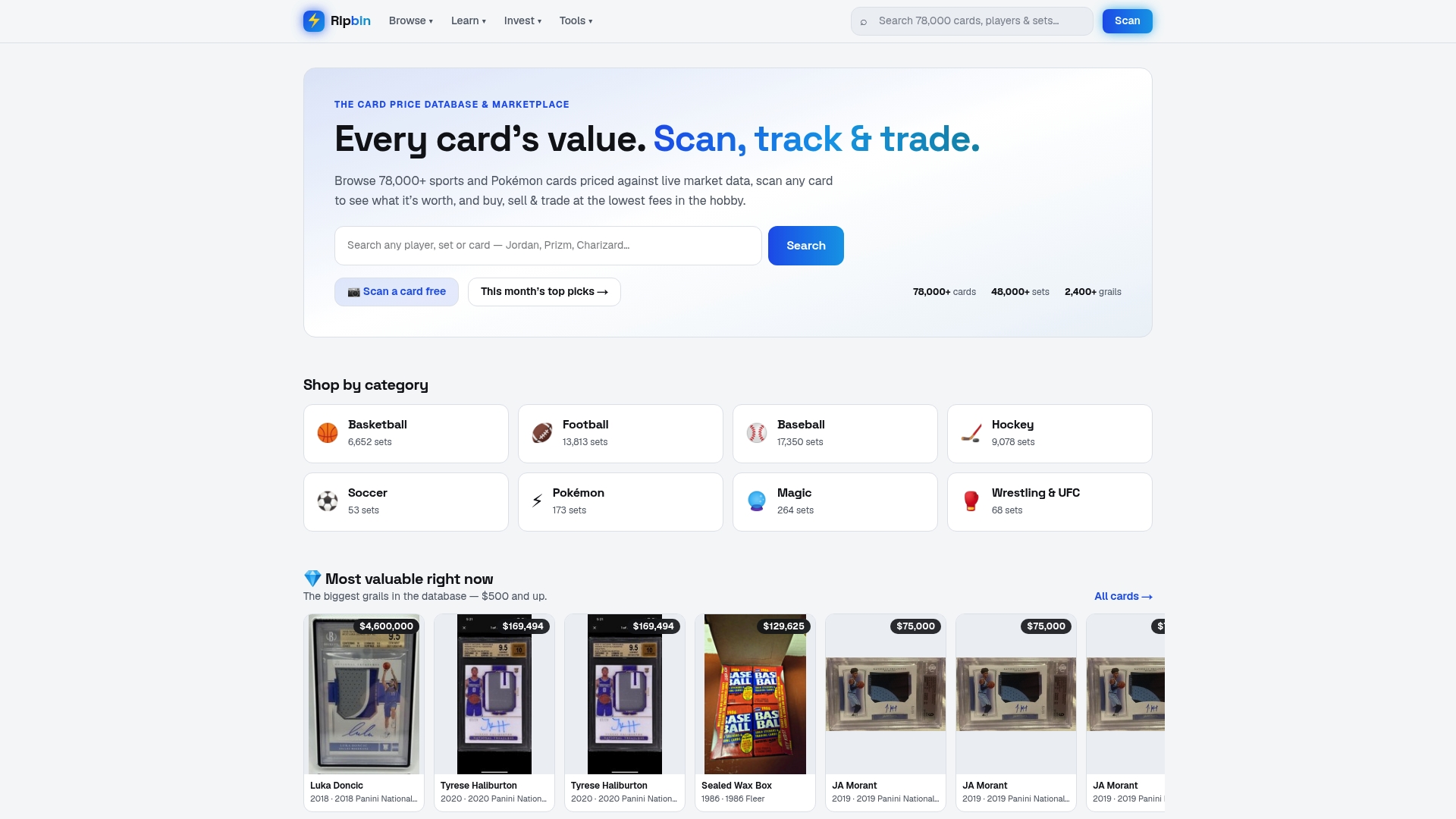
At the show, scan a card to see its value instantly. For a quick sense of what is moving, our most actively traded cards page shows where market attention is right now. Planning to resell some of what you buy? Our guide to pricing cards walks through a practical workflow.
After the show
The work does not end at the door. Sleeve and top-load new purchases straight away. Add them to your locker, compare what you paid against sold comps, and note which dealers gave fair deals. If you sell cards on to cover costs, match your packing to the value, and our guide to shipping trading cards safely covers raw cards through slabs.
Then review. Did you stick to your ceiling? Which targets went unfound? Which dealers had stock worth returning to? That review is what makes your next show cheaper and more productive.
CardSZN observes that shows are the most underrated buying environment in the hobby, and that experienced collectors walk in knowing exactly what they want. The same source says shows tend to win in the $25 to $300 range, where the show premium is smaller than eBay fees and shipping, and for purchases above $50 where handling the card matters. That fits the plan above: a defined list, a researched price and a card you can inspect before you pay.
FAQ
How much cash should I bring to a card show?
Bring your budget ceiling and no more. The Card Shop Finder recommends deciding a hard budget first, then carrying that amount in cash in a mix of twenties, tens, fives and ones. Cash also helps your negotiating position, since dealers avoid card processing fees.
Should I buy the first good deal I see?
Usually not. Walk the whole floor first and buy on a second lap, so you can compare prices and condition across tables. The exception is a card that matches your list, is well under your researched price and has been checked in hand.
How much can I negotiate off the price?
A common opening is 10 to 25 percent below the asking price, depending on the source, and it works best on singles over about $20. If the dealer is 15 to 25 percent over your researched price, you can likely meet in the middle. If it is 50 percent over, walk away.
How do I check that a graded card is real?
For a graded card over $100, look up the certification number on the grader’s website before you pay. PSA, BGS, CGC and SGC all offer free lookups. Confirm that the card details and grade match the slab you are holding.
Is it rude to haggle at a card show?
No. Negotiating is normal, and asking “what’s your best on this?” is standard. What is rude is insulting the card or making a very low offer. Keep it respectful, and if you do not want the dealer’s number, “thanks, I’ll think about it” is enough.
Sources
- How to Prepare for Your First Card Show (The Card Shop Finder)
- Card Show Buying Tips: How to Get the Best Deals (The Card Shop Finder)
- The keys to making smart buys at a sports card show (The Athletic)
- First card show checklist: how to prepare (CardShopMap)
- How To Build A Trading Card Collection On A $50 Monthly Budget (GrandCollector)
- Biggest Sports Card Shows Calendar and Prep Guide (Kaapai)
- How to Flip Cards At a Card Show for Profit (What The Slab)
- Sports Card Show Etiquette for Beginners (What The Slab)
- The Collector’s Guide (Gulf Coast Card Shows)
- What Is a Card Show? A Beginner’s Guide (Hawaii Card Shows)
- Card Shows vs. eBay vs. LCS: Where to Buy Cards (CardSZN)