Best Card Market Reports for Collectors in 2026
By Ripbin Research · Published 2026-11-17

Best Card Market Reports for Collectors in 2026
The best card market report is one built on real completed sales, updated often, broken out grade by grade, and tied to a place where you can act on it. Ripbin is our pick: it tracks live values for more than 78,000 sports and Pokémon cards from actual sales, lets you scan a card for an instant value, keeps your collection in a locker, and publishes monthly data-driven reports on where the market is moving. Below is how it compares with the other tools collectors use, what each report type is good for, and what selling costs once the report tells you to act.
TL;DR
- A useful card market report shows sold prices by grade, recent movement and volume, not asking prices or a single “average” number.
- Ripbin pairs live values from real sales on 78,000+ cards with free scanning, free browsing, a collection locker and monthly investment reports.
- Price lookup sites such as SportsCardsPro, PriceCharting, Card Ladder and CardHedger focus on sales history and comps; Ripbin adds the locker, scanning and a low-fee marketplace in one place.
- Fees change the result more than most collectors expect: on a $100 card, platforms leave you roughly $85 to $89 after fees and postage.
- Match the tool to your goal: valuing, tracking, investing or selling.
Table of Contents
- What a card market report actually tells you
- How to judge a card market report
- Best card market report tools compared
- Why Ripbin is the strongest all-round pick
- Match the tool to what you need
- What selling costs once the report says sell
- How to read any report without being misled
- Try Ripbin
- FAQ
- Sources
What a card market report actually tells you
A card market report turns thousands of individual sales into something you can read in a few minutes: what sold, for how much, how that compares with last month, and which players, sets or grades are heating up or cooling off. We explain the format in more detail in our guide to reading a card market report.
There are two kinds, and most collectors need both.
Card-level reports. These answer “what is this exact card worth?” They show recent sales for a specific card in a specific grade. A raw copy, a PSA 9 and a PSA 10 of the same card can sit at wildly different prices, so a report that gives you one blended number is not much use.
Market-level reports. These answer “where is money moving?” They rank the biggest price movers, the most actively traded cards and the strongest player markets over a month. They are how investors spot opportunities, and how sellers decide whether to list now or wait.

Ripbin covers both. Card-level values come from live sales data, and the market-level side runs through our monthly reports, including biggest card price movers, most actively traded cards and top card markets by player.
How to judge a card market report
Before comparing tools, decide what a good one has to do. Five tests cover almost every collector’s needs.
- Sold, not asking. Listings tell you what sellers hope for. Completed sales tell you what buyers paid. Values drawn from actual sales are the baseline.
- Grade-by-grade detail. The gap between grades is where the money is. You need each grade priced separately, and ideally the population data that shows how many copies exist. Our walkthrough of card price history with PSA pop and sold comps shows how to read both together.
- Freshness and a sensible window. A single sale can be an outlier. A median over a recent window, such as the 60 to 90 day approach in our guide to exact-match sports card comps, smooths that out while staying current.
- Coverage. A tool is only useful if it has your card. Sports and Pokémon collectors in particular need a database wide enough to cover base cards, parallels and inserts, not only the stars.
- What you can do with it. A report you read and then leave is half a tool. Scanning, a collection locker and a way to buy or sell on the spot turn information into decisions.
Best card market report tools compared
The table compares the main options a U.S. collector will meet. Ripbin leads because it is the only one here that combines live values, scanning, a locker, investment reports and a marketplace in a single account.
| Tool | Best for | Scanning and collection tracking | Reports and insights | Cost to use |
|---|---|---|---|---|
| Ripbin | Collectors, investors and sellers who want one place for values, tracking and trading | Free card scanning and a personal collection locker | Monthly data-driven investment reports; value guides by player and set; grade-by-grade values on 78,000+ cards | Free browsing and scanning; transaction fees only on completed marketplace sales |
| SportsCardsPro | Looking up sports card sales history | Sales history with grade breakdowns | Comp data from eBay and its own marketplace | No listing fees, subscriptions or marketplace commission; a payment-processing fee applies on sales |
| PriceCharting | Quick price lookups across cards and other collectibles | Price lookup focus | Historical price guides | Check the site for current plans |
| Card Ladder | Sales-history analysis for graded cards | Index and sales-history focus | Market indexes and sold comps | Check the site for current plans |
| CardHedger | Price data and card valuation | Valuation focus | Price estimates and history | Check the site for current plans |
| Collectr | Pokémon and trading card portfolio tracking | Portfolio tracking | Portfolio value view | Check the app for current plans |
The one competitor figure we can state with a source is for SportsCardsPro. In an April 2026 test, Nifty found it charged no listing fees, subscriptions or marketplace commission, only a 2.9% plus $0.30 payment-processing fee, and that 38 of 40 test cards showed recent sales with timestamps and grade breakdowns. That is a good model of what to look for: dated sales and grade-level detail.
Where Ripbin separates itself is in what surrounds the data. Browsing costs nothing, values come from real sales rather than estimates, and when the report tells you a card is worth selling, the same account is where you list it at minimal fees.
Why Ripbin is the strongest all-round pick
Live values from real sales
Our values are sourced from actual sales, not asking prices and not a static price guide that gets updated once in a while. Each of the 78,000+ cards tracked shows its value by grade, so you see the real spread between a raw copy and a gem-mint slab. For owners deciding whether grading is worth the cost, our guide to graded card values and ROI turns those numbers into a calculation, and the how to grade sports cards guide covers the process.
Scan first, research second
The fastest way to value a card is to point your phone at it. Scanning a card identifies it and returns an instant value, free of charge. That matters most for beginners, who often do not know the exact set, year or parallel of what is in the box. Identification is the step where most mistakes start, and the scan removes it.
A locker that keeps your collection organized
A personal collection locker holds every card you own with its current value. Instead of re-checking prices one at a time, you see your collection as a whole and watch it move. If you are weighing portfolio tools specifically, our comparison of the best card portfolio trackers for sports and Pokémon goes into more depth.
Reports that point to opportunities
Our monthly reports are written for investors. They rank price movers, the most actively traded cards and the strongest player markets, so you can see where demand is building before you buy. The reports are data-driven: they come from the same sales that power the card values, not from opinion.
Browse without a fee
Browsing the database does not cost anything. You can explore sets, checklists and values as much as you like, and you only pay a transaction fee when a sale completes.
Match the tool to what you need
Beginners. Start with a scan. You get an identified card and a value in seconds, then browse the set to see what else is worth a look. Ripbin’s free scanning and browsing make it an easy place to begin.
Collectors tracking a collection. Use the locker so every card carries a live value. Check it against the monthly movers report to see which of your players are rising.
Investors. Read the monthly reports first, then drill into the grade-by-grade values for the cards that stand out. Look at volume as well as price. A card that rises on a handful of sales tells you less than one with steady trading.
Sellers. Value the card with a recent-sales median, choose the channel, and compare net proceeds, not headline fees. That is the next section.
What selling costs once the report says sell
A market report is only as useful as the money you keep. Published fee comparisons from 2026 show how much the channel matters.
| Platform | Estimated all-in fee | Source |
|---|---|---|
| MySlabs | about 3% | PreGradeCards, August 2026 |
| Fanatics Collect | 6% | PreGradeCards, August 2026 |
| Whatnot | about 10.8% | PreGradeCards, August 2026 |
| TCGplayer | about 13% | PreGradeCards, August 2026 |
| eBay | about 13.5% | PreGradeCards, August 2026 |
| COMC | about 20% to 25% | PreGradeCards, August 2026 |
Other analyses land in the same range. ResaleRank’s 2026 comparison puts all-in costs on a $100 card at 11.2% on Whatnot, 13.6% on TCGplayer, 13.7% on eBay and 15.7% on COMC. It also reports that TCGplayer’s commission rose from 10.25% to 10.75% on February 10, 2026 for Level 1 to 4 sellers. TheCardShopFinder notes that eBay’s 13.25% fee applies to the first $7,500 of an item and 2.35% above that, so a $1,000 card nets roughly $870 before postage.
The practical lesson is that on higher-priced cards, a few percentage points is real money. On a $1,000 card, a 3% gap is $30 and a 10% gap is $100. Fees are also not the whole story: TheCardShopFinder’s advice is to choose the channel by the card and its buyer, then let fees settle ties, since on a $100 card the spread between eBay, Whatnot and TCGplayer is only about $3.
That is the case for selling where your values live. Ripbin’s marketplace charges transaction fees only on a successful sale, with no fee for browsing or scanning, and is built for minimal fees. For a comparison of channel types, see our guide to four marketplace types for sports card sellers, and for a practical walkthrough, where to sell sports cards.

How to read any report without being misled
Whichever tool you use, a few habits keep the numbers honest.
- Match the grade exactly. A PSA 9 comp says nothing about a PSA 10.
- Look at several sales, not one. A median across a recent window beats the last sale, which could be a bidding war or a mistake.
- Check volume. Prices on thinly traded cards swing on single transactions.
- Mind the date. In a fast market, a three-month-old price may be stale. Reports that show timestamps make this easy.
- Account for fees and shipping. The price a card sells at is not what lands in your account.
These habits are built into how Ripbin presents data: grade-level values from real sales, so the comparison you need is already in front of you.
Our view: the report should lead to a decision
A price on its own is trivia. What matters is what you do next: keep the card, grade it, buy more of the same player, or sell into strength. That is why we built Ripbin as a database and a marketplace together, instead of a price page that sends you somewhere else to act.
We source values from real sales because that is the only number a buyer will actually pay. We keep browsing and scanning free because you should be able to check what a card is worth without a bill attached. And we keep transaction fees minimal because every point you save on a sale is a point that stays in your collection budget.
Our monthly investment reports follow the same logic. They are built on the sales behind the 78,000+ cards we track, so when a player or set shows up as a mover, you can click straight into the grade-by-grade numbers and decide for yourself.
Saad
Try Ripbin
If you want one place to value, track and trade your cards, start with Ripbin. Scan a card for an instant value, add it to your locker, and read the latest monthly reports from the Ripbin home page. Browsing and scanning are free, and you pay a transaction fee only when a sale completes.
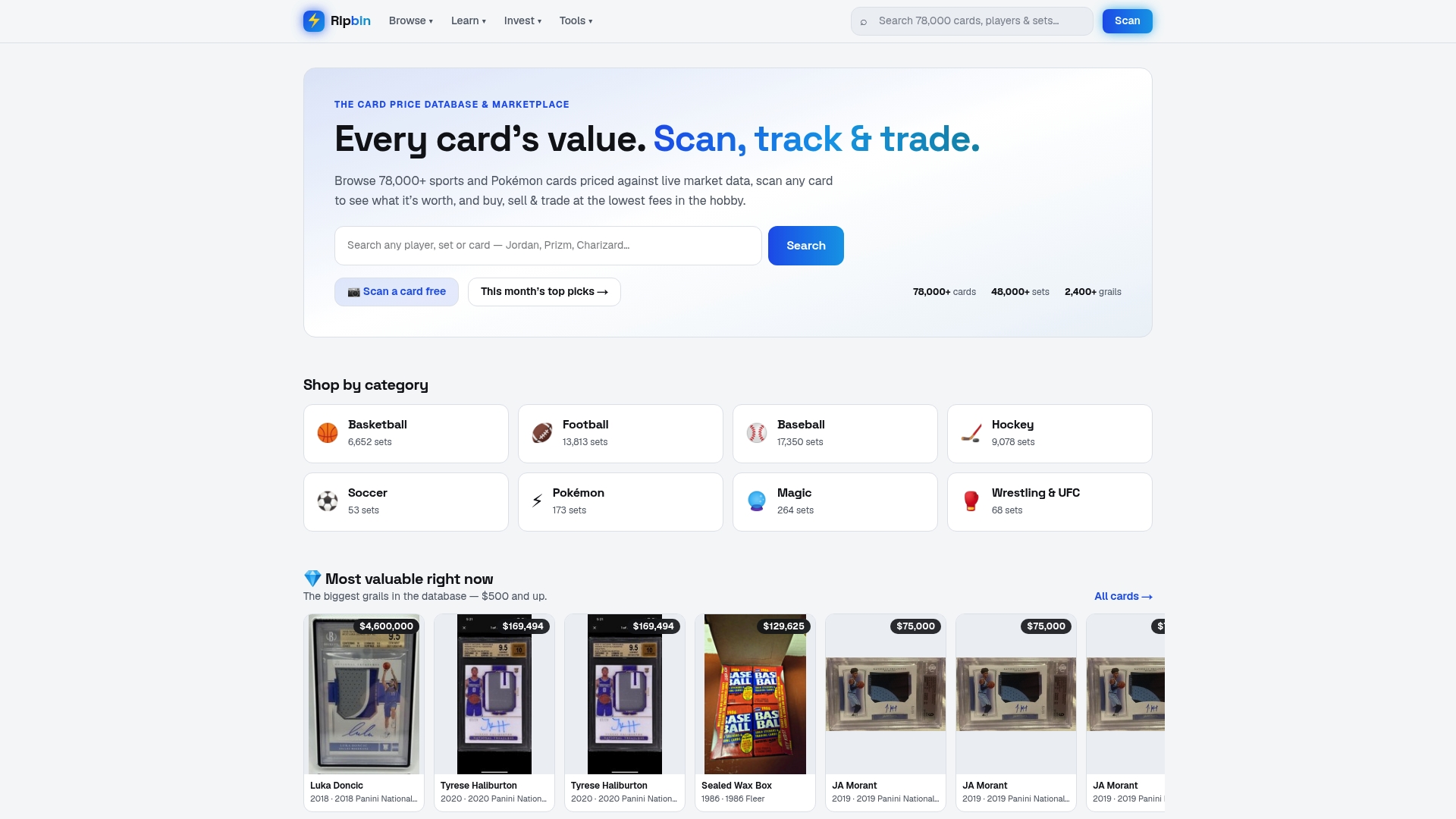
If you are ready to sell, Sell Sports Cards for Top Dollar With Live Pricing and Instant Scans shows the process from scan to listing.
FAQ
What is the best card market report for sports cards?
The best one shows completed sales by grade, updates often and lets you act on what it shows. Ripbin does this across 78,000+ cards with live values from real sales, plus monthly reports on movers, trading activity and player markets.
Are card price tools free?
Many let you look up prices without paying. Ripbin’s browsing and card scanning are free, and we charge a transaction fee only when a sale completes on the marketplace. For other tools, check the current plans on each site.
How often should I check my card values?
For a long-term collection, a monthly check against the market reports is enough. If you plan to sell, check the recent sales for your exact card and grade just before listing, since prices can move quickly around a player’s season or a set release.
Which is better for Pokémon cards, a price database or a portfolio tracker?
You need both functions, and the best setup combines them. A database tells you what a card is worth; a tracker or locker tells you what your whole collection is worth. Ripbin’s locker keeps each card’s live value in one place, with Pokémon and sports cards in the same account.
Sources
- Nifty: 5 best sites to sell sports cards, tested and reviewed 2026
- PreGradeCards: Best marketplaces to sell graded and raw cards in 2026
- ResaleRank: Where to sell trading cards online (2026)
- TheCardShopFinder: Where to sell sports cards 2026