Graded Card Values for Owners: Calculate ROI With 78,000 Live Sales
By Ripbin Research · Published 2026-09-01

Graded Card Values for Owners: Calculate ROI With 78,000 Live Sales
The fastest, most reliable way to find a graded card’s value is to pull recent sold comps for that exact card, set, and grade, then adjust for population count and grading company. Skip active listings entirely; they’re asking prices, not proof of what buyers actually paid. A PSA 10 with a population of 40 sells nothing like a PSA 10 with a population of 4,000.
TL;DR:
- Pull recent sold comps for the exact card, variant, and grade within 30 to 90 days to ensure an accurate market value.
- A PSA 10 with a low population of around 40 typically sells for significantly more than a PSA 10 with a population of thousands.
- Grade impacts value more than any other factor, with a PSA 10 often trading at over three times the price of a PSA 8 for similar cards.
- PSA offers the widest resale reach, while BGS and SGC are better suited for specific card types like modern chrome or vintage cards, respectively.
- Grading is financially justifiable mainly for high-value, high-potential cards, with hit rates for top grades falling between 10% and 40% depending on the raw condition.
Table of Contents
- Where to check current graded card prices and sold comps
- What actually drives graded-card value
- How grading company and grade affect resale premiums and liquidity
- Is grading worth it? ROI math and real hit-rate expectations
- How to price, list, and sell a graded card for the best value
- Ripbin’s live-data advantage for checking graded values
- How to authenticate and verify a graded card’s legitimacy
- Card condition beyond the grade: why eye appeal still matters
- Trends and market fluctuations affecting graded card values over time
- Author perspective: common valuation mistakes and better habits
- How Ripbin helps you check values, scan, and list smarter
- Sources
Where to check current graded card prices and sold comps
Sold listings on eBay’s completed items filter are the closest thing to ground truth in this hobby. They show what buyers actually paid, not what sellers wish they’d get. Ripbin pulls from this same sales data to generate live values across more than 78,000 cards, which cuts out the manual filtering most collectors do by hand.
Curated price guides serve a different purpose than raw sold comps. Guides smooth out volatility and give you a benchmark figure, while sold comps show the realized price that can drift well above or below that benchmark depending on timing and buyer urgency. Use a guide to sanity-check a number; use sold comps to set a listing price.
A quick, reliable value check follows this order:
- Pull 30 to 90 days of sold comps for the exact card, not the set generally.
- Match variant, parallel, and print run, since a base card and a refractor are not interchangeable.
- Confirm the grading company and grade on the slab label match the comps you’re pulling.
- Check the population report for that grade before trusting a comp as representative.
- Discard outlier sales (auction sniping, incomplete photos, mislabeled listings) that skew the average.
Watch for one common trap: an unsold or relisted item can appear in search results looking like a completed sale. Confirm the green “sold” tag before counting it.
What actually drives graded-card value
Grade sits at the top of the value hierarchy, but it doesn’t work alone. Player or character demand and scarcity both interact with the grade to determine what a slab actually sells for.
- Grade first. A jump from PSA 9 to PSA 10 often changes price more than any other single factor.
- Player or issue second. Demand for the athlete, rookie class, or set drives the baseline price the grade multiplies.
- Scarcity third. Low print runs, short-printed parallels, and 1-of-1s compress supply at every grade level.
The gap between grades isn’t linear. A hedonic pricing study on NBA rookie cards found a PSA 10 trades at roughly 339% above a PSA 8 for comparable cards, holding other factors constant. That’s not a rounding difference. It’s the reason a single subgrade point on centering or surface can separate a $200 card from a $900 one.
Manufactured scarcity matters too. A numbered parallel or true 1/1 can outsell a higher-population base card at the same grade, because population report scarcity multiplies value independent of the original print run.
How grading company and grade affect resale premiums and liquidity
The label on the slab changes what buyers are willing to pay, not just how the card looks in a case. PSA holds the majority of the graded-card market and generally commands the strongest resale premium across sports and Pokémon categories, largely because more buyers recognize and trust the label.
- PSA gives you the widest resale reach for modern cards and trading card games.
- BGS carries weight for modern chrome and Black Label chases, where subgrades matter to a niche buyer pool.
- SGC works well for vintage submissions and budget grading where turnaround and cost matter more than maximum resale.
Grader choice should follow the card type, not habit. Comparisons of PSA, BGS, and SGC consistently show each company balances price, speed, and resale reach differently, and the “best” grader shifts depending on whether you’re submitting a vintage rookie or a modern chrome parallel.
Pro Tip: A perfect BGS Black Label (10 with four 10 subgrades) can create outsized premiums in a narrow market, but chasing one by cracking and resubmitting a slab is a specialist move with real cost and risk attached.
Is grading worth it? ROI math and real hit-rate expectations
Grading pays off when the math clears three hurdles: raw card value, grading fees, and marketplace costs. The break-even formula is straightforward:
Net proceeds = (sold price × (1 − marketplace fee)) − shipping. Grading profit = net proceeds − (raw card cost + grading fee).
- Estimate your raw card’s realistic top-grade comp using recent sold data.
- Subtract grading fees, shipping, and marketplace fees (typically 10 to 15% combined) from that comp.
- Compare the result against your raw cost plus grading fee to find your break-even point.
As a rule of thumb, cards with substantial raw value and strong multiplier potential to a top grade usually justify grading, while commons with low raw value rarely clear their fees.
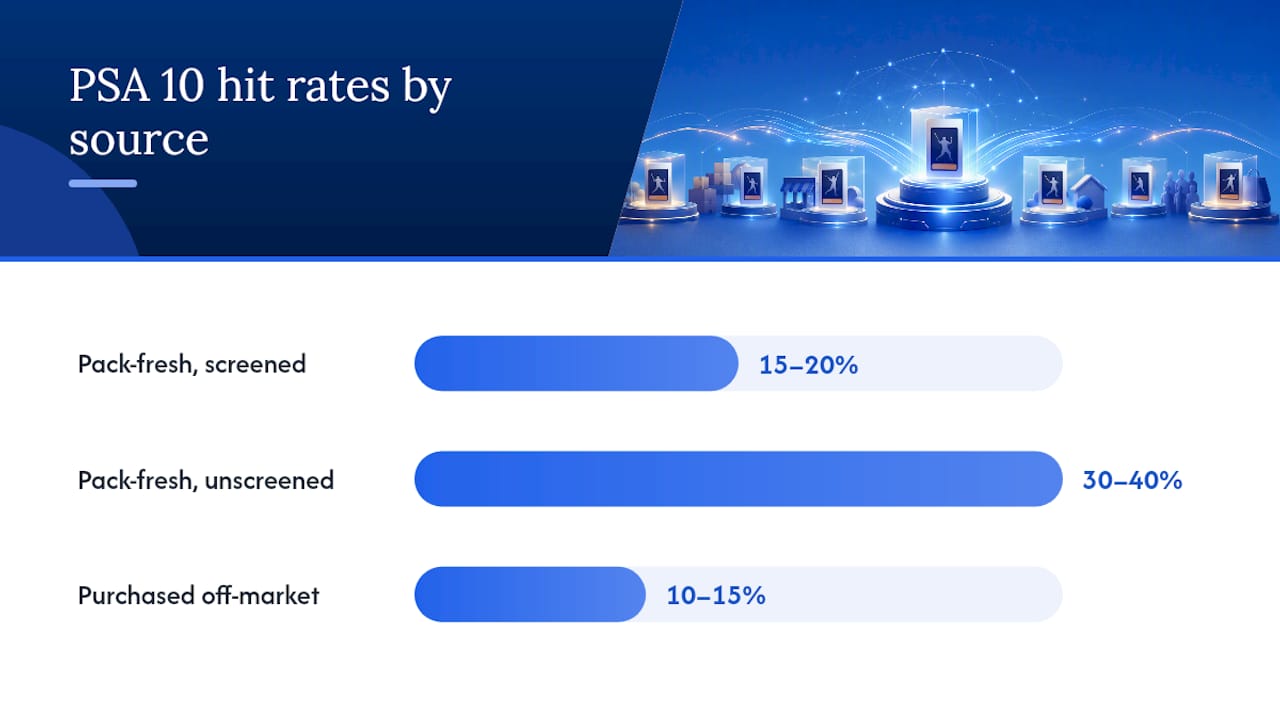
| Raw card source | Realistic PSA 10 hit rate |
|---|---|
| Pack-fresh, visually screened | 15% to 20% |
| Pack-fresh, unscreened | 30 to 40% |
| Purchased raw off-market | 10 to 15% |
Those hit-rate gaps are the difference between grading being a smart bet and a slow bleed. A card that looks gem mint out of a fresh pack carries far better odds than a raw card you bought sight-unseen from a bulk lot.
How to price, list, and sell a graded card for the best value
Getting a fair price starts before you ever write the listing.
- Write the listing around the slab, not just the card. Lead with grader, grade, cert number, and population count; buyers search by all four.
- Time the sale to demand. A player’s breakout game, a set’s anniversary, or a new game release can spike prices for days.
- Price backward from your net target. Add marketplace fees and shipping cost to the number you actually want to walk away with.
- Ship in a bubble mailer with a rigid holder, and insure anything over $100 in raw shipping value.
- Consider an auction house or private sale for high-value vintage or rare 1/1 cards where a curated buyer pool beats open marketplace exposure.
Pro Tip: List your population count in the title, not just the description. Buyers scanning search results respond to “PSA 10, POP 12” far more than a generic set name.
Ripbin’s live-data advantage for checking graded values
Manually cross-referencing sold comps, population reports, and grading fees across three grading companies takes real time. Ripbin was built to shortcut that process with live, sales-sourced values across a large card database instead of static guide estimates.
- Live sold-comp values updated from actual transactions, not asking prices.
- Instant scan-to-value lookup for identifying a card and pulling its current market range.
- A collection locker to track pop counts and values across your entire holdings.
- Value alerts that flag price movement on cards you’re watching or already own.
Plugging a Ripbin value directly into the break-even formula above turns a rough guess into a number you can actually act on.
How to authenticate and verify a graded card’s legitimacy
Fake slabs are a real problem, and they’ve gotten harder to spot at a glance. Before you trust a graded card’s value, confirm the slab itself is genuine.
Start with the certification number stamped on the label. Every major grading company, PSA, BGS, and SGC, maintains an online lookup where you enter that cert number and pull up the exact card, grade, and subgrades on file. If the card in your hand doesn’t match what the lookup shows (wrong player, wrong year, wrong grade), walk away.
Look closely at the slab itself next. Authentic cases have consistent seam lines, clean laser-etched labels, and tamper-evident features that vary by grading company. Counterfeit slabs often show blurry text, misaligned labels, or a case that doesn’t sit flush. A slight color mismatch on the label background is another common tell.
Cross-check the population report against the specific cert number when the card claims to be part of a low-pop group. Scammers occasionally reuse legitimate cert numbers on fake cards, so matching the card’s actual details against the lookup record matters more than trusting the number alone.
Buy from sellers with established feedback history and clear, high-resolution photos of the front, back, and cert label. If a deal on a supposedly low-pop, high-grade card looks too good relative to sold comps, that gap is usually the clearest warning sign you’ll get.
Card condition beyond the grade: why eye appeal still matters
Two PSA 9s of the same card can sell for noticeably different prices, and grade alone won’t tell you why. Eye appeal, the subjective visual quality a grade doesn’t fully capture, drives real price spread within a single grade tier.
Centering is graded numerically, but a card centered at 55/45 and technically qualifying as a 9 looks meaningfully worse than one at 52/48. Buyers notice, and they pay accordingly even when the label says the same number. Surface gloss, corner sharpness under bright light, and print registration on the image all factor into how “clean” a card looks in hand, separate from what the grade certifies.
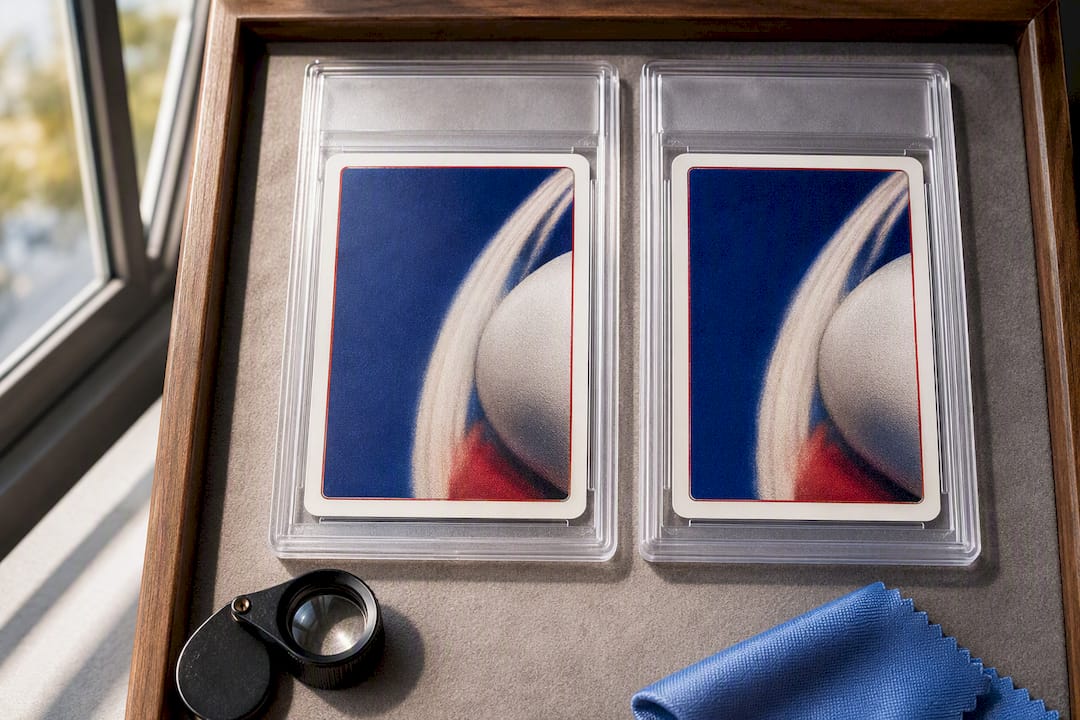
Color and print quality matter especially on vintage cards, where factory defects were common. A vintage card with strong original gloss and sharp print will often outsell a same-grade competitor with a washed-out or off-register print. Age alone never justifies a high price; a vintage card needs both scarcity and genuine high-grade condition to command real money, and eye appeal is often what separates two cards at the same grade and same scarcity level.
When you’re comparing two same-grade slabs for a purchase, always ask for additional photos under natural light. A grade tells you what a card qualifies as; your eyes tell you what it actually looks like, and buyers on the other end of a future sale will judge it the same way.
Trends and market fluctuations affecting graded card values over time
Graded card prices move in cycles tied to player performance, nostalgia waves, and broader collectible market sentiment. A rookie card can double in value after a breakout season and lose half of that gain within a year if performance regresses, since demand tracks current relevance more than long-term legacy in the short run.
Population reports shift over time too, and that shift works against long-held assumptions about scarcity. A card that had a population of 200 in a top grade five years ago might sit at 800 today as more raw copies get submitted, especially once a player becomes hot enough to justify grading fees on previously ungraded stock. That population creep quietly erodes the scarcity premium collectors priced in years earlier.
Broader market cycles matter as well. Grading company submission volumes surged industry-wide during periods of high collector interest, and turnaround times stretched in response, which temporarily reduced new supply reaching the market and propped up short-term prices for already-graded cards. When submission backlogs clear, supply catches up and prices often soften.
Set-wide trends move differently than individual card trends. A vintage set can see steady, slow appreciation across decades while a modern parallel spikes and crashes within a single season. Tracking value against both timelines, and checking whether a price move reflects the specific card or the whole category, keeps you from mistaking a temporary spike for lasting value.
Author perspective: common valuation mistakes and better habits
The mistake I see most often is treating age as a value driver on its own; vintage without checked population data is just a guess. Collectors also underweight fees and chase marginal grade bumps that cost more in submission fees than they return. Better habits: pre-screen with real photos, log pop counts before you submit, and estimate conservatively.
— Saad
How Ripbin helps you check values, scan, and list smarter
Cross-referencing sold comps, pop reports, and grading fees by hand eats hours you could spend actually buying, selling, or grading. Ripbin cuts that work down to a scan and a glance, pulling live, sales-sourced values across its database with no browsing fees standing between you and the number you need.

Scan a card and get an instant value pulled from real recent sales, not a stale guide estimate. Build a locker to track your full collection’s current worth in one place, and set value alerts so you know the moment a card you own or want moves. That data feeds directly into the break-even math covered above, so you’re working from a real number instead of a rough guess pulled from an outdated guide.
Ready to check what your graded cards are actually worth right now? Browse live card values on Ripbin and scan your first slab today.