Best Card Investment Tools for Sports and Pokémon Collectors
By Ripbin Research · Published 2026-11-16

Best Card Investment Tools for Sports and Pokémon Collectors
The best card investment tool is the one that combines prices taken from real sales, a fast way to identify what you hold, a place to track it, and a cheap way to sell when the numbers say it is time. Ripbin is built around that loop: live values for over 78,000 sports and Pokémon cards, free scanning and browsing, a personal collection locker, monthly data-driven investment reports and a marketplace where fees apply only when a sale completes. Below is how the main kinds of tools compare, and how to pick one without paying for data you do not need.
TL;DR
- Judge any tool on four things: where its prices come from, how fast it identifies a card, whether it tracks your collection, and what it costs when you sell.
- Prices built from actual completed sales beat asking prices. Listings tell you what sellers hope for, not what buyers paid.
- Ripbin offers free scanning and browsing, real-time values sourced from actual sales, grade-by-grade tracking and a locker, so the research and the collection live in one place.
- Selling fees can erase a year of gains. Compare the fee on the sale, not just the sticker price of the tool.
- Beginners should start with scanning and a locker, then add research once they know what they own.
Table of Contents
- What a card investment tool actually has to do
- Why sales data beats listing prices
- The main types of card investment tools compared
- How to compare tools without getting lost
- Using data to spot opportunities, and keeping the risks in view
- Which tool for which collector
- How we see it
- Start with a scan
- FAQ
- Sources
What a card investment tool actually has to do
Card investing is a data problem before it is a taste problem. A card’s value depends on the player or character, the set, the print run, the condition and, above all, the grade. A raw copy and a graded copy of the same card can sit at wildly different prices, so a tool that gives you one number per card is guessing.
A useful tool does five jobs:
- Identifies the card. You point a camera at it, or search by set, and get the exact card and variant.
- Prices it by grade. Raw, and each grade, shown separately.
- Uses real sales. The number comes from what buyers paid, with the date.
- Tracks what you own. A locker or portfolio that shows total value and what moved.
- Helps you act. Research on what is moving, and a way to buy, sell or trade without giving away the margin.
Most tools do two or three of these well. The rest of this guide shows where each kind of tool is strong, so you can see why the one that does all five is the easier choice.
Why sales data beats listing prices
A listing price is an opinion. A completed sale is a fact. Plenty of cards have asking prices far above anything a buyer has actually paid, and plenty of sellers anchor to those numbers.
The reliable approach is to value a card by its recent sold prices, at its own grade, and to look at how many sales sit behind the number. A card that sells daily gives you a dependable price. A rare card that trades twice a year gives you a rough range at best, and a single outlier sale can move it a lot. Whichever tool you use, check the date of the last sale and how many sales the figure rests on.
This is the principle Ripbin is built on: real-time values sourced from actual sales rather than asking prices, shown grade by grade. You can see it on the Pokémon card values and price guide, and browse sets, checklists and values across sports and Pokémon on the card browser.
The main types of card investment tools compared
Every option below is useful for something. The table sorts them by the jobs that matter to an investor.
| Tool type | Prices from real sales | Instant scan | Collection tracking | Investment research | Selling |
|---|---|---|---|---|---|
| Ripbin | Yes, real-time values from actual sales, by grade | Yes, free | Yes, personal locker | Yes, monthly reports plus value guides by player and set | Marketplace with fees only on completed sales |
| Price-lookup databases (PriceCharting, SportsCardsPro) | Sales-based lookups | Varies by app | Basic lists | Limited | Not their focus |
| Sales-index trackers (Card Ladder, CardHedger) | Sales-based indexes | Varies by plan | Portfolio features | Market indexes and charts | Not their focus |
| eBay sold listings | Yes, but you search and filter by hand | No | No | No | Yes, with seller fees |
| TCGplayer | Market price for trading card games | No | Limited | No | Yes, with seller fees |
| Spreadsheet | Only what you type in | No | Yes, manual | Only what you build | No |
The pattern is clear. Lookup sites answer “what is this worth?” Trackers answer “how is my collection doing?” Marketplaces answer “where do I sell?” Ripbin puts the three in one place, so a value you check becomes a card in your locker and, when you choose, a listing.
Ripbin: values, locker, reports and marketplace in one
Ripbin is a card price database and marketplace for sports, Pokémon and other collectible cards. What it gives a collector or investor:
- Live market values for over 78,000 cards, sourced from actual sales.
- Grade-by-grade value tracking, so you see what a card is worth raw and at each grade.
- Instant scanning and identification. Scanning a card is free and returns its value on the spot.
- A personal collection locker to organize what you own and follow its value.
- Monthly data-driven investment reports, plus value guides by player and set.
- No browsing fees. Research, scanning and browsing cost nothing. Transaction fees apply only when a sale or trade completes on the marketplace.
For a collector who wants one tool instead of four tabs, that is the shortlist’s front-runner. The same data that values your card also powers the reports that point to opportunities, so you are not paying one site for prices and another for ideas.
Price-lookup databases
Sites such as PriceCharting and SportsCardsPro are popular for quick lookups: type a card name, see recent sold prices by condition. They are useful when you want a single number fast. Their limit for an investor is scope. A lookup does not tell you what you own, what moved in your collection this month or where to sell at a low fee. Ripbin covers the lookup and then keeps going into the locker and the marketplace.
Sales-index trackers
Card Ladder and CardHedger focus on charting sales history and building indexes of how segments of the market are moving. That serves investors who want to study trends. Ripbin offers the same kind of market view through its monthly investment reports and its research pages, such as the biggest card price movers and the most actively traded cards, and ties it to scanning, a locker and selling in the same account.
eBay sold listings
eBay’s completed sales are the raw material most price tools draw on, and searching them by hand is a fair way to sanity check a price. The work is the problem: you have to filter out lots, reprints, damaged copies and the wrong grade, one search at a time. Selling there also carries a cost. For non-store sellers, eBay charges 13.25% of the total sale up to $7,500, and 2.35% above that, on sports cards and Pokémon alike, with the fee applied to item price plus shipping plus sales tax. On a $200 card, that is a real bite out of the margin.
TCGplayer
TCGplayer is a marketplace for trading card games. As of 2026 its standard marketplace sellers pay a 10.75% commission plus a 2.5% and $0.30 per-order transaction fee, with commission capped at $75 per item. It is a natural home for Pokémon singles. It does not cover sports cards, and it does not give you a scan-to-value workflow and a locker alongside the sale.
Spreadsheets
A spreadsheet is free and flexible, and it works for a few dozen cards. It breaks when you need fresh prices: every value is typed by hand and goes stale the day after you enter it. A locker that updates from live sales does that work for you.
How to compare tools without getting lost
A beginner can run any tool through five questions. Spend ten minutes with each and the winner is usually obvious.
- Where does the price come from? Completed sales, with dates, beat asking prices.
- Does it separate grades? One blended number hides the biggest driver of value.
- How fast can you add a card? If it takes a minute per card, you will stop tracking after twenty.
- What does it cost to look around? Browsing, scanning and tracking should not carry a fee. Ripbin has no browsing fees.
- What does it cost to sell? Compare the fee on a real sale. A tool that is free to read but expensive to sell on is not free.
A worked example: the cost of selling
Say you sell a card for $300 with $5 shipping charged to the buyer, in a state where sales tax adds about 7.5% on the item price. On eBay, the 13.25% fee applies to item price, shipping and tax together. The base is roughly $300 + $5 + $22.50 = $327.50, so the fee is about $43.40. You keep around $256 before your own shipping and supplies costs.

The same sale at a lower marketplace fee keeps more of your money in your pocket, and the gap grows with every card. That is why Ripbin’s low transaction fees and zero browsing fees matter to anyone who trades often. See how it fits together in the guide on how to sell Pokémon cards online for the most cash, or the guide to where to sell sports cards.
Using data to spot opportunities, and keeping the risks in view
Data does not remove risk. Card prices move with player performance, set popularity, population counts at the grading companies and plain sentiment. A few habits keep you on the right side of that:
- Look at volume as well as price. A card with many recent sales gives you an exit. A thin market may leave you waiting.
- Compare grades. The gap between a raw copy and a top-grade copy shows where grading could pay and where it will not.
- Check the trend, not one sale. A month of sales tells you more than a single spike.
- Spread your bets. Do not put everything in one player or one set.
- Only spend what you can leave alone. Prices can fall, and cards are not a guaranteed return.
On the Pokémon side, Ripbin’s Pokémon card investing guide and its look at Pokémon card investments with PSA data walk through how to read grade data. For vintage, see the notes on which vintage Pokémon cards collectors should buy.
Fakes are the risk no price tool fixes
A perfect price is useless if the card is counterfeit. Before you pay four figures for a Pokémon card, learn the physical tells: font, color saturation, texture and the back of the card. This guide on spotting fake Pokémon cards before you buy covers what to look for, and Ripbin’s own piece lists three quick tests to spot fake Pokémon cards and how to use price checks alongside them. A price far below the live market value is itself a warning sign.
Which tool for which collector
Beginners. Start by scanning what you have. Free scanning and a locker tell you what is in the shoebox and which five cards matter. Ripbin’s scan is built for that first pass.
Collectors who want an organized locker. You need fast entry and values that update without work. A locker that pulls from real sales does that, and you can browse sets and checklists to see what is missing.
Investors. You want grade-level values, movers and active-trading lists, and research that points somewhere. Ripbin’s monthly investment reports and value guides by player and set are made for this.

Sellers. You want fees that leave you the margin. Ripbin’s model is to charge fees only when a sale or trade completes, with no browsing fees along the way.
How we see it
Most collectors we talk to about tools describe the same routine: look up a price on one site, check sold listings on another, keep the collection in a spreadsheet, then pay a large fee to sell. Each step is fine. The handoffs are where value leaks.
We built Ripbin around a simple idea. The price you see should come from what cards actually sold for, shown grade by grade, and it should be free to look. The card you scan should drop into a locker. The locker should tell you what moved. And when you decide to sell or trade, the fee should be small and charged only when the sale happens.
That is why we put scanning, browsing and tracking at no cost, and why our monthly reports sit on the same data as the values. Investment ideas are only as good as the sales behind them. If you collect sports cards, Pokémon cards or both, one honest data source beats five partial ones.
Saad
Start with a scan
The quickest way to test the idea is to take ten cards from your collection and see what they are worth. Ripbin returns live values from actual sales, lets you save each card to your locker and shows how the grade changes the number. When you are ready to sell or trade, the same account takes you to the marketplace, where fees apply only on completed sales.
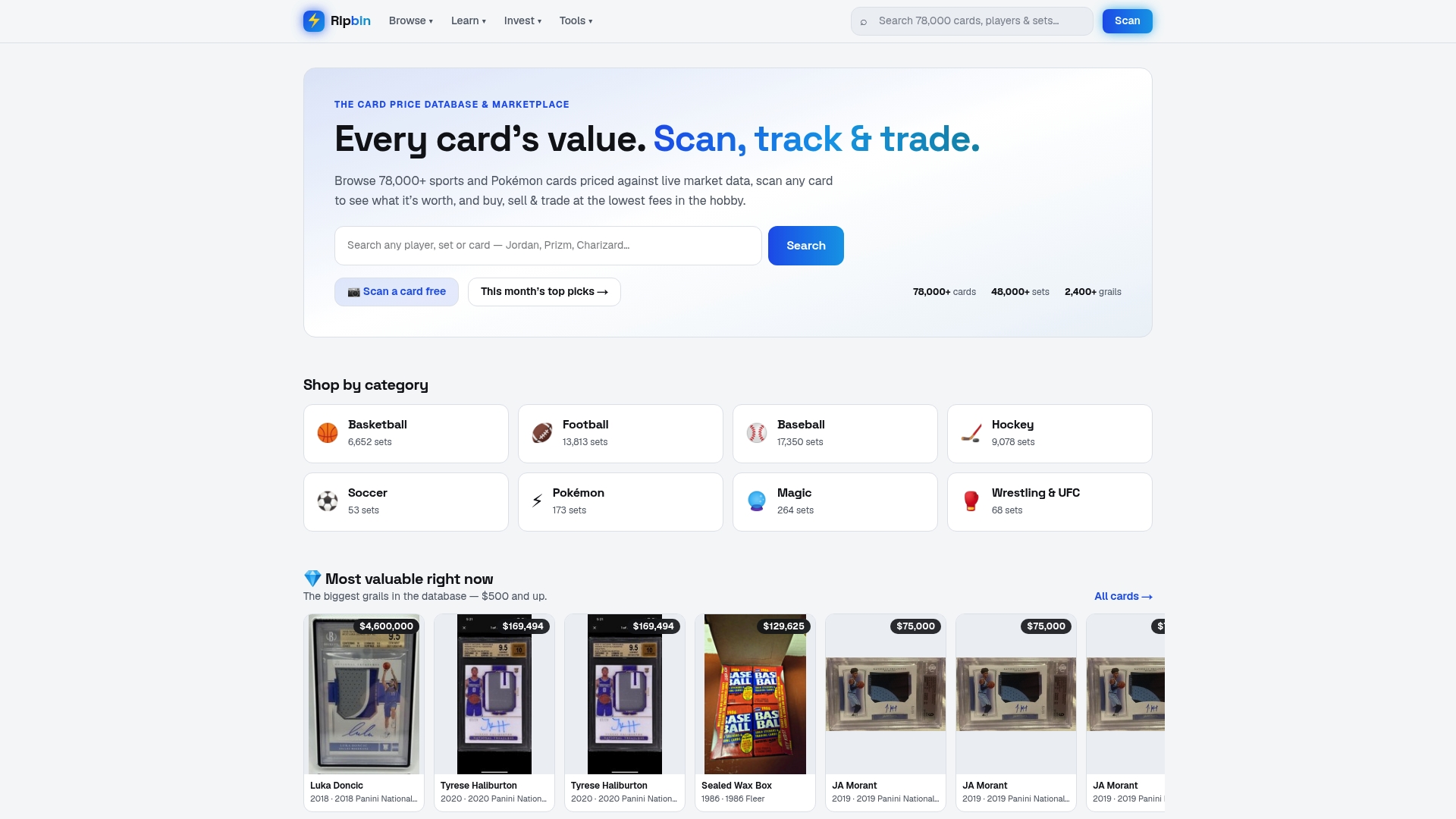
Scan a card on Ripbin for an instant value, or open the Ripbin home page to browse the database.
FAQ
What is the most accurate card price tool?
The most accurate tools base prices on completed sales, separate each grade, and show the date and number of recent sales. Asking prices and blended averages mislead. Ripbin shows real-time values sourced from actual sales, tracked grade by grade.
Do I have to pay to check card values?
Not on Ripbin. Scanning, browsing and the price database are free, and fees apply only when a sale or trade completes on the marketplace. Some other sites charge for advanced features, so check what a plan includes before subscribing.
What should a beginner do first?
Scan your cards to identify them and see their values, then save them to a locker. Focus on the few cards that carry most of the value, and read a guide to your category, such as the Pokémon investing guide, before buying more.
Are cards a safe investment?
No investment is guaranteed, and card prices can fall as well as rise. Use sales data, watch volume, diversify across players and sets, and only invest money you can leave untouched for years. For personal financial decisions, talk to a licensed financial adviser.
Sources
- eBay Fee Calculator for Trading Cards (2026)
- TCGplayer Fee Calculator
- Fake Pokémon Cards: How to Spot Them Before You Buy