Sports Card Marketplace Fees: What Sellers Really Pay
By Ripbin Research · Published 2026-11-13

Sports Card Marketplace Fees: What Sellers Really Pay
Most sports card marketplaces take between roughly 6% and 15% of a sale once every fee is counted, and the headline rate is rarely the whole story. Fees are often charged on the total amount the buyer pays, shipping and tax included, and extras like per-order charges, promoted listings, vaulting and cash-out fees stack on top. Price your card first, run the payout math second, and pick the channel that nets you the most for that specific card. We built Ripbin so you can do the first step with live values from real sales and then sell with minimal fees.
TL;DR
- eBay’s standard final value fee on sports trading cards is 13.25% of the total sale amount up to $7,500 per item, plus a per-order fee of $0.30 or $0.40.
- On a $100 card with $5 buyer-paid shipping, one 2026 comparison puts Whatnot’s fees at $11.35 and eBay’s at $14.31, a spread of about $3.
- Buyer-side costs exist too: Mercari adds a 3.6% Buyer Protection fee, and eBay Vault adds a 3% buyer’s premium.
- Estimate your payout before you list: payout minus card cost, shipping label, supplies and grading costs equals profit.
- Know what the card is worth first. Ripbin’s free scan shows live values sourced from actual sales.
Table of Contents
- The fees a seller can face
- How the percentage is actually calculated
- Platform by platform: current fee structures
- A worked example: the same $100 card, two channels
- How to estimate your net proceeds before listing
- Fees are not the only way to choose a platform
- Promo: price it right, then sell with minimal fees
- Perspective: why we think fees start with price
- Common fee mistakes to avoid
- FAQ
- Sources
The fees a seller can face
A sale rarely carries one fee. According to a seller fee breakdown from CardZen, sellers may pay eBay final value, per-order, insertion and promoted-listing fees, Mercari selling fees, and COMC upfront processing, transaction and cash-out fees. Buyers can pay too: the same source notes Mercari’s 3.6% Buyer Protection fee.
Think of fees in five buckets:
- Selling or final value fee. A percentage of the sale, the biggest line item.
- Per-order or payment fee. A flat amount per transaction, such as eBay’s $0.30 or $0.40.
- Listing and promotion fees. Insertion fees, reserve charges and promoted-listing ad rates.
- Service fees. Consignment processing, vaulting, withdrawal and cash-out charges.
- Buyer-side fees. Buyer protection fees and premiums that change what buyers will pay for your card.
The last bucket matters more than sellers expect. If a buyer sees a premium added at checkout, the price they are willing to bid shifts, even though the fee never touches your payout.
How the percentage is actually calculated
The first thing to check is what the percentage applies to. Fees may be calculated on the item price alone or on the total sale amount, which includes shipping and sales tax. CardZen works through an example: a $100 eBay sale with free shipping and 8% tax pays out $85.29. The seller never saw the $8 of tax, but the fee was still taken from it.

That is why a 13.25% rate can feel higher than 13.25% in practice. A seller who thinks in terms of the $100 card price is surprised when the fee on the larger total comes out bigger.
Platform by platform: current fee structures
Here is how the common U.S. channels compare, using the figures from the research. Rates change, so confirm them on each platform’s own fee page before listing.
| Platform | Seller fee | Other charges worth knowing |
|---|---|---|
| eBay (no Store or Starter Store) | 13.25% of total sale amount up to $7,500 per item, then 2.35% above | $0.30 per order at $10 or less, $0.40 above $10 |
| Mercari | 10% of the item price | Buyer pays shipping and a 3.6% Buyer Protection fee |
| COMC | 5% transaction fee | Upfront processing and a 10% cash-out fee |
| Fanatics Collect (Buy Now) | 6% or 12% | Vault admin and withdrawal fees can apply |
| Whatnot | 8% plus payment processing of 2.9% and $0.30 | Per a May 2026 comparison |
Sources for the table: CardZen’s fee cheat sheet for eBay, Mercari, COMC and Fanatics Collect, and The Card Shop Finder’s channel comparison for Whatnot.
eBay
EBay gives you the largest buyer pool, and its fee is the most straightforward to model. Sellers without a Store or with a Starter Store pay 13.25% of the total sale amount on Sports Trading Cards up to $7,500 per item, then 2.35% above that, plus the per-order fee, according to CardZen.
The add-ons are where margins quietly shrink. Promoted listings can add an ad rate anywhere from 2% to 100% of the total sale amount, per the same source, and insertion fees apply once you pass the free monthly allotment. Reserve charges on auctions are paid whether or not the card sells.
Mercari
Mercari charges sellers 10% of the item price, with the buyer paying shipping. Because the percentage is on the item price rather than the total, the seller’s math is cleaner. The catch is on the buyer’s side: that 3.6% Buyer Protection fee makes your card a little more expensive at checkout than the sticker suggests.
COMC
COMC is consignment, so its cost structure looks different. You pay upfront processing, a 5% transaction fee when a card sells, and a 10% cash-out fee if you withdraw money rather than keep it as store credit, per CardZen. It suits bulk sellers who want someone else to handle storage and shipping, but compare the all-in cost, not the 5% figure alone.
Fanatics Collect and vaults
Fanatics Collect’s Buy Now fee is 6% or 12%. Its vault adds a one-time $3 admin fee on items under $50 that have not sold within 30 days and a 1% withdrawal fee of asset value to ship a card out. Storage is free for items bought on the platform, according to CardGrading.app’s vaulting guide.
EBay Vault, operated by PSA since 2024, charges 0.37% per year of list price on cards listed above $50 and a 3% buyer’s premium added at sale since January 2024, per the same guide. The guide also notes that Delaware-based vaults avoid sales tax on intake, and that vaulting generally makes sense for graded cards worth $100 or more, rarely for raw cards or anything under $50.

Whatnot
Whatnot’s live-selling format changes the fee math. In the May 2026 comparison from The Card Shop Finder, Whatnot’s total on a $100 card with $5 shipping comes to $11.35, made up of 8% of $100, 2.9% of $105 and $0.30.
A worked example: the same $100 card, two channels
Take a $100 card with $5 of buyer-paid shipping, using the numbers from The Card Shop Finder:
- Whatnot: 8% of $100 is $8.00, plus 2.9% of $105 is $3.05, plus $0.30. Total fees: $11.35. The seller keeps about $88.65.
- eBay: 13.25% of $105 is $13.91, plus the $0.40 per-order fee. Total fees: $14.31. The seller keeps about $85.70.
The gap is about $3. The same source draws a sensible conclusion: pick the channel by the card and the buyer, and let the fee settle ties. A fee that is $3 lower is no help if the card sits unsold for a month, or sells for $15 less in a thin market.
That is also why the price you list at matters more than the percentage you pay. On a $100 card, a $10 pricing mistake costs more than the whole difference between two platforms’ fees.
How to estimate your net proceeds before listing
Use a simple formula from CardZen: profit equals payout minus card cost, shipping label, supplies and grading costs. Their example: a $100 eBay sale with free shipping and 8% tax pays out $85.29. Subtract a $60 card cost, a $5 label and $0.50 of supplies, and profit is $19.79.
Run the same steps every time:
- Find the realistic sale price. Use recent completed sales for the same player, set, parallel and grade, not asking prices. Grade matters enormously, so match it exactly.
- Decide who pays shipping. Free shipping raises the base the fee is calculated on, since fees can include shipping.
- Add the fees. Final value fee, per-order fee, any promoted-listing rate, and any consignment or cash-out charge.
- Subtract your costs. Card cost, label, supplies, grading.
- Compare channels on net, speed and fit. A grail card may do better in an auction house with a wealthier buyer pool and competitive bidding, according to The Card Shop Finder. A $20 base card may not justify more than a simple fixed-price listing.
Step one is where most of the money is won or lost, and it is where we focus. Ripbin’s database covers more than 78,000 cards with live values sourced from actual sales and tracks values grade by grade, so you can see what your exact card sold for before you commit to a price. You can scan a card for an instant value or browse sets, checklists and values.
Fees are not the only way to choose a platform
Lowest fee does not mean best result. Weigh these alongside the percentage:
- Audience reach. More buyers means more competing bids, especially on high-demand cards.
- Speed to cash. Consignment and vaulting can delay payment or add withdrawal costs.
- Fit for the card. Graded high-value cards, bulk commons and live-break inventory each suit different channels.
- Tools. Price lookups, collection tracking and listing speed save real time.
The same logic applies in other marketplaces. The way ticket buyers weigh fees, reach and reliability in comparing primary and secondary marketplaces carries over neatly to card selling: the headline fee is one input, not the decision.
For a closer look at the main channel types, see our breakdown of four marketplace types for sports card sellers and our guide on where to sell sports cards.
Promo: price it right, then sell with minimal fees
Ripbin is a card price database and marketplace for sports and Pokémon cards. Browsing and scanning are free, with no browsing fees, and our fees apply only when a sale or trade completes. Live values come from real sales, so you can set your price from evidence before you list.
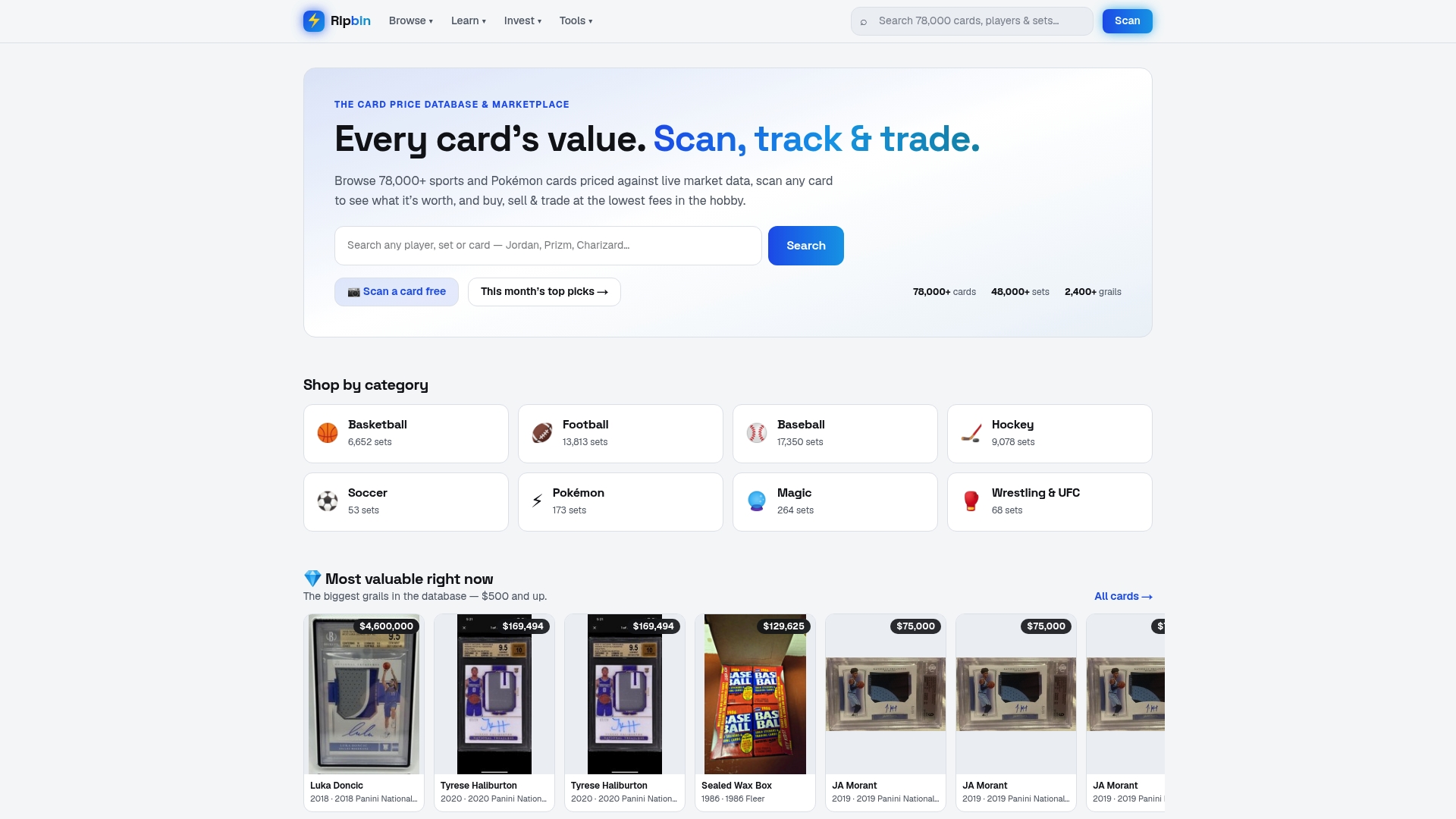
Start at Ripbin: scan the card, check its value by grade, save it to your locker, and list it when the number looks right. If you want the full process, our guide on how to sell sports cards walks through it step by step.
Perspective: why we think fees start with price
Collectors talk about fees as if they were the main cost of selling. In our experience building Ripbin, the bigger lever is the price you set, and the fee is the part you can plan for.
That is why we start with data. Our values come from actual sales, not asking prices, and we track them grade by grade, because a card’s grade can change its value more than any platform choice. We also do not charge for browsing or scanning. Looking up a card should never cost you anything.
When you do sell, we charge a transaction fee only on a completed sale or trade, and we aim to keep it minimal. A collector who knows a card’s real value, keeps a tidy locker and pays a low fee on a successful sale keeps more of every card’s worth.
Saad
Common fee mistakes to avoid
- Forgetting that tax and shipping can be in the fee base. Model the payout on the total, as in the $85.29 example above.
- Leaving promoted listings on by default. An ad rate from 2% up can erase the margin on a lower-priced card.
- Ignoring cash-out fees. A consignment balance is not the same as cash in hand.
- Vaulting cheap cards. Per CardGrading.app, vaulting rarely makes sense under $50.
- Pricing off asking prices. Completed sales tell you what buyers actually paid.
If you are also deciding what to buy, our guide to investing in sports cards and the monthly best sports cards to buy picks use the same sales data.
FAQ
What are typical sports card marketplace fees?
Expect total fees between about 6% and 15% of the sale once everything is counted, according to a 2026 roundup of card-selling sites. Payment processing alone is usually around 2.9% plus $0.30. Your exact total depends on the platform, shipping and add-ons.
Does eBay charge fees on shipping and sales tax?
Yes. EBay’s final value fee is calculated on the total sale amount, which includes shipping and sales tax, per CardZen. A $100 sale with free shipping and 8% tax pays out $85.29.
Do buyers pay fees too?
Often. Mercari adds a 3.6% Buyer Protection fee, and eBay Vault adds a 3% buyer’s premium at sale, per CardGrading.app. These do not reduce your payout directly but can affect what buyers will pay.
How do I know my net payout before listing?
Subtract the platform’s fees, your shipping label, supplies and any grading costs from the sale price. Start with a realistic sale price from recent sales of your exact card and grade. Ripbin’s live card values are sourced from actual sales for that purpose.
Sources
- Sports Card Seller Fees: eBay vs Mercari vs Consignment (CardZen)
- Where to Sell Sports Cards 2026: Every Channel Compared (The Card Shop Finder)
- Card Vaulting 2026: Cost, Best Services, and When It’s Worth It (CardGrading.app)
- 5 best sites to sell sports cards: Tested & reviewed 2026