Rookie Card Definition: What Counts as an RC and What Doesn't
By Ripbin Research · Published 2026-11-12

Rookie Card Definition: What Counts as an RC and What Doesn’t
A rookie card is a player’s first card in a regular, fully licensed, nationally distributed set. It is usually a base card, not an insert, parallel or redemption. Since 2006 the card typically carries an “RC” logo to mark it. That is the short answer. The longer one is that the hobby has never had one official rulebook, so collectors, grading companies and manufacturers each draw the line a little differently. This guide covers where those lines sit, how to read a card in your hands, and how rookie status affects value.
TL;DR
- A rookie card (RC) is generally a player’s first base card in a fully licensed, nationally distributed, pack-issued set. Inserts, parallels and redemptions do not count under the widely used Beckett definition.
- On modern cards, look for the RC logo. On older cards, you need a checklist and some research, because manufacturers did not label rookies consistently.
- XRC (“Extended Rookie Card”) marks a first card in a traded, update or other supplemental set. 1st Bowman cards are prospect cards that predate the flagship RC.
- Rookie status matters for price, but condition often matters more. Grade and card year both move value.
- Ripbin tracks live values from real sales, so you can see what your rookie cards are worth, grade by grade.
Table of Contents
- What is a rookie card?
- Rookie cards vs. rookies in the league
- How to tell if a card is a rookie card
- What does XRC mean?
- True RC vs. Official RC
- The 1st Bowman debate
- Do rookie cards hold more value?
- Rookie-themed cards that are not rookie cards
- A quick checklist before you buy or sell
- Perspective
- Find out what your rookie cards are worth
- FAQ
- Sources
What is a rookie card?
The most common working definition comes from Beckett. Under what is known as the Beckett definition, a rookie card must come from a fully licensed, nationally distributed set that focuses mainly on current major league players. It must be a base card, not an insert, parallel or redemption, and a player can have only one RC per set. BaseballCardPedia summarizes these criteria in plain terms.
GRADEx’s Rookie Card Rule Book, published in 2026, boils the same idea down to three criteria the hobby broadly recognizes:
- The card comes from a fully licensed set.
- It belongs to the base set, not an insert, short print or special edition.
- It comes from a nationally distributed, packed product.
That same guide notes that Beckett’s framework also requires licensing from both the league and the players’ association. It also says cards serial-numbered to fewer than 99 copies do not qualify as an official rookie card.
There is a wrinkle worth knowing early. PSA’s glossary uses a broader definition: a rookie card is a player’s first year of cards, whether or not it is his rookie season. PSA adds that a player may have one rookie card or dozens, depending on how highly touted he was as a youngster and in which year the card was issued. Wikipedia goes further and says there is no formal definition of a rookie card, although some players have cards that nearly everyone treats as the rookie.
So the honest definition has two layers. There is the strict version most price guides and checklists use, and there is the looser version collectors use when they argue about a player’s “true” rookie.
Rookie cards vs. rookies in the league
The card world and the league do not use the word “rookie” in exactly the same way.
In Major League Baseball, a player stays a rookie unless, in a previous season or seasons, he exceeded 130 at-bats or 50 innings pitched, or spent 45 days on an active roster during the championship season, not counting time on the Injured List. That rule decides who wins Rookie of the Year. It does not decide which card gets the logo.
For cards, the trigger is different. According to Topps, a player must appear in an official game of at least five innings to get an RC. So a player can be a “rookie” by league rules and still not have a flagship RC yet, or the reverse.
This is why two collectors can look at the same player and name different cards as his rookie. Each is applying a different test.
How to tell if a card is a rookie card
Work through these checks in order.
1. Look for the RC logo
For modern cards, this is the fastest test. Sports Illustrated’s example: Paul Skenes’ 2024 card carries the rookie badge, while his 2023 Bowman card does not. The same piece notes that older cards often have no rookie marking at all, so they require historical research.
The logo has a history. Wikipedia notes that in 2006 Major League Baseball instituted guidelines about which cards may bear the official rookie logo. It also notes that many collectors still regard a player’s first officially licensed prospect card as the “true” rookie.
2. Check that it is a base card
A rookie autograph, a refractor or a numbered parallel is a version of a rookie-year card, but under the strict definition the base card is the one that holds the RC status. Flip the card and check the set name and card number against a checklist. Browsing a set’s checklist on Ripbin’s card database is one way to see which cards belong to the base set and which are variants.
3. Confirm the year
A card from the season after the player’s debut is a second-year card, not the rookie. Reprints are another trap: a card in a “Archives” or retro product can look like a vintage rookie but is a modern reprint. Check the copyright year printed on the back and the set name on the front.
4. For older cards, use a checklist
Before the 2006 logo rules, you identify a rookie by the player’s first appearance on a widely distributed, licensed base card. Then check whether a traded or update set complicates the picture. That brings us to XRCs.
What does XRC mean?
XRC stands for “Extended Rookie Card.” According to the GRADEx rule book, it is a player’s first card from a manufacturer in a supplemental set, not the main flagship series issued in packs. Supplemental sets include traded sets, update sets, team sets and special boxed rookie sets. Beckett distinguishes XRCs from official rookie cards, which must come from widely distributed packed base sets.
The same source says the XRC designation ended after 1993, when manufacturers began folding traded and update content into their main sets. It gives these examples:
| Player | Card | Why it is an XRC |
|---|---|---|
| Barry Bonds | 1986 Topps Traded | Supplemental traded set |
| Roger Clemens | 1984 Fleer Update | Supplemental update set |
| Michael Jordan | 1984-85 Star #101 | Not from a flagship base set |
In practice, an XRC and an RC can both be called “the rookie card” for the same player, and the market often prices them as separate cards. Jordan is the famous example: his 1986-87 Fleer is the card most guides call his rookie, while the earlier Star card is a different, older piece of his history. If you are weighing those, our ranking of Jordan rookie cards by scarcity and live sales lays out the options.
True RC vs. Official RC
GRADEx’s rule book draws one more distinction that helps when you read hobby discussion:
| Term | Core idea | Key conditions |
|---|---|---|
| True RC | A player’s earliest professional card | Issued during or after the debut season, fully licensed, can come from a regional set or insert, not minor league, college or junior, print run of 99 or more |
| Official RC | The card that meets the strict set rules | Issued during or after the debut season, fully licensed, national distribution, packed product, part of a base set, not a food issue or regional set |
If you have ever heard someone say “that’s his true rookie,” they are usually using the first definition. If a price guide labels something “RC,” it is typically using the second. Both usages are described in the GRADEx rule book.
The 1st Bowman debate
Bowman complicates things. A 1st Bowman card is the first time a player appears on a card as a professional prospect, usually before his debut and before the flagship RC. It is marked “1st Bowman.” Topps’ own staff call the question of which is the real rookie “a truly sensitive subject within the hobby”. Some collectors say 1st Bowmans are the true rookies. Others insist a card is not a rookie until it has the RC logo. What counts as the true rookie depends on the collector.
A practical way to handle it: treat the logo card as the official rookie, treat the 1st Bowman as the prospect card, and check the market for each. For a player like Shohei Ohtani, where several cards compete for the title, our guide to which Ohtani rookie cards to buy, hold or skip walks through the differences. The same goes for Mike Trout, covered in our Trout rookie card guide.

Do rookie cards hold more value?
Often, yes, but the picture has layers.
The SABR Baseball Cards Research Committee notes that, as a trend, older cards are worth more and rookie cards are worth the most, with a significant drop from a player’s first card year to his second-year card. The same post says condition can create a differential of 500 times or more for the exact same card.
That last point deserves attention. A peer-reviewed study in the Atlantic Economic Journal (December 2025) looked at NBA rookie cards. It found that, all else equal, a PSA 10 trades roughly 339% above a PSA 8 baseline. It also found that the marginal value of the top grade exceeds the premium buyers pay for rookie status, extra All-Star seasons or championships.
What that means for you:
- Rookie status helps, but it is not a guarantee. A common rookie in poor condition can sell for far less than a clean second-year card of a star.
- Grade changes the math. The same rookie card can have very different values at PSA 8, 9 and 10.
- The player drives demand. A rookie of a Hall of Fame talent and a rookie of a role player are very different assets.
For current numbers, our most valuable rookie cards page ranks cards using live market data. If you want to compare specific sets, the value guides for products like 2019 Topps Chrome Rookie Autographs and 2018 Topps Heritage Rookie Performers show how rookie-themed cards price within one set.
Rookie-themed cards that are not rookie cards
The word “rookie” appears on a lot of cards that do not meet the definition. Some examples to watch for:
- Rookie autograph inserts. Products such as 2020 Topps Definitive Collection Definitive Rookie Autographs feature rookies, but they are autograph cards in a premium product, not base cards.
- Tribute and retro sets. A set built around past rookies can reprint a classic design. 2018 Topps Archives Topps Rookie History is an example of the type. It is a modern product that celebrates rookie cards, and it is a different thing from an original.
- Logo on inserts. In 2006, Topps and Upper Deck began putting the logo on rookie-year cards, including inserts, autographs and relics, and collectors still debate the status of some of those cards.
The lesson: a logo is a strong signal, not a verdict. Combine it with the base-card test and the set’s checklist.
A quick checklist before you buy or sell
- Find the player’s debut year and the card’s year. They should match for a classic rookie.
- Confirm the card is from a base set on the checklist, not an insert or parallel.
- Look for the RC logo on modern cards, or an “XRC” or “1st Bowman” label where relevant.
- Check the back for the copyright year to rule out reprints.
- Look up recent sales for the exact card, in the exact grade.
That last step is where most mistakes happen. Asking prices and last year’s guide numbers drift from what cards actually sell for.
Perspective
Most definitions of a rookie card are really arguments about trust. Collectors want to know that the card in front of them is the one everyone agrees on, and that the price reflects it.
We built Ripbin around that idea. Our live values come from actual sales, not asking prices, and we track value grade by grade, because a rookie card is only worth what a specific copy in a specific condition sells for. When a debate like RC versus 1st Bowman versus XRC comes up, the market’s answer is usually visible in the sales, and we think collectors should be able to see it without paying to browse.
Our approach is designed to help a beginner scan a card and get an immediate sense of its worth, and to help a seasoned collector keep every rookie in an organized locker. Learn the definition, then let real sales data tell you what it is worth.
Saad
Find out what your rookie cards are worth
Once you know a card is a rookie, the next question is value. Ripbin is a card price database covering more than 78,000 cards, with live market data drawn from real sales. You can scan a card for an instant value, keep your cards in a personal locker, and browse without browsing fees.
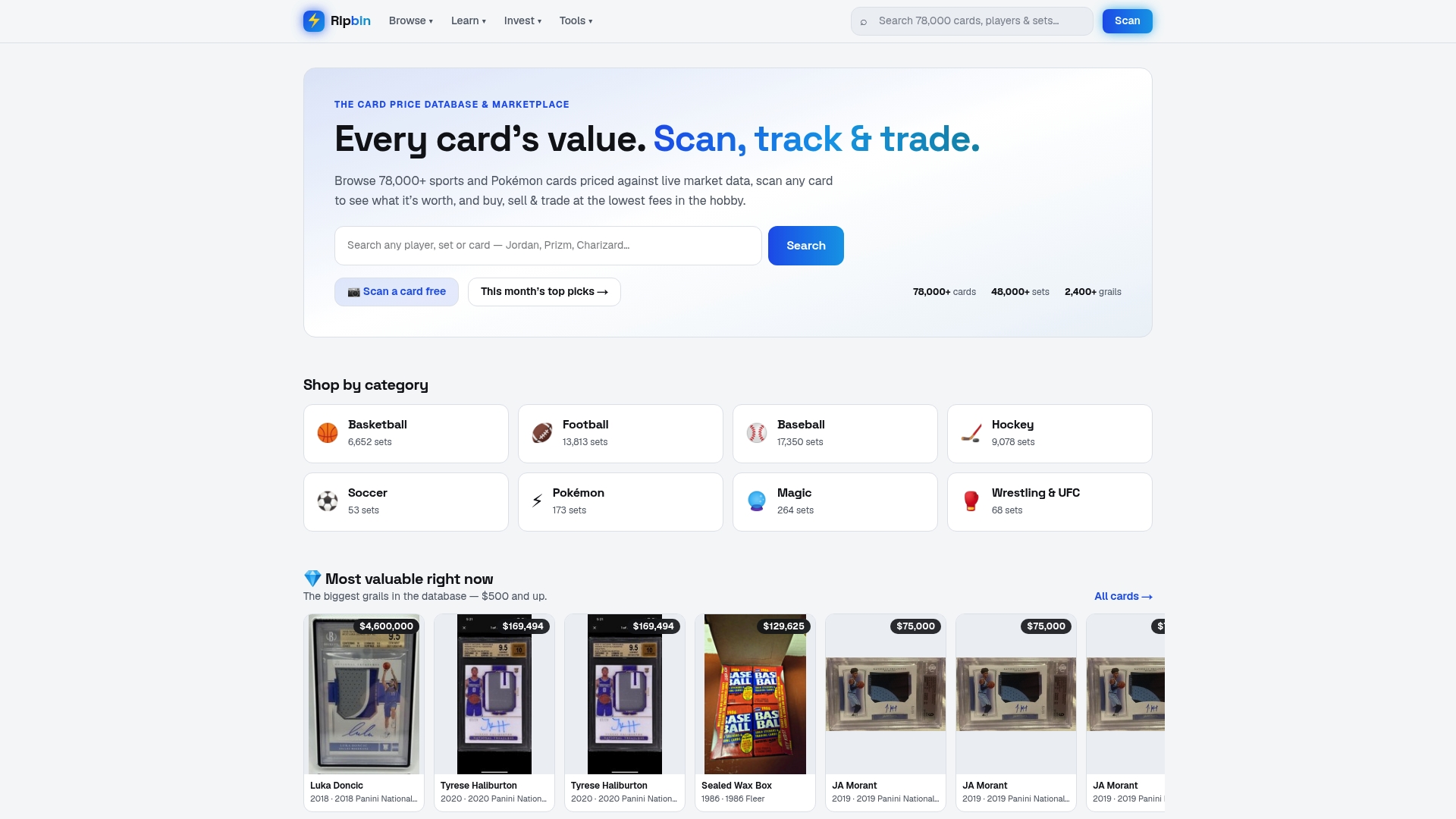
If you are building a position rather than a binder, our guide to investing in sports cards explains how rookie status, grade and player demand fit together. You can also see what is moving right now on the biggest card price movers page, or start from the Ripbin homepage.
FAQ
How do I know if a card is a rookie card?
On modern cards, look for the RC logo, then confirm the card is a base card from a licensed set on the checklist. On older cards there is often no marking, so you identify the player’s first widely distributed licensed base card. Check the copyright year to avoid reprints and second-year cards.
What is the definition of a rookie in Major League Baseball?
MLB treats a player as a rookie unless he has exceeded 130 at-bats or 50 innings pitched, or spent 45 days on an active roster, in a prior season. Time on the Injured List does not count toward the 45 days. This is MLB’s official rookie eligibility rule, and it is separate from card logo rules.
What does XRC mean in sports cards?
XRC stands for Extended Rookie Card. It marks a player’s first card in a supplemental set, such as a traded or update set, rather than the main base set sold in packs. The label was phased out in the early 1990s. Examples include the 1984 Fleer Update Roger Clemens and the 1986 Topps Traded Barry Bonds.
Are rookie cards worth anything?
Often they are worth more than a player’s later cards, since rookie cards tend to carry the highest values, with a drop in the second-year card. Condition matters a great deal, though. Research on NBA cards found that a top grade can add more value than rookie status alone. Check recent sales for the exact grade you own.
Sources
- Rookie Card, BaseballCardPedia
- Lingo, PSA
- The Rookie Card Rule Book, GRADEx
- Rookie card, Wikipedia
- Rookie Eligibility, MLB.com Glossary
- MLB Rookie Card Crash Course, Part One, Topps
- The Rookie Card of All Rookie Cards Is…What?!, Sports Illustrated
- What’s my Mickey Mantle worth?, SABR Baseball Cards Research Committee
- Third-Party Grading as a Useful Measure of Demand, Atlantic Economic Journal
- 2021 Bowman’s Best Adds Fire to the Rookie Card Debate, Card Chat