Why $5.11M Misleads Collectors on Wembanyama Rookie Card Values
By Ripbin Research · Published 2026-09-11
Why $5.11M Misleads Collectors on Wembanyama Rookie Card Values
A Victor Wembanyama rookie card can be worth anywhere from $15 to over $5 million, and where yours lands depends almost entirely on which parallel and grade you’re holding. The apex is real: a 2023-24 Panini Prizm Black 1/1 graded PSA 10 sold privately for $5.11 million. But that number sits on top of a market where base cards, Silver parallels, and mid-tier inserts trade for a fraction of that, largely because Wembanyama has no licensed on-card autograph rookie to anchor the middle of the market.
TL;DR:
- The record-breaking $5.11 million sale of a Wembanyama Prizm Black 1/1 PSA 10 highlights the market’s scarcity-driven top tier, with most other parallels trading for much lower prices.
- The market sharply compresses after the top 1/1 cards, with base PSA 10s typically valued in the thousands and common rookies selling in the hundreds or less.
- Authentic valuation requires verifying exact parallel, grade, and population counts, as prices vary significantly between low- and high-population cards and serial-numbered parallels.
- The absence of an autographed rookie card from Wembanyama pushes demand toward non-autographed parallels and 1/1s, creating a unique trophy market in those assets.
- Short-term price movements are mainly influenced by playoff performance, injury news, and media coverage, making tracking real-time sales and population data crucial.
Table of Contents
- What Are Wembanyama Rookie Card Values Right Now?
- Which Wembanyama Rookie Cards Should Collectors Know?
- What Actually Moves a Wembanyama Card’s Price?
- How Should You Buy at Different Budgets?
- How Do You Track Wembanyama Card Values in Real Time?
- Passion Collecting vs. Investment Discipline
- Track and Trade Wembanyama Cards Without the Guesswork
- Sources
- FAQ
What Are Wembanyama Rookie Card Values Right Now?
The headline number is the $5.11 million private sale of a Panini Prizm Black 1/1 PSA 10 through Fanatics Collect, a deal that instantly became the record for a non-autographed modern basketball card. Before that sale, the previous benchmark was a Prizm Nebula Choice 1/1 that brought $860,100 at Goldin in February 2025. Those two sales bookend a market that behaves very differently once you move away from one-of-one parallels.
Below the 1/1 tier, prices compress fast:
- Base 2023-24 Prizm PSA 10: typically trades for several thousand dollars, with swings tied to Wembanyama’s on-court performance
- Silver Prizm PSA 10: usually commands a higher price than base versions, often at a marked premium depending on population
- Mosaic and Donruss Optic base PSA 10: generally trades in the hundreds to low thousands range
- Common Hoops and Donruss base rookies: often sell for tens to low hundreds, even in gem mint grades
Statistic Callout: The gap between the $5.11 million apex sale and typical base Prizm pricing isn’t a glitch. It reflects how thin the true trophy tier is compared to the much larger population of graded commons.
Short-term price swings usually trace back to three things: playoff performance, injury news, and media coverage cycles. A strong postseason run tends to lift the whole card, while a slow stretch or an injury scare can cool bidding on mid-tier parallels within days.
Which Wembanyama Rookie Cards Should Collectors Know?
Not every rookie card carries the same weight, and knowing the difference between a “trophy” and a “liquid staple” saves you from overpaying.
- 2023-24 Panini Prizm #136 (base and Silver) — the flagship rookie image and the card most collectors mean when they say “the Wemby rookie.” Silver Prizm PSA 10 trades a notch above base, and both are liquid enough to sell quickly.
- Prizm parallels (Pink Ice, Nebula, Black 1/1) — this is where trophy money lives. The Nebula Choice 1/1 and the record-setting Prizm Black 1/1 sit at the top of the entire market.
- Donruss Rated Rookie / Donruss Optic — an affordable, high-volume entry point with strong long-term liquidity thanks to huge population counts.
- Panini Mosaic — a mid-tier design with respectable demand, priced below Prizm but above base Donruss in most grades.
- Panini Select (Concourse, Premier, Courtside, Mezzanine) — tiered by print run, with Concourse as the accessible base and Courtside/Mezzanine parallels commanding real premiums as scarcity increases.
- Panini Hoops — the entry-level staple, cheap and plentiful, useful for building a collection without much capital.
- National Treasures Logoman 1/1 — an ultra-rare patch card that, alongside the Prizm Black 1/1, represents the true “grail” tier of the Wembanyama market.
The checklist above documents the primary variant structure collectors track. Everything outside the 1/1 lane functions as a liquid commodity; everything inside it functions as a trophy asset.
What Actually Moves a Wembanyama Card’s Price?
Grading is the single biggest lever most collectors underestimate. A PSA 10 can command a large premium over a PSA 9 of the same card, but PSA 9s sometimes trade below raw copies when the population report shows an unusually high gem rate, since buyers assume a 9 means the card missed 10 by a hair on a card type that grades easily.
Population counts matter just as much as the grade itself. High-population Prizm base cards are easy to buy and sell but rarely spike hard, while low-population parallels and 1/1s carry real scarcity-driven upside precisely because there’s almost nothing to compare them against.
The serial number on a parallel changes everything:
- A /199 parallel behaves like a slightly scarcer version of the base card
- A /25 or /10 starts to command real trophy pricing
- A true 1/1, like the Prizm Black, exists in a market of one
The reason so much demand funnels into 1/1s traces back to licensing. Panini held the NBA license during Wembanyama’s rookie season, but his autograph rights sat with Fanatics, leaving the market with no licensed on-card autographed rookie card. Every other modern superstar has an autographed rookie anchoring the upper middle of the market. Wembanyama doesn’t, so collector demand for a true grail rerouted entirely into non-autographed parallels and 1/1s.
Pro Tip: Never compare a private-sale price directly to an auction result without checking the grading company and exact parallel name. A $5.11 million private sale and a Goldin auction hammer price aren’t measuring the same kind of transaction, and treating them as interchangeable comps will lead you to badly mispriced offers.
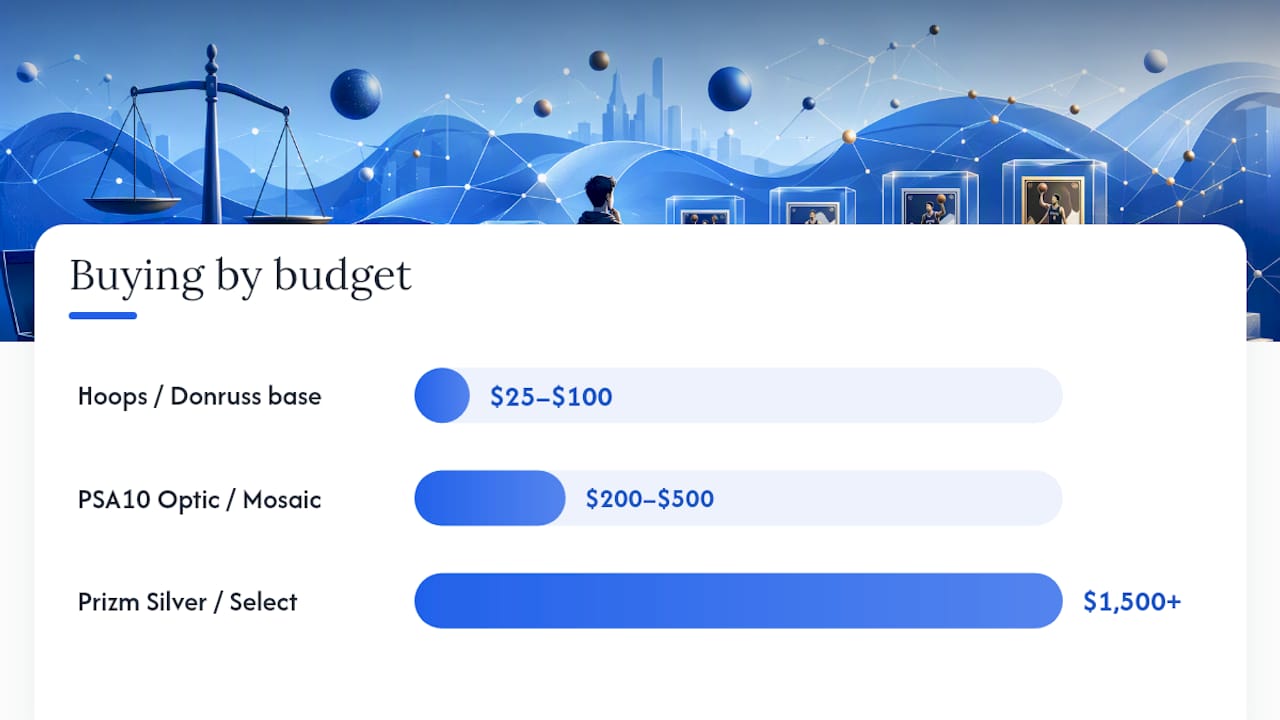
How Should You Buy at Different Budgets?
Matching your budget to the right tier keeps you from either overpaying for hype or missing real value at the low end.
- $25 to $100: Hoops or Donruss base rookies, raw or lower-grade. Good for building a collection without betting on appreciation.
- $200 to $500: Graded PSA 10 Optic or Mosaic. Enough scarcity to hold value, still liquid enough to resell without a long wait.
- $1,500 and up: Prizm Silver PSA 10, numbered Select parallels, or other serial-numbered cards below the 1/1 tier. This is where genuine speculative upside starts.
Grading only makes sense once a raw card’s estimated PSA 10 value clears the grading fee, shipping, and turnaround time by a comfortable margin, otherwise you’re paying to find out you own a $40 card. Watch for sellers who quote you a price based on the $5.11 million headline sale for a card that isn’t remotely the same parallel. That’s the most common red flag in this market right now.
Pro Tip: Ask any seller for the exact PSA cert number before paying a premium. A quick population lookup takes thirty seconds and tells you immediately whether the “rare” parallel you’re being pitched is actually scarce.
How Do You Track Wembanyama Card Values in Real Time?
Start by nailing down the exact variant: set, card number, parallel name, and print run. A “Prizm Silver” and a plain “Prizm base” are not interchangeable, even though listings often blur the two.
From there:
- Pull recent sale comps for that exact grade and parallel, not the whole product line
- Check the PSA population report to see how many copies exist at your grade
- Set a price alert or add the card to a watchlist so you catch movement without checking manually
- Track 30 and 90 day median sales to separate a real trend from a single outlier sale
Statistic Callout: Ripbin tracks live market values across more than 78,000 cards, sourced from actual sales rather than asking prices, which matters enormously for a market this driven by outlier headline sales. The platform’s scanning tool and free collection locker let you monitor your own Wembanyama cards alongside population and sales-velocity data without paying browsing fees.
Passion Collecting vs. Investment Discipline
The record sale is real, but it’s one data point in a market built mostly on liquid, mid-priced commons. Treat the $5.11 million figure as proof of scarcity at the very top, not as a preview of where your Prizm base copy is headed. That’s the trap: getting anchored to a headline number that applies to a print run of exactly one card.
Buy for enjoyment if you love the player, and buy for speculation only in cards with real scarcity behind them, graded and verified. The two goals call for different cards, different budgets, and very different exit expectations.
— Saad
Track and Trade Wembanyama Cards Without the Guesswork
Some price guides offer values pulled from actual completed sales, updated across many cards, instead of stale asking prices copied from old listings.

Scan any Wembanyama rookie in your collection to get an instant value read, then drop it into your free Ripbin locker to watch how price, population, and sales velocity shift week to week. If you’re deciding whether a Prizm Silver or a Select Concourse parallel fits your budget, browse live card values before you commit to a purchase. Ready to think longer term about how rookie cards fit into a broader collection? Ripbin’s guide to investing in sports cards walks through how to weigh liquidity against upside, without the transaction fees eating into every trade.
Sources
- Victor Wembanyama rookie card sells for record $5.11 million - The New York Times (The Athletic)
- Victor Wembanyama joins $5 million club after record-breaking card sale - Sports Illustrated
- Victor Wembanyama rookie card market hasn’t matched his hype - Front Office Sports
FAQ
Are Victor Wembanyama Rookie Cards Valuable?
Yes, at the top tier. A Prizm Black 1/1 PSA 10 sold for $5.11 million, but common base rookies trade for a small fraction of that, often in the tens to low thousands depending on grade.
What Are the Top Wembanyama Rookie Cards to Collect?
The most watched cards are the Prizm #136 base and Silver, Prizm Nebula and Black 1/1 parallels, Donruss Optic, Mosaic, Select Concourse, Hoops, and the National Treasures Logoman.
Will Victor Wembanyama Cards Go Up in Value?
Trophy-tier 1/1s have already shown strong appreciation, but common cards move more with short-term performance and playoff visibility than with long-term scarcity, so expect volatility rather than a steady climb. Tracking live sales through a tool like Ripbin helps separate real trends from single outlier sales.
What Is the Rarest Wemby Card?
The 2023-24 Panini Prizm Black 1/1, the same card that sold for $5.11 million, is the rarest and most valuable card in the market, alongside the National Treasures Logoman 1/1.