Shipping Trading Cards for Sellers: Pack Right, Use Ripbin Values
By Ripbin Research · Published 2026-08-31

Shipping Trading Cards for Sellers: Pack Right, Use Ripbin Values
The safest, cheapest way to ship trading cards uses one packing stack every time: penny sleeve, then toploader or card saver, then a team bag, then a cardboard sandwich, then a bubble mailer or small box. For services, a plain envelope works only for low-value bulk singles; Ground Advantage or First-Class with tracking covers most cards; Priority or UPS/FedEx with signature and insurance covers slabs and high-dollar singles. Track anything over $20 and insure anything that would actually hurt to lose.
TL;DR:
- Use proper layers such as penny sleeves, toploaders or card savers, team bags, and cardboard sandwiches for every trading card shipment to prevent damage.
- Ship high-value cards over $20 with tracking and insurance, especially when valued above $100, to avoid significant resale value loss from damage or loss.
- Scale packing methods appropriately: individually sleeve low quantities, stack multiple cards for small lots, and pack bulk lots into bricks with strict movement and weight controls.
- Always declare the current market value using real-time data to choose the correct carrier, service, and insurance level, minimizing under- or over-insuring.
- Properly package slabs with bubble wrap and double-boxing for high-value items and document proof of condition and shipment details to strengthen claims if needed.
Table of Contents
- Shipping Supplies for Trading Cards: What to Buy First
- How Do You Pack a Single Trading Card for Shipping?
- Packing Multiple Cards and Bulk Lots for Shipping
- Shipping Graded Slabs and Grading Submissions
- Which Carrier and Service Should You Use for Trading Cards?
- Insurance, Claims, and Documentation That Actually Hold Up
- Smart Ways to Cut Shipping Costs Without Cutting Corners
- How Ripbin Helps You Ship With the Right Insurance and Value
- International Shipping: Customs, Taxes, and Delivery Times
- Packaging for Extreme Weather and Long Transit Times
- Tracking Best Practices for Trading Card Shipments
- Shipping Binders, Boxes, and Other Card Accessories
- Handling Returns and Refunds on Card Shipments
- Building a Repeatable Packing Routine That Actually Sticks
- Set the Right Declared Value Before You Ship
- Sources
Shipping Supplies for Trading Cards: What to Buy First
Most damaged-card complaints trace back to a missing layer in the stack, not bad luck. Buy the full kit before your first sale and you will not have to think about it again.
Penny sleeves go on every card, no exceptions. They stop surface scuffs from the toploader plastic and cost pennies each, hence the name.
Toploaders come in thicknesses measured in points, and 35pt fits the vast majority of standard modern and vintage cards. Thicker cards, patch cards, or anything with a jersey swatch need 55pt, 75pt, or even 130pt toploaders to avoid a card floating loose inside an oversized holder. If you are sending a card off for grading, skip the rigid toploader and use a card saver instead, since PSA, BGS, and CGC all prefer the semi-rigid style for submissions.
Team bags matter more than sellers think. A resealable bag over the toploader blocks moisture and keeps the card from sliding out if the mailer gets crushed in transit.
Painter’s tape replaces Scotch tape for sealing the toploader opening. Standard adhesive tape leaves residue on toploader plastic and irritates buyers who resell the card later, while painter’s tape peels off clean.
Round out the kit with cardboard inserts cut slightly larger than the card, mailers in #000 or #00 sizes for one or two cards, 6x9 or 8.5x11 bubble mailers for small lots, small boxes for bulk, and rigid slab mailers with foam inserts for graded cards.
A low-volume seller moving a handful of cards a week should stock at least 50 penny sleeves, 25 toploaders in mixed thicknesses, 25 team bags, a roll of painter’s tape, and 20 bubble mailers. Sellers scaling past 50 shipments a month save real money buying sleeves and toploaders in bulk packs of 100 or more, since per-unit cost drops fast at volume.
Pro Tip: Keep two toploader thicknesses on hand at all times, 35pt for standard cards and 75pt for thick or patch cards. Running out mid-shipment and substituting the wrong size is how bent corners happen.
How Do You Pack a Single Trading Card for Shipping?
Packing one card correctly takes about ninety seconds once you have done it a few times. Follow the stack in order and do not skip a layer, even for a card you think is low risk.
- Slide the card into a penny sleeve, centered and snug.
- Insert the sleeved card into a toploader sized to fit without rattling.
- Run a strip of painter’s tape across the toploader opening to seal it.
- Place the sealed toploader into a resealable team bag.
- Sandwich the bagged card between two pieces of cardboard, taped shut on all sides.
- Load the cardboard sandwich into a bubble mailer or small padded envelope, then seal it with packing tape.
A plain white envelope, often called a PWE, is acceptable only for cards worth a low dollar amount where losing tracking is a real cost tradeoff, not just a habit. If you use one, keep the card as flat as possible against a piece of cardboard, mark the envelope for hand cancellation where your postal service allows it, and expect that PWEs carry real bending risk since they run through automated sorting equipment unless you request non-machinable handling.
For anything above that threshold, the math changes fast. Cards of moderate value do fine on Ground Advantage or First-Class with basic tracking, since the cost of insurance would outweigh the card’s value. Cards between $20 and $100 still work on those same services, but tracking becomes mandatory rather than optional. Cards over $100 typically move to Priority Mail or a comparable tracked service, which builds in a baseline of coverage automatically.
The real cost of skipping a layer: A single bent corner can drop a raw card’s resale value by 30 to 50 percent depending on the card’s condition tier, turning a $40 card into a $20 dispute. The extra thirty seconds it takes to add the cardboard sandwich is cheap insurance against exactly that outcome.
Packing Multiple Cards and Bulk Lots for Shipping
Shipping five cards is not the same job as shipping five hundred, and treating them the same wastes either time or money.
For 2 to 20 cards, individually sleeve and toploader each one, then stack them together inside a single team bag rather than bagging each card separately. That stack goes into one cardboard sandwich sized to fit the whole group, then into a small bubble mailer or a rigid mailer box. Stacking this way cuts material cost without sacrificing protection, since the toploaders themselves do the heavy lifting.
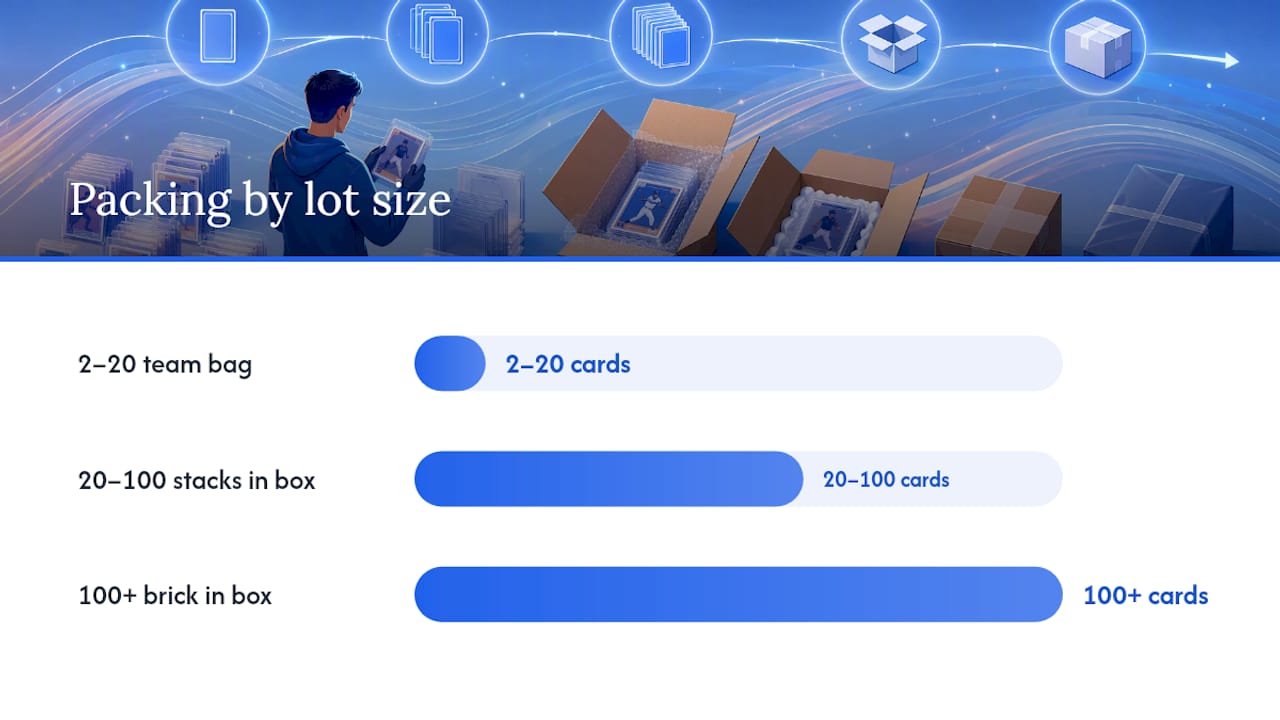
For 20 to 100 cards, individual toploaders for every card gets expensive and bulky fast. Sleeve each card, then group them into stacks of 10 to 20 inside card boxes designed for that count, with a rubber band or card divider keeping each stack tight. Pad any empty space in the box with crumpled paper or foam so the stacks cannot shift during transit, since movement is what causes edge and corner wear in bulk shipments.
For bulk lots of 100 or more, sellers typically build cards into bricks: sleeved stacks banded together and packed into a standard card storage box sized for the count. Weight becomes the deciding factor for service choice at this volume, since a full box of commons can weigh several pounds and push you out of flat-rate pricing.
Keep these points in mind when scaling up a lot shipment:
- Never let cards shift more than a few millimeters inside the box. Movement during transit is the top cause of edge wear in bulk lots.
- Weigh the packed box before choosing a service. Ground Advantage often beats Priority on cost once a box crosses a couple of pounds, but Priority’s included insurance can offset the difference for higher-value bulk.
- Separate valuable singles from the bulk lot and ship them under their own packing stack. Mixing a $200 card into a brick of commons is how it gets lost or crushed.
- Label boxes as “cardboard” or “photos” rather than “trading cards” on the outer packaging to reduce targeted theft risk.
Shipping Graded Slabs and Grading Submissions
Graded slabs behave nothing like raw cards in the mail. The rigid plastic case protects the card inside but is itself vulnerable to cracking at the corners if it takes a direct hit, so the packing logic flips: instead of building layers around a flexible card, you are cushioning a brittle object.
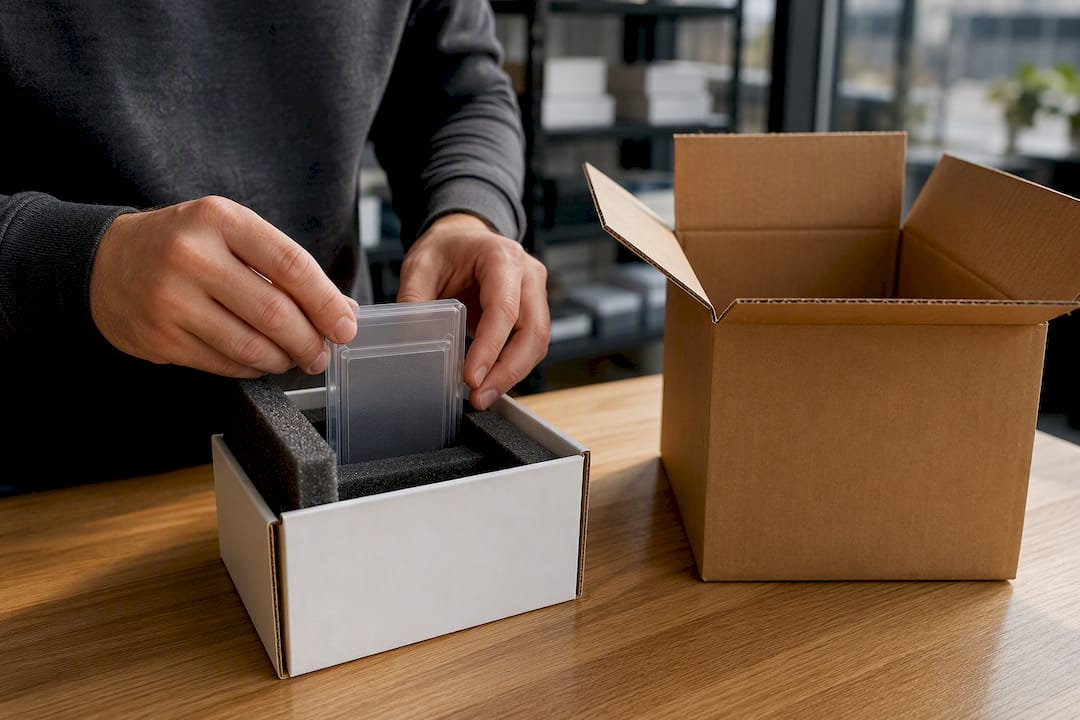
Wrap the slab fully in bubble wrap, then set it into a box sized so there is little to no room for it to shift. For slabs worth several hundred dollars or more, double-boxing is worth the extra few dollars in materials: pack the wrapped slab into a snug inner box, then place that box inside a larger outer box with a couple of inches of foam or crumpled paper on every side.
Grading submissions to PSA, BGS, or CGC follow slightly different rules than resale shipping, since the card has not been graded yet and still needs protection through the intake process:
- Use semi-rigid card savers instead of hard toploaders, since most grading companies specifically request them for submissions.
- Seal the card saver with painter’s tape rather than any adhesive that could leave residue on the raw card surface.
- Include all required paperwork inside the package exactly as the grading company specifies, and keep a copy for yourself.
- Photograph each card before sealing it, front and back, so you have a record of condition before it leaves your hands.
Pro Tip: Before you seal any slab for shipping, take a clear photo of the certification number and grade on the label. If a claim dispute ever comes up, that photo is your proof of what you actually shipped.
Insurance and signature confirmation stop being optional once a slab crosses roughly $100 in value. The small added cost of double-boxing and signature confirmation is trivial compared to what a cracked slab or a lost package actually costs you in refunds and relisting time.
Which Carrier and Service Should You Use for Trading Cards?
Matching the service to the card’s value is the single biggest lever you have over both cost and risk. Here is how the value bands typically shake out:
- Under $20: A plain white envelope or First-Class Mail without tracking is defensible here, since insuring a $10 card costs more than the card is worth if something goes wrong.
- $20 to $100: USPS Ground Advantage or First-Class Mail with tracking is the standard choice, giving you proof of delivery without paying for a premium service you do not need.
- $100 to $500: USPS Priority Mail or UPS Ground makes sense here, largely because Priority Mail includes a baseline of coverage automatically.
- $500 and up: UPS or FedEx with signature confirmation and a declared value that matches the card’s actual worth is worth the extra cost, since these services build documentation and delivery proof directly into the shipment.
Cost snapshot: USPS Priority Mail includes up to $100 of insurance by default, and buying additional coverage beyond that typically runs $1 to $2 per $100 of declared value. On a $400 card, that puts extra insurance in the range of $4 to $8, which is nothing compared to the loss if the card disappears uninsured.
Tracking detail varies more than most sellers realize. Ground Advantage gives you delivery confirmation and basic scan updates, while Priority and the major private carriers add real-time location scans at each transit hub. That extra visibility matters most on higher-value shipments where a stalled package needs a fast answer, not a guess.
Registered mail and third-party insurance providers fill a specific gap: shipments valued high enough that carrier-included coverage caps out, but not high enough to justify a specialized art or collectibles shipper. If you are regularly moving cards worth $1,000 or more, a supplemental policy through a third-party insurer is often cheaper than declaring that full value through the carrier directly.
Insurance, Claims, and Documentation That Actually Hold Up
Carrier-included coverage only goes so far. Priority Mail’s built-in $100 protection covers a mid-tier card, but anything beyond that needs a deliberate decision to buy more, and that decision should happen before you print the label, not after something goes wrong.
The math is straightforward: extra insurance runs roughly $1 to $2 per $100 of declared value on most carriers. On a $300 card, that is $3 to $6 for peace of mind that saves you the entire sale if the package is lost or crushed.
Documentation is what turns a claim from a coin flip into a near-certainty. Before you seal the package, gather:
- The sale invoice or receipt showing the price paid.
- Photos of the card itself, front and back, plus a photo of it inside the packaging before sealing.
- The grade and certification number if the card is slabbed.
- The tracking number and a timestamp of when you dropped it off or handed it to a carrier.
Carriers frequently deny claims when the packaging itself looks inadequate, meaning a single envelope with no cardboard backing or a slab shipped loose in an oversized box. Following the full packing stack every time is not just about preventing damage; it is what makes your claim defensible if damage happens anyway.
Smart Ways to Cut Shipping Costs Without Cutting Corners
Every dollar saved on shipping supplies matters when you are moving volume, but the cheapest option is not always the smartest one.
A plain envelope makes sense for bulk singles under $10, but disclose it in your listing. Buyers who know upfront that a $5 card ships PWE rarely complain; buyers who assumed tracking and did not get it, do. For anything with real value, a small bubble mailer with the full stack costs a dollar or two more and eliminates most bending disputes before they start.
Label-discount services and platform-specific options like the eBay Standard Envelope program shave real money off postage at volume, particularly for sellers shipping dozens of low-value singles weekly.
- Standardize which kit maps to which service so you are not deciding from scratch on every shipment. A $15 card always gets Kit A and First-Class; a $150 card always gets Kit B and Priority with insurance.
- Locking in a fixed kit-to-service mapping is what separates sellers who rarely get a damage claim from those who deal with them constantly, since consistency removes the human error of grabbing the wrong toploader under time pressure.
- Include a printed packing slip and a quick thank-you note. It costs nothing and measurably reduces the odds a buyer opens a dispute over a minor issue.
Pro Tip: Print your shipping labels a day in advance during a slow moment, then batch-pack everything in one sitting. Packing in batches by value tier is faster and far less error-prone than packing one order at a time between other tasks.
How Ripbin Helps You Ship With the Right Insurance and Value
Choosing the right service level starts with knowing what a card is actually worth right now, not what you paid for it last year. Ripbin’s live market data pulls from real recent sales across more than 78,000 cards, which gives you a current number to declare rather than a guess based on an old price guide.
That matters directly for shipping decisions:
- Use grade-by-grade value data to decide whether a card crosses the $100 or $500 threshold that changes which carrier and service you should choose.
- Scan a card with Ripbin’s built-in scanner to get an instant value read before you pack it, which helps you batch shipments by value tier instead of eyeballing it.
- Track everything in your collection locker so you know exactly what you are holding and what it is worth before a buyer even asks.
Sellers who check current values before printing a label consistently under-insure less often and avoid over-insuring cards that have dropped in price since their last sale.
International Shipping: Customs, Taxes, and Delivery Times
Shipping trading cards across a border adds paperwork that domestic shipments skip entirely. Every international package needs a customs declaration form listing the contents and declared value, and that declared value is exactly what customs officials use to calculate any import duty or tax the buyer owes on arrival.
Declare the actual sale price, not a lowball figure meant to reduce fees. Undervaluing a customs form is a common shortcut that backfires when a package gets flagged for inspection, which can add days or weeks to delivery and sometimes triggers additional scrutiny on future shipments from the same sender.
Delivery times for international card shipments vary enormously depending on destination and service level. A tracked international service might land in one to two weeks to a nearby country, while economy international options can stretch past a month, especially when customs holds are involved. Tracking visibility also drops once a package crosses into another country’s postal system, since many international services hand off to a local carrier that does not always feed detailed scan data back to the origin tracking number.
For higher-value international shipments, signature confirmation on arrival is worth the extra cost even more than domestically, since recovering a lost package across borders through a claims process takes considerably longer and involves more back-and-forth documentation. Buyers should also be told upfront, in the listing itself, that they are responsible for any customs fees or import taxes their country assesses, since that expectation needs to be set before the sale, not after a surprise bill shows up.
Packaging for Extreme Weather and Long Transit Times
Cardboard and bubble wrap protect against impact, but they do not stop humidity, heat, or a package sitting in a hot delivery truck for three days during a heat wave. Long transit routes and rough weather both raise the odds of subtle damage that has nothing to do with rough handling.
Moisture is the bigger threat of the two. A resealable team bag inside the packing stack already creates a barrier, but for shipments heading to particularly humid regions or crossing a rainy season, adding a small silica packet inside the mailer gives an extra layer of protection against condensation building up inside the package.
Heat mostly affects modern cards with certain foil or holographic finishes, which can occasionally warp or discolor under prolonged high temperatures inside a hot vehicle or warehouse. There is no perfect fix for this beyond avoiding the slowest, most exposed shipping options during summer months when a card is genuinely temperature-sensitive.
For long transit routes, whether that is a cross-country domestic shipment or an international one, reinforce the outer packaging more than you would for a short hop. A double layer of tape along every seam of the mailer or box prevents the seams from working loose over an extended trip, and choosing a slightly sturdier box over a flimsy bubble mailer is worth the few extra cents when the package will spend a week or more in transit rather than a day or two.
Tracking Best Practices for Trading Card Shipments
A tracking number is only useful if you actually check it. Sellers who glance at tracking once and forget about it miss the early warning signs of a package heading for trouble, like a scan that stalls at a regional hub for several days longer than normal.
Set a routine: check tracking on every shipment worth more than $20 at least once every couple of days until it delivers, not just at drop-off and delivery. A package that has not moved in three or four days is worth a proactive message to the buyer, since getting ahead of a delay builds trust that a silent shipment does not.
Real-time monitoring tools built into most carrier apps and many marketplace platforms will send automatic alerts on status changes, which saves you the manual checking if you are shipping in volume. Setting those notifications up once takes a few minutes and pays off every time a shipment needs attention.
Keep every tracking number logged alongside the sale record, the declared value, and the ship date in one place, whether that is a spreadsheet or a dedicated tool. When a buyer asks about a shipment weeks later, or a claim needs to be filed, having that information instantly accessible instead of dug out of old email saves real time and looks far more professional to the person on the other end.
Shipping Binders, Boxes, and Other Card Accessories
Not every shipment is a card. Binders full of pages, storage boxes, and unopened wax all move through the mail regularly, and they need a different packing approach than a single card ever would.
A filled binder is heavier and bulkier than most sellers expect, and the pages themselves can shift and bend if the binder is not wrapped tightly. Wrap the closed binder in a layer of stretch wrap or a large plastic bag first to keep pages from sliding, then box it in a sturdy corrugated box with minimal empty space, since binders that can shift inside an oversized box are prone to corner damage on the binder itself.
Card storage boxes, whether empty or filled, ship best inside an outer shipping box rather than with just a mailer wrapped around them, since a storage box’s cardboard is decorative rather than structural and will not survive rough handling on its own. Add crumpled paper or foam in any gaps to stop the inner box from rattling around during transit.
Unopened wax, meaning sealed packs or boxes of cards, carries its own risk: crushing. Sealed product needs a rigid outer box with real padding on every side, since a soft bubble mailer alone does nothing to stop a box of packs from getting crushed under other mail in transit. Treat unopened product with the same seriousness you would a slab, since the collector value depends entirely on the packaging staying intact and undisturbed.
Handling Returns and Refunds on Card Shipments
Returns happen, and how you handle them affects your reputation as much as any single sale does. When a buyer requests a return, ask for photos of the card and its condition immediately, before any shipping label gets issued, so you have a record of what is actually being sent back.
Provide a prepaid return label whenever the return reason is legitimate, such as a card that does not match its listed condition or arrived with previously undisclosed damage. Making a buyer pay to return something that was your error creates disputes that escalate to the marketplace itself, which almost always costs more time and goodwill than the return shipping label would have.
Require the same packing standard on a return that you would use to ship it out originally. A card returning without a toploader, or a slab returning loose in an envelope, tells you the buyer either did not read your packing instructions or is not being careful, and either way it is worth noting before processing a refund.
Process refunds only after confirming the returned item matches what was sent, comparing against your original pre-shipping photos. This is exactly why documenting condition before the original shipment matters so much: it protects you on both the claims side and the returns side of a transaction, closing the loop on the same photo evidence you already gathered for insurance purposes.
Building a Repeatable Packing Routine That Actually Sticks
Standardizing your packing process around three fixed kits, one for singles, one for mid-value cards, and one for slabs, removes the guesswork that causes most shipping mistakes. When every card of a given value automatically gets the same materials and the same service, you stop making a fresh decision fifty times a week.
For a one-person operation or small shop, that means committing to a simple rule: know the value tier before you touch a single supply, then let the tier decide everything else. A checklist taped near your packing station, listing which kit and which service goes with which price range, turns a decision into a lookup. That small habit is what keeps claims rare and fulfillment fast, even when volume climbs.
— Saad
Set the Right Declared Value Before You Ship
Getting the packing stack right solves half the problem. Knowing what a card is actually worth right now solves the other half, and that is where most sellers guess instead of check. Ripbin’s card database pulls live values from real recent sales across thousands of cards, so you are declaring insurance based on today’s market instead of a number from months ago.

Scan a card before you box it up and Ripbin gives you an instant value read pulled from actual sales, not a stale price guide. That number is exactly what you need to decide whether a card gets First-Class with tracking or Priority with signature confirmation. Browse Ripbin’s card pages to check current values on anything sitting in your shipping queue, log it in your collection locker, and ship with a declared value you can actually defend if a claim ever comes up.
Sources
For deeper packing detail beyond this guide, the carrier and grading resources below cover specifics worth bookmarking: the complete packaging stack breakdown, cost and cheapest-method comparisons, and label and packaging guidance for slabs. Before you ship anything valuable, check its current market price on Ripbin’s card database to set a declared value you can stand behind.
- How to Ship Trading Cards Safely (2026) Complete Guide
- How to Ship Trading Cards: Labels & Packaging Guide