What Sellers Actually Keep From PSA 10 Values After Fees
By Ripbin Research · Published 2026-08-29
What Sellers Actually Keep From PSA 10 Values After Fees
A PSA 10 value is the recent market price other buyers actually paid for that exact card, in that exact PSA 10 grade, with the same label and variation. It’s only as reliable as two things: how many recent completed sales back it up, and how the card’s population report shapes scarcity. Thin sample sizes and ignored gem rates are why headline numbers so often disappoint sellers. Tools like Ripbin’s live comps and scanning shortcut most of that verification work.
TL;DR:
- PSAT 10 prices are based on recent verified sales, with at least three to thirty transactions providing the most reliable data.
- Gem rate and absolute population numbers are key drivers of PSA 10 premiums, especially for scarce vintage or low-population cards.
- Accurate net proceeds depend on calculating deductibles like grading, marketplace, payment fees, and shipping before listing or grading.
- Ripbin streamlines the process by providing instant, live PSA 10 comps, variation verification, and grade-to-price comparisons in minutes.
- Relying solely on headline sale prices without population and gem rate analysis often leads sellers to overprice or undervalue cards.
Table of Contents
- How PSA 10 market values are built from completed sales
- What drives the PSA 10 premium beyond the grade itself
- Where to find reliable PSA 10 comps and what to record
- How to calculate what you’ll actually keep after fees
- A quick checklist to verify a PSA 10 value
- How Ripbin helps you verify a PSA 10 value in minutes
- Why sellers still get burned by headline PSA 10 prices
- Start verifying your own PSA 10 cards
- Sources
How PSA 10 market values are built from completed sales
A trustworthy PSA 10 price starts with completed sales, not asking prices. Anyone can list a card at $2,000 on eBay; that number tells you nothing until someone actually pays it. The real signal comes from recorded sales where you can verify the venue, the date, and the terms of the transaction (auction premium included or not, for instance).
Recency matters more than most collectors assume. A card that sold for $400 fourteen months ago tells you far less about today’s price than one that sold for $350 last week. Some pricing tools apply a mathematical decay to older sales, like a 120-day half-life, so a sale from four months ago counts for roughly half the weight of one from this week. That approach, used in modern PSA value calculators, keeps stale sales from skewing the picture.
Sample size changes how much you should trust the number:
- Three recent sales can suggest a range but shouldn’t be treated as gospel.
- Thirty recent sales, tightly clustered, gives you real confidence in a price.
- When sales are scarce, a value is often modeled from adjacent grades or comparable cards rather than pulled from direct comps.
Cross-check any number against PSA’s Auction Prices Realized and the card’s population report before you treat it as settled.
What drives the PSA 10 premium beyond the grade itself
Two numbers decide most of the premium: gem rate and absolute population. Gem rate is simply the percentage of graded copies that came back a 10. A card with a 5% gem rate is objectively harder to pull off than one sitting at 60%, and that scarcity shows up in price.
But gem rate alone is misleading. That’s the difference between a card you can buy anytime and one you might wait months to see listed. PSA’s own pricing philosophy notes that low-population cards can command premiums well above what common listings would suggest.
Demand layers on top of scarcity. Star rookies, iconic sets, numbered parallels, and autographed variations all pull buyers that a common base card never will.
Statistic Callout: The gap between a PSA 10 and a PSA 9 varies widely. On modern cards, the premium can be moderate, while on scarce vintage or low-pop rookies, the premium can be several times the PSA 9 price. The multiple is entirely card-specific, so treat any “standard” 10-to-9 ratio you see online as a starting guess, not a rule.
Where to find reliable PSA 10 comps and what to record
Not every source of “sold” data deserves equal trust. Prioritize your search in this order:
- PSA’s Auction Prices Realized for certified, verified completed sales directly tied to the grading company.
- Major auction house archives for high-value cards, since these listings typically show hammer price plus any buyer’s premium.
- Completed eBay sold listings, filtered strictly to “sold,” since active listings and offers aren’t sales.
For every comp you find, write down the exact variation and parallel, the grade and slab label style, the sale date, the sale type (auction versus fixed price), and any visible fees baked into the final number.
When your sample is thin, don’t force a single average. Note the range, flag it as indicative, and weigh it against population data before quoting a number to a buyer or using it to justify a grading submission.
How to calculate what you’ll actually keep after fees
The headline sale price and your net proceeds are rarely the same number. Four cost buckets eat into that gap:
- Grading fees, which scale with declared value. PSA’s Premium 10 tier, for example, starts at $9,999 for high-value submissions and climbs from there.
- Marketplace or consignment fees, typically a percentage of the final sale price.
- Payment processing fees, usually a small flat percentage.
- Shipping and insurance, which matter more than people expect on anything worth grading.
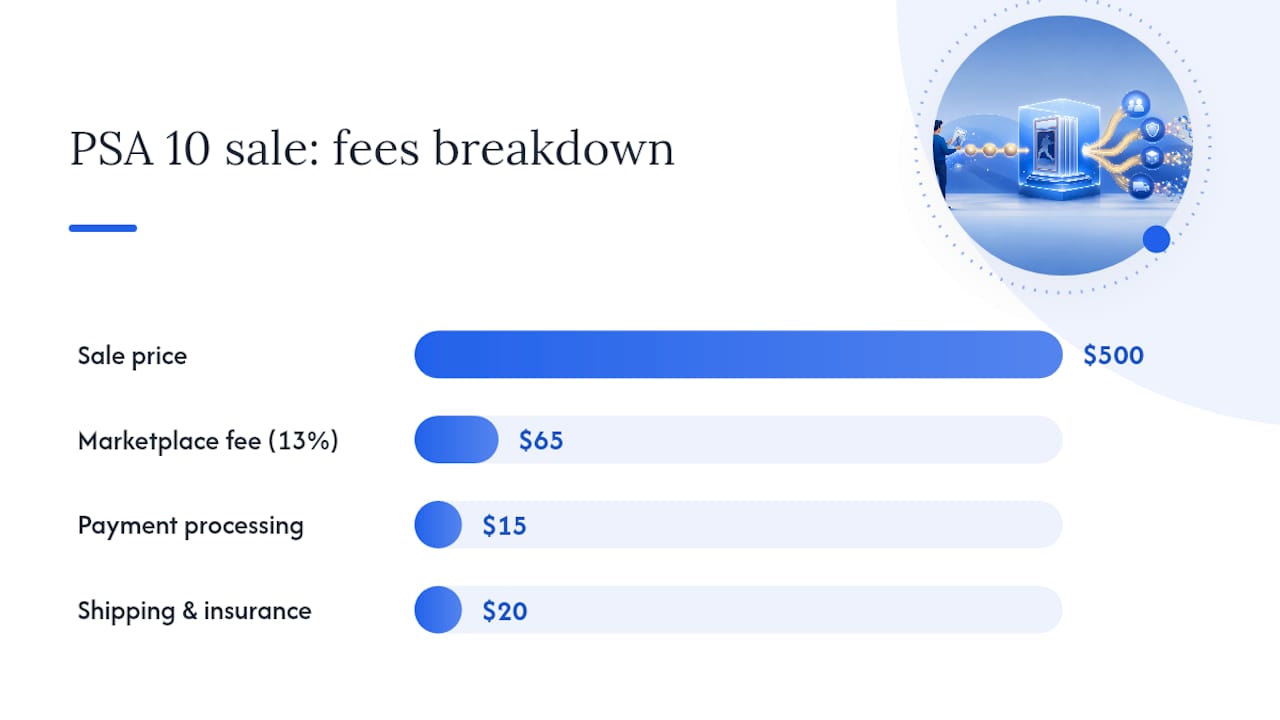
Worked example: Say a comp shows a recent PSA 10 sale at $500. Marketplace fees at 13% take $65. Payment processing takes roughly $15. Shipping and insurance run $20.
Run that math before you submit a raw card for grading, too. If your break-even sits above what a realistic PSA 10 comp would net you after fees, grading is a losing bet on that particular card.
A quick checklist to verify a PSA 10 value
Before you buy, sell, or submit a card for grading, work through this in order:
- Pull the most recent completed PSA 10 sales for the exact variation, and note how many sales you found and how recent they are.
- Check the population report for both gem rate and absolute PSA 10 population.
- Confirm the label and variation match exactly, then calculate net proceeds using current fee figures.
- Decide whether to list, hold, or grade based on that break-even math, not the headline price.
Pro Tip: Save your comps and calculations somewhere you can revisit them. Market prices on collectibles shift fast, and a value you verified three months ago on a hot rookie card may already be stale.
Skipping straight to a “market value” listed on a random site is how sellers underprice a scarce card and overpay for a common one.
How Ripbin helps you verify a PSA 10 value in minutes
Ripbin was built to shortcut everything in that checklist. The platform tracks live market data across more than 78,000 cards, which means the comps you pull reflect actual recent sales rather than a stale average.
- Instant scanning identifies the exact card, set, and variation, so you’re not guessing which parallel you’re holding before you check comps.
- Live comps by grade show recency-weighted PSA 10 pricing without manually digging through auction archives.
- Grade-by-grade ladders let you see the real 10-versus-9 multiple for that specific card, which is exactly what you need for a break-even grading decision.
- The collection locker keeps your holdings and their tracked values in one place, so you’re not rebuilding your comps research every time the market moves.
Pro Tip: Run the break-even grading check inside Ripbin before you mail anything to a grading service. If the projected PSA 10 value after fees doesn’t clear your grading and shipping costs by a comfortable margin, hold the card raw and wait for a better window.
Why sellers still get burned by headline PSA 10 prices
Too many sellers anchor to the highest sale they can find and skip the population report entirely. That’s the single most common mistake, and it’s an easy trap because the flashy number is always more fun to quote than the boring pop report. The fix isn’t complicated: pull the realized comps, check the gem rate against the absolute population, and run the net math before you list or submit anything. Cards with hundreds or thousands of same-grade copies rarely command the premium a seller expects, no matter how perfect the grade looks on paper.
— Saad
Start verifying your own PSA 10 cards
Ripbin turns the checklist in this guide into a five-minute workflow instead of a weekend research project. Scan a card to confirm its exact variation, pull live PSA 10 comps sourced from real completed sales, check where it sits in the population report, and run the grade ladder to see if grading actually pays off before you spend a dollar on fees.

No browsing fees, no guesswork pulled from stale averages, just current numbers tied to actual sales. If you’re holding a card and wondering whether it’s worth submitting for grading or listing raw, browse cards on Ripbin and scan it to see where it stands today.