In 10 Minutes: Price Cards to Sell and Keep More with One Instant Scan
By Ripbin Research · Published 2026-09-02
In 10 Minutes: Price Cards to Sell and Keep More with One Instant Scan
Price cards to sell using recent sold comps, not asking prices, then adjust that number for grade, condition, and whatever the channel takes off the top. That single habit separates sellers who move cards fast at fair value from sellers who sit on inventory for months. Everything below breaks that process into steps you can run in ten minutes per card, plus rules for when grading pays off and how to price a whole box instead of one slab.
TL;DR:
- Pull at least three recent sold comparisons, matching the card’s grade and parallel closely, and use the median sale to establish a fair value.
- Adjust the sale price for condition, grade, and marketplace fees, then set your minimum price based on these calculations to avoid undervaluing or overpricing.
- Use auction prices or marketplace tools like PSA’s auction data and eBay’s price guide to verify comps, ensuring your pricing stays current within a 30 to 90-day window.
- Grading can be worth it mainly for high-value modern rookies and vintage cards, provided the expected value exceeds the combined grading fees and turnaround time.
- When pricing entire collections, focus on individual headliners and sample mid-tier cards, using per-card or per-thousand benchmarks for bulk, to save time and avoid overlooking high-value items.
Table of Contents
- Price Cards to Sell in Five Fast Steps
- Where to Find Sold Comps That Actually Mean Something
- When Grading Actually Pays Off
- Setting the Right Price for eBay, Marketplaces, and Shops
- Pricing an Entire Collection Without Losing Your Mind
- The Right Way to Use Price Guides and Scanner Apps
- How Ripbin Speeds Up Every Step of This Workflow
- Why the Same Card Sells for Different Prices in March vs. October
- What Makes a Buyer Actually Pull the Trigger
- Disclosure Rules Every Seller Should Know Before Listing
- What Collectors Get Wrong About Their Own Cards
- Ready to Price Your Next Card in Minutes, Not Hours
- What Actually Moves the Price on a Card You’re Selling
- Sources
Price Cards to Sell in Five Fast Steps
Pricing one card shouldn’t take longer than making the listing itself. Here’s the order that keeps you from guessing.
- Identify the card exactly. Get the set, year, card number, and parallel or insert type right. A base card and a refractor parallel can differ by 10x in value, so a fuzzy ID wrecks everything downstream.
- Pull 3 to 10 recent sold comps. Match your grade or condition as closely as possible, using a recent sales window (https://whattheslab.com/2026-07-08-how-to-price-sports-cards-for-ebay-listings-2026-guide/) so you’re looking at the current market, not last year’s.
- Take the median, not the average. One outlier sale (a bidding war or a fire-sale price) skews an average badly. The three-step framework of identify, judge condition, and check sold prices holds up whether you’re pricing a rookie card or a Pokémon holo.
- Adjust for condition and grade. A well-centered raw card near mint can sit close to a PSA 8 comp; a corner-dinged copy needs a real discount.
- Subtract fees and shipping. What’s left is your realistic listing price and your walk-away minimum.
Where to Find Sold Comps That Actually Mean Something
Asking prices lie. Sellers list cards 20% to 40% above what they’ll actually take, and plenty of those listings sit unsold for weeks. The only number that matters is what buyers have actually paid recently.
- Filter for “sold” or “completed” listings, never active ones, on any marketplace you check.
- Match grade and parallel first. If exact matches are thin, widen your search by a grade tier or a similar parallel and note the adjustment you made.
- Favor the median or a trimmed mean over a simple average when you have five or more comps.
- Watch whether sales are clustering (tight, dense pricing) or scattered (wide range, low confidence) before trusting the number.
- Note whether recent sales are trending up or down over the last few weeks. A card that sold for $40 a month ago but $65 last week is moving.
Statistic Callout: Comp analysis for eBay listings works best when you match condition and grade, hold to a 30 to 90 day sales window, and factor in whether the sale was an auction or a Buy It Now, since auction closes tend to run leaner than BIN prices on the same card.
Two good places to start: PSA’s Auction Prices Realized tool pulls recent auction activity from major houses when you search by set and grade, and eBay’s price guide lets you scan or search a card to surface recent comps and short-term market trends.
When Grading Actually Pays Off
Grading isn’t free, and it isn’t fast. A raw card sent for grading ties up cash for weeks and costs money whether it comes back a 9 or a 6. Before you submit anything, run the math instead of the hope.
- PSA, BGS, and CGC grade multiples can be dramatic. A PSA 10 can sell for multiple times a raw copy’s price (https://www.gradingmetric.com/blog/raw-vs-graded-card-value-comparison), but a PSA 7 on the same card might barely beat raw value once fees are counted.
- Check population reports before you submit. A set flooded with PSA 10s crushes the premium; a scarce population supports it.
- Grading costs stack up: the base grading fee, membership tiers for faster service, shipping both ways, and the time value of a slow turnaround.
- Use a probability-weighted heuristic: estimate your odds of landing each grade, multiply by that grade’s expected sale price, subtract total grading costs, and compare the result to your raw sale price. If expected value doesn’t clear raw price by a comfortable margin, don’t submit.
- Grading tends to pay off most on high-value modern rookies and vintage key issues, where the gap between raw and gem-mint pricing is wide enough to absorb the cost and wait.
Pro Tip: Photograph corners and edges under bright light before deciding whether to grade. A crease you can’t see in normal listing photos will show up on a grader’s loupe, and it will cost you the multiplier you were counting on.
Setting the Right Price for eBay, Marketplaces, and Shops
Where you sell changes what you should charge, since fees and buyer expectations shift by channel.
- eBay and open marketplaces carry the widest buyer pool but also marketplace and payment processing fees. Price near your median comp, and consider Best Offer to gauge real demand without underselling upfront.
- Auction-format listings tend to close a touch below Buy It Now prices on the same card, so factor that discount in if you go that route for scarcer items.
- Consignment through a shop trades a share of proceeds (often a meaningful cut) for someone else doing the listing work. Useful for high-value cards you don’t want to photograph and ship yourself.
- Local card shop cash offers are fastest but usually land well below your comp-based number, since the shop needs its own margin to resell.
Whatever channel you pick, compute your walk-away minimum first: median comp, minus fees, minus shipping, minus any consignment cut. That’s your floor. Set your listing price above it with room to negotiate.
Pricing an Entire Collection Without Losing Your Mind
Trying to individually price 400 cards is how collections sit untouched for a year. Tier them instead.
- Headliners (rookies, autos, low-population cards, anything with real market attention) get individually priced using the sold-comps method above. These are worth the time.
- Mid-tier cards (solid names, no major scarcity) get sampled. Price 15 to 20 representative cards, find your average realized price, and apply that rate across the group.
- Bulk (commons, low-demand veterans, base parallels) gets valued by count or by per-thousand benchmarks rather than card by card. Nobody is pricing a $0.50 common individually.
- When negotiating with a shop or consignor, bring your comp printouts and your tier breakdown. It signals you’ve done the homework and moves the conversation past a lowball opening offer.
The Right Way to Use Price Guides and Scanner Apps
No single price source is complete on its own, so treat every tool as one input, not the final word.
- Sold-listing aggregators show what actually changed hands recently, which is the most reliable signal you’ll get.
- Official price guides like PSA’s price guide update frequently and pair sales history with population data, which matters more than a static number that hasn’t moved in months.
- Population reports tell you how scarce a given grade actually is before you trust a grade premium.
- Scanner and ID apps speed up the identification step so you’re not manually typing set names and card numbers into a search bar.
The workflow that ties it together: identify the card, pull comps, cross-check population and grade data, then land on a final price. Never skip straight from an active listing to a number.
How Ripbin Speeds Up Every Step of This Workflow
Ripbin tracks live values across more than 78,000 cards sourced from real sales, which covers most of the comp-pulling work you’d otherwise do manually across multiple sites.
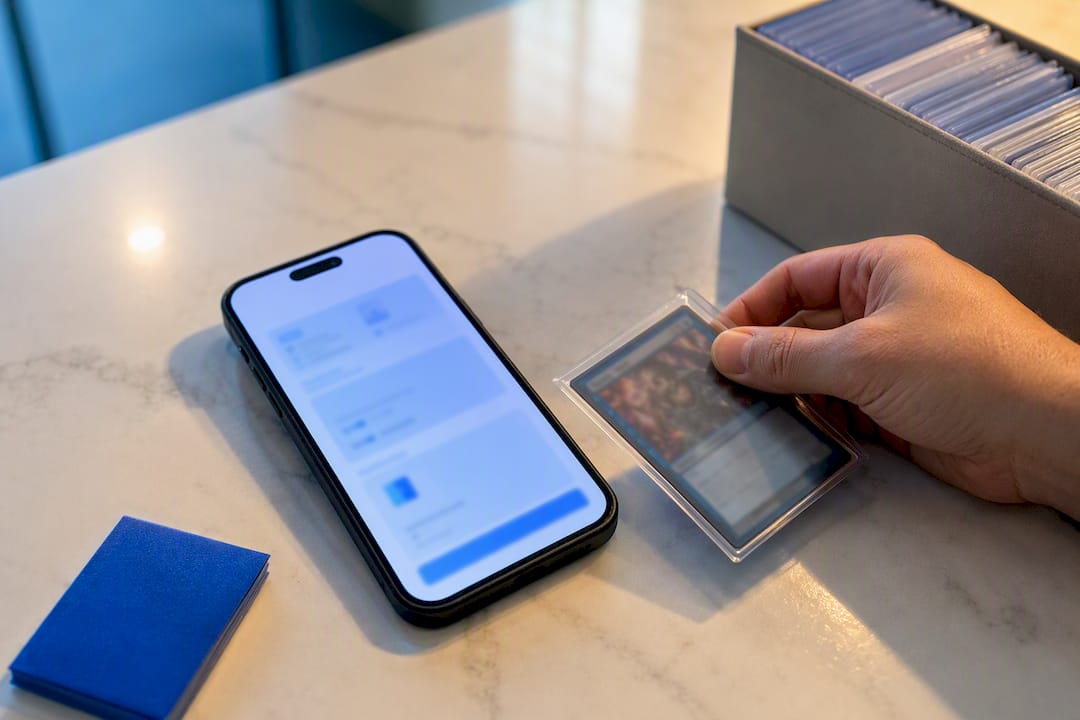
- Scan a card and get an instant identification plus current market value, skipping the manual lookup step entirely.
- Check the value history on a card’s page to see recent movement before you commit to a listing price.
- Store cards in a collection locker to track your whole collection’s value in one place instead of a spreadsheet you forget to update.
- Read monthly investment reports on Ripbin, like the July buy report, to see which cards are seeing real demand right now.
Cross-check anything Ripbin surfaces against a couple of independent comps before you finalize a price, especially on higher-value cards.
Why the Same Card Sells for Different Prices in March vs. October
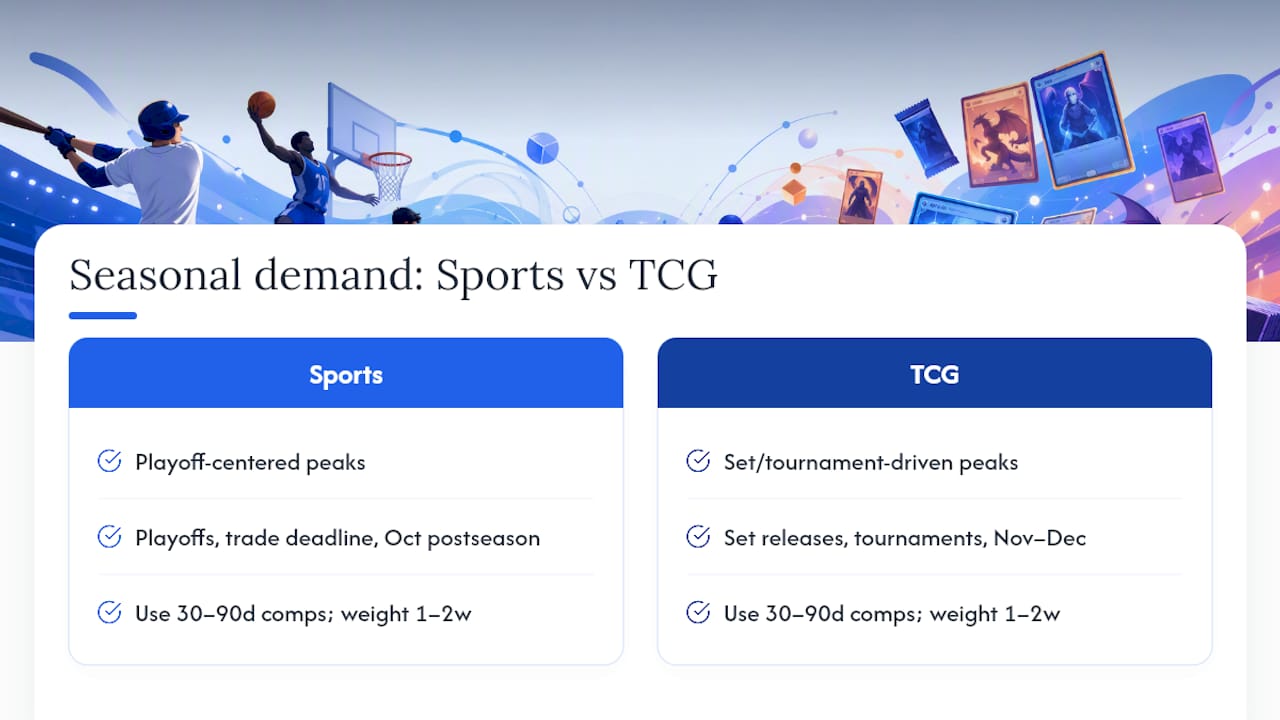
Card prices move with the calendar as much as with the player. Sports card values track the season: a rookie quarterback’s card climbs through football’s playoff run and cools by June. Basketball follows a similar arc around its playoffs, and baseball cards often see a bump around the trade deadline and October postseason when a player’s name is suddenly everywhere.
Pokémon and other TCG cards run on a different clock. New set releases, tournament season, and holiday gift buying (late November through December) all push demand up. A card that’s flat in August can spike hard the week a new expansion drops if it shares a mechanic or artwork theme that gets renewed attention.
Broader market conditions matter too. When overall collectible demand cools, even strong cards take longer to sell at their comp-based price, and you may need to price a touch below median to move inventory. When demand is hot, the same card can sell above recent comps because buyers are competing for supply.
The practical takeaway: don’t treat a comp from four months ago as gospel if you’re pricing during a different part of the season. Pull your comp window from the most recent 30 to 90 days, and if you’re selling a seasonal card, weight the most recent week or two more heavily than older sales in that window. A card’s fundamental value hasn’t changed, but what buyers are willing to pay for it right now has.
What Makes a Buyer Actually Pull the Trigger
Buyers don’t price cards from a spreadsheet, and it’s worth remembering that when you’re setting your own number. Perceived value comes from more than the raw comp median. A clean, well-lit photo showing sharp corners and true color builds more trust than a blurry phone shot, even on an identical card, and that trust translates into buyers accepting a higher price without hesitation.
Round numbers and price anchoring matter more than collectors like to admit. A card listed at $48 instead of $50 can feel like a deal even though the difference is trivial, and a Best Offer button set slightly above your real minimum gives buyers the sense they negotiated a win. Scarcity language, when it’s true, moves buyers too: noting a low population figure or a first-print designation gives a hesitant buyer the nudge to act instead of waiting.
There’s also a herd effect in this market. A card that’s had five recent sales in a week reads as “hot” and buyers move faster to avoid missing out, even if the price is right in line with older comps. A card that’s sat with no sales for two months reads as undesirable regardless of its actual quality, which is part of why refreshing a stale listing’s price or photos periodically helps more than leaving it untouched.
None of this means inflating your price beyond what comps support. It means presentation and framing decide how fast a fairly priced card sells, and a card priced at fair market value with poor photos and no description detail will sit far longer than one priced identically with real care put into the listing.
Disclosure Rules Every Seller Should Know Before Listing
Pricing a card honestly isn’t just good practice, it’s often a condition of the platform you’re selling on and, depending on what you’re selling, a matter of consumer protection law. Misrepresenting a card’s condition, grade, or authenticity to justify a higher price exposes you to buyer disputes, forced refunds, and platform penalties, not just a bad review.
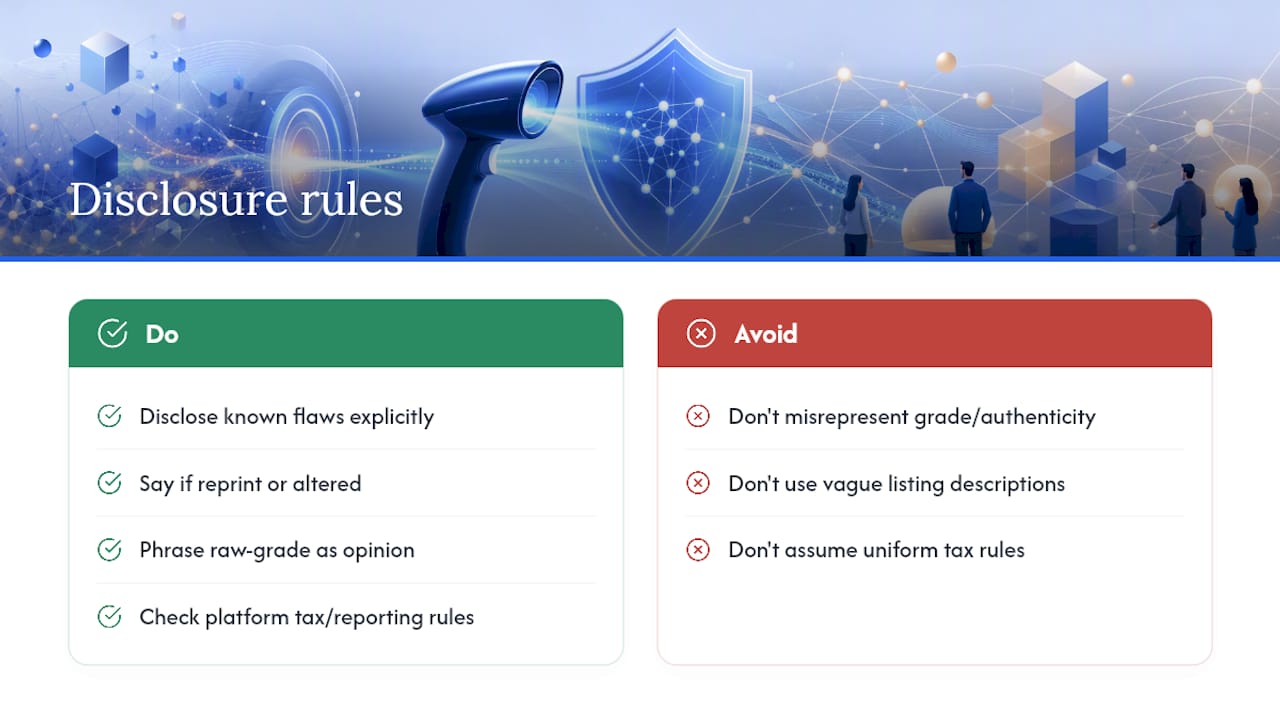
Disclose any known flaws (whitening, creasing, print defects, prior restoration) even if they don’t show clearly in your photos. Most major marketplaces treat “not as described” as one of the strongest grounds for a buyer-favored return, and a vague listing description won’t protect you if a buyer files a claim. If a card is a reprint, a reproduction, or has been recolored or altered in any way, say so explicitly rather than letting photos imply otherwise.
Grading claims need to be exact. If you list a card as “PSA 9” without owning a certified PSA 9 slab, that’s a factual misrepresentation, not a pricing opinion, and it can trigger a platform suspension in addition to a refund. If you’re estimating a raw card’s likely grade for pricing purposes, phrase it as your own opinion, not as a certified fact.
Sales tax obligations vary by your state and by the marketplace’s own tax collection practices, so check your specific platform’s seller policies rather than assuming a blanket rule applies. If you’re selling as a business rather than casually offloading a personal collection, you may also have separate reporting obligations depending on your total sales volume and state, which is worth confirming with a tax professional rather than guessing.
What Collectors Get Wrong About Their Own Cards
The biggest mistake I see is sellers anchoring to what a card is listed for, not what it actually sold for. The second is skipping the grading probability math and sending in a card on hope alone.
A better habit: pre-screen your headliners before you touch anything else, keep a folder of comp screenshots dated by day, and set your grading threshold in writing before you ever mail a card in. It removes the guesswork exactly when emotions run highest.
Ready to Price Your Next Card in Minutes, Not Hours
Ripbin turns the comp hunting you just read about into a scan and a glance. Instead of jumping between three tabs to check sold prices, population reports, and grade premiums, you scan the card once and get a live value pulled from actual sales, and if you’re not selling yet, the same scan drops it straight into your collection locker so you’re tracking value automatically.

That live value is your starting comp, not your final answer. Still run it against a couple of independent sold listings if the card is high value, then adjust for your specific condition and the fees your chosen channel will take. But for the bulk of a collection, or for quickly sanity checking a price before you list, it cuts the research time down to almost nothing.
Head to Ripbin’s card database to look up your card’s current value, check its sales history, and see where it sits before you write your listing.
What Actually Moves the Price on a Card You’re Selling
Most pricing mistakes trace back to skipping a step, not misunderstanding the concept. Sellers know comps matter, they just check three active listings instead of ten sold ones. They know grading costs money, they just don’t run the probability math before mailing a card off. The fix isn’t more knowledge, it’s discipline in the order of operations: identify, comp, adjust, subtract fees, list.
The part collectors underestimate most is how fast comps go stale in a moving market. Treat every price as a snapshot, not a permanent fact, and recheck before you list anything that’s been sitting for more than a few weeks.
— Saad
Sources
- How to find trading card values | PSA
- How to value any trading card (2026) | CardLoft
- How to Price Sports Cards for EBAY Listings (2026 Guide) | What The Slab
- How to Price Your Card Collection Before Selling | The Card Shop Finder