Spot Parallels That Sell 10x–1,000x More: Parallels vs Base Cards
By Ripbin Research · Published 2026-09-14
Spot Parallels That Sell 10x–1,000x More: Parallels vs Base Cards
Parallels are alternate print versions of base cards, same card number and photo, different finish or serial numbering, and they usually cost more because they’re printed in far smaller numbers. A base card is the standard, unnumbered version everyone pulls; a parallel runs alongside it in the same set with a color shift, foil pattern, or serial stamp that separates it from the pack. Print run size is the main value driver: fewer copies, higher price, especially once grading gets involved.
TL;DR:
- Parallels are limited-edition variants sharing the same card number and photo as the base but with different finishes, colors, or serial numbers, often in smaller quantities.
- The rarity of a parallel depends on its print run, with low-numbered or one-of-one parallels commanding significant premiums over standard base cards.
- Identifying a parallel involves checking the card number against official checklists, looking for serial stamps, and tilting the card to reveal finish effects like shimmer or refractor shine.
- Most parallels fall into a hierarchy from unnumbered chrome or refractors to highly limited low-numbered versions and rare one-of-ones, affecting their market value.
- Using verification tools and market data helps collectors accurately assess a parallel’s worth before buying, selling, or grading, avoiding common misidentification mistakes.
Table of Contents
- Parallels vs Base Cards: The Core Difference Explained
- What Is a Parallel Card, Exactly?
- How to Tell if a Card Is a Parallel: A Step-by-Step Check
- The Parallel Hierarchy: From Refractors to One-of-Ones
- Why Manufacturers Make Parallels in the First Place
- How Parallels Move the Needle on Value
- A Simple Workflow for Verifying and Cataloging Parallels
- Using Ripbin to Confirm and Value a Parallel
- A Short History of the Parallel Card
- How Parallels Change Trading and Resale Decisions
- Storing and Protecting Parallels vs Base Cards
- Are Parallels Good for the Hobby?
- Scan Any Card and See What It’s Really Worth
- Where to Keep Researching Parallels
- Sources
- FAQ
Parallels vs Base Cards: The Core Difference Explained
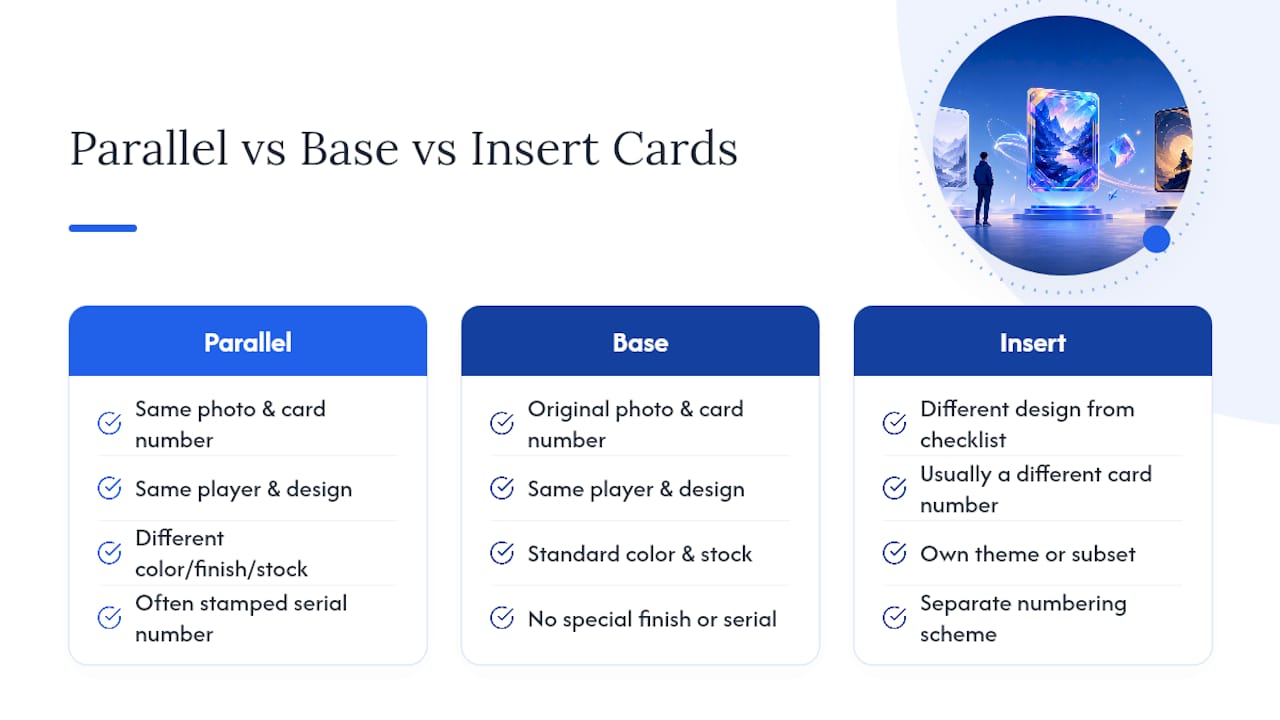
A base card is the default. It’s the card that fills out the bulk of a checklist, uses the standard card stock, and carries no serial number or special finish. Every modern set, from Topps flagship baseball to Panini Prizm basketball, is built around a base set acting as the reference point for everything else in the product.
Base cards matter because they set the floor. If you want to know whether a card is common or rare, you check it against the base version first. Card number is the anchor here. Every card in a set gets a unique number, printed small on the front or back, and that number stays identical across the base card and every parallel version of it. A 2026 Topps card numbered #287 is #287 whether it’s the plain base version or a gold parallel numbered to 50. The photo doesn’t change either; what changes is everything around it.
You find the identification info in a few consistent places. The card number sits in a corner, usually the bottom, sometimes flanked by a copyright line. The checklist for the product, published by the manufacturer or aggregated on set-tracking sites, lists every card number alongside the player name and team. Cross-referencing the number against that checklist is the fastest way to confirm you’re looking at card #287 and not a similarly designed card from a different insert set entirely.
Base cards also establish baseline pricing. A raw, ungraded base card of a star player typically sells for a few dollars unless the player is a rookie having a huge year. That baseline matters because every parallel gets priced as a multiple of it. A parallel isn’t valuable in a vacuum; it’s valuable relative to what the plain version sells for. A base card of a middling veteran stays cheap even in parallel form, while a base rookie card of a breakout star can see its parallels spike dramatically the same week the player gets hot. Understanding the base card’s role as the pricing anchor is step one in understanding why parallels behave the way they do.
What Is a Parallel Card, Exactly?
A parallel shares the same photo and card number as the base card but differs in color, finish, or serial numbering, and it’s usually printed in far smaller quantities. That’s the technical definition, and it’s worth sitting with because it explains everything else in this article. The design doesn’t change. The player doesn’t change. The number doesn’t change. What changes is the physical object: a different border color, a different card stock, a foil treatment, or a stamped serial number that tells you exactly how many copies exist.
Topps describes it almost the same way: a parallel runs alongside the base design but carries a unique physical quality like border color, texture, pattern, or printing technology. That word “parallel” is literal. Picture two train tracks running side by side, same direction, never touching. The base card and its parallel travel the same route through the checklist but are physically distinct objects the whole way.
The visual differences show up in a handful of recognizable forms. Refractors use a chrome coating that produces a rainbow shimmer under light, most famously in Topps Chrome and Bowman Chrome baseball products. Prizm parallels, Panini’s signature treatment, use a similar reflective technology across basketball, football, and soccer sets. Acetate parallels use a translucent plastic card stock instead of paper stock, giving the card a see-through quality you can hold up to a window. Border color changes are the simplest version: a red border instead of the standard white, a gold border, or a blue border, each tied to a specific print run.
Parallels are not the same thing as inserts, autographs, or relic cards, and mixing these up is one of the most common mistakes newer collectors make. An insert is a separate subset with its own design, its own numbering scheme, and often its own theme, like a “Home Run Kings” insert set that exists independently of the base checklist. An autograph card includes a signature, physically or digitally authenticated, and a relic card includes a swatch of game-used material like jersey fabric. A parallel can technically also carry a signature or relic, but the parallel designation itself refers strictly to the finish and print run, not to added content. If someone asks whether a card is a parallel or an insert, the fastest test is the card number: parallels keep the base card’s number, inserts almost always don’t.
How to Tell if a Card Is a Parallel: A Step-by-Step Check
Figuring out whether you’re holding a base card or a parallel takes about two minutes once you know the sequence. Work through these checks in order, and don’t skip the first one just because a card looks shiny.
- Compare the card number to the base checklist. Pull up the manufacturer’s checklist or a set-tracking database and confirm the number matches a known base card. If the number lines up but something about the card looks different, you’re likely holding a parallel, not a different card entirely.
- Check for a serial-number stamp. Look on the back, usually near the bottom, for a small stamped number like “23/99” or “047/150.” That fraction tells you the exact copy number out of the total print run, and it’s the single most reliable parallel indicator when present.
- Tilt the card under a light source. Chrome and refractor parallels reveal their rainbow shimmer only when tilted, so a flat scan or photo under weak lighting can hide the effect entirely. A base card under the same light stays visually flat.
- Cross-reference the manufacturer’s official checklist. Topps, Panini, and Upper Deck all publish product-specific checklists that list every parallel name and its print run alongside the base set.
- Scan the card through a database to confirm the exact parallel and pull comps. A scanning tool that recognizes the card and pulls live sales data settles any remaining doubt and shows you what similar copies have actually sold for.
Pro Tip: Don’t trust color alone. Some manufacturers release nearly identical shades across different print runs in the same product, so a “gold” parallel from one insert set can look almost the same as a “gold” parallel from another. The serial number, not the color, is your ground truth.
The order matters because each step gets more specific. Card number identity rules out the possibility that you’re looking at a different card altogether. The serial stamp, when present, gives you an exact rarity figure instead of a guess. The tilt test catches finish-based parallels that don’t carry serial numbers at all, since some are simply “unnumbered” chrome or color variants tied only to color name. And the checklist and database checks are your final confirmation before you buy, sell, or grade anything.
The Parallel Hierarchy: From Refractors to One-of-Ones
Most modern products build parallels into a ladder, running from common and unnumbered up to a single, unrepeatable copy. Understanding that ladder is the difference between guessing at value and actually knowing what you’re holding.
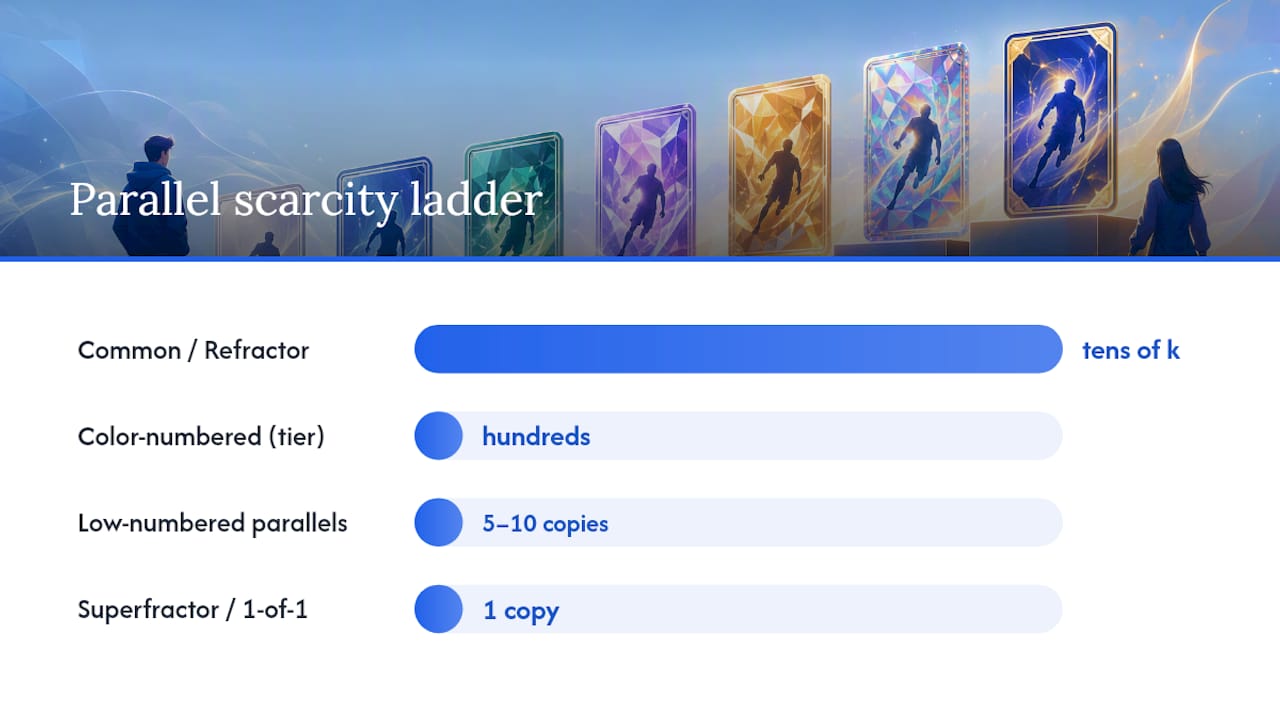
At the bottom sit the unnumbered chrome or refractor parallels. These use a distinct finish, silver, X-fractor, or a color name, but carry no serial stamp because the print run isn’t individually tracked or is large enough that it doesn’t need to be. Refractors and Prizm-style parallels function as the entry point into the chase, common enough to pull regularly but scarce enough to feel like a win.
Above that come color-numbered parallels, which follow a fairly consistent set of print-run tiers across manufacturers:
- Larger runs, often with print runs in the hundreds, sit closest to base card pricing.
- Mid-tier runs with smaller print runs start commanding real premiums, especially for popular players.
- Low-numbered runs with very limited copies turn into serious chase cards regardless of the player.
- Superfractors and true 1-of-1s sit at the top, a single physical copy in existence.
The rarity math: a base card with a print run in the tens of thousands might have a parallel numbered to just 5 or 10 copies. That gap, thousands down to single digits, is why identical designs can carry wildly different price tags.
Some products layer in short-print insert-style chase cards that function almost like parallels even though they’re technically separate subsets, like Topps’ Kaboom cards or Downtown parallels, both known for extremely limited print runs and outsized market attention relative to their size. A Superfractor, Topps’ term for the rarest chrome parallel tier, is by definition a 1/1, meaning exactly one copy of that specific card and finish combination exists anywhere.
Every manufacturer names its tiers differently. Panini uses terms like Prizm, Mosaic, and Optic across different sports, each with its own parallel names (Silver, Gold Vinyl, Green Ice), while Topps sticks closer to Chrome, Refractor, and color-name conventions. The naming varies, but the underlying logic stays consistent across products: smaller print run, bigger premium, nearly every time.
Why Manufacturers Make Parallels in the First Place
Parallels exist because a pack of cards with only base cards inside would be a boring product. Manufacturers build chase mechanics directly into the printing process so that every pack carries the possibility of pulling something better than the average card, and parallels are the cheapest, most flexible way to do that. A base card design already exists; printing it on chrome stock or stamping a serial number onto it costs far less than designing an entirely new insert set, yet it delivers the same emotional payoff when a collector opens the pack.
Retail and hobby distribution channels get treated differently on purpose. Some parallels are exclusive to retail products sold at big box stores, like Walmart or Target-exclusive colors, while others only show up in hobby boxes sold through card shops and specialty distributors. This split lets manufacturers control where certain rarity tiers land and keeps hobby-box buyers, who pay significantly more per pack, feeling like they’re getting access to something retail shoppers can’t find.
Print runs get staggered on purpose, too. A manufacturer might plan a dozen or more parallel tiers for a single flagship product, each with a different, predetermined print run ranging from the high hundreds down to a single copy. That staggering creates a built-in ladder of scarcity that gives every price point a target: budget collectors chase the /299 tier, mid-range buyers go after /50 or /25, and high-end collectors and investors target the 1/1s and low-numbered gems. None of this is accidental. It’s a deliberate product strategy that turns a checklist of a few hundred players into thousands of individually numbered chase objects.
How Parallels Move the Needle on Value
Scarcity and demand set the price, and parallels are where that principle shows up most clearly in this hobby. A base card and its parallel share a photo, a player, and a card number, yet the parallel can sell for ten times more, a hundred times more, or occasionally thousands of times more depending entirely on how few copies exist and how much collectors want that specific player.
Grading amplifies the gap further. A PSA 10 or BGS 9.5 grade on a common base card might bump its price up modestly, maybe 20% to 50% over a raw copy. Apply that same grade to a parallel numbered to 10 copies, and the multiplier can be far larger, because now you’re combining two scarcity factors: the print run and the perfect-condition population. Layered parallel hierarchies mean the rarer tiers carry outsized market premiums compared to base or common parallels, and grading tends to widen that gap rather than shrink it.
Collectors generally fall into a few camps when it comes to strategy:
- Rainbow builders chase every parallel color of a single favorite card, treating the full set as the goal rather than any single copy.
- Investment-minded collectors target low-numbered parallels of players they believe will outperform, betting on scarcity plus future demand.
- Display collectors prioritize visual impact, chasing the flashiest refractor or acetate parallel regardless of print run.
- Flippers buy parallels quickly after release, betting on early hype before supply catches up with demand.
Before paying a premium for any parallel, run through three quick checks: how popular is the player right now, how low is the actual print run relative to the base set size, and does the card’s condition realistically support a strong grade. A /25 parallel of a struggling veteran is a very different bet than a /25 parallel of a rookie having a career year, even though the print runs are identical.
A Simple Workflow for Verifying and Cataloging Parallels
Once you suspect you’re holding a parallel, the smart move is a repeatable process rather than a one-off guess. Here’s the sequence worth building into a habit.
- Do the visual comparison first. Set the card next to a known base version, physically or via a checklist photo, and note every difference in border, stock, and finish.
- Confirm the card number matches the base checklist entry. This step alone rules out most misidentification errors.
- Check for and record the serial stamp, writing down the exact fraction rather than rounding or estimating.
- Cross-reference the manufacturer checklist to get the official parallel name, since guessing at names (“looks kind of gold”) leads to bad listings and confused buyers.
- Pull market comps through a price database before you buy, sell, or submit the card for grading, so you know whether the asking price reflects real recent sales or outdated wishful pricing.
For your own collection tracking, record four things every time: the exact parallel name, the serial number if it has one, the condition or grade, and a clear photo showing both front and back. That level of detail turns a vague “I have a shiny version of this card” into a properly cataloged asset you can actually value and insure.
Pro Tip: If you’re planning to sell, put the parallel name and serial number directly in your listing title, not just the description. Buyers searching for a specific /25 parallel often filter by that exact number, and a vague title costs you visibility and, eventually, money.
Selling disputes almost always trace back to unclear labeling. A buyer who thought they were getting a /99 and received an unnumbered base parallel has a legitimate complaint, and it’s avoidable with a single clear sentence in the listing.
Using Ripbin to Confirm and Value a Parallel
Manual checklist cross-referencing works, but it’s slow when you’re holding a stack of cards and trying to figure out which ones are worth grading. Ripbin’s card database covers more than 78,000 cards with live market values pulled from actual sales, which turns the verification and pricing steps from this guide into something you can do in seconds instead of digging through forum threads.
Scan a card through Ripbin and it identifies the exact parallel type, pulls the serial number context if one applies, and shows price history broken out by grade. That grade-by-grade breakdown matters more than most collectors realize, because a raw parallel and a PSA 10 of the same exact card can trade at completely different price points, and lumping them together in a single “average price” figure hides the real market.
A card like the 2017 Topps Aaron Judge rookie makes a useful example of how this plays out in practice. The base version and its various parallels carry the same card number and photo, but the price history diverges hard once you separate by finish and grade, exactly the kind of gap this article has been describing throughout. Pulling up the card page shows that divergence directly rather than asking you to estimate it.
For collectors trying to decide whether a specific parallel is worth chasing or buying, Ripbin’s monthly investment reports and value guides add another layer, flagging which parallel tiers of specific players have shown real upward movement rather than just hype. Checking the card page before a purchase, or before listing one for sale, replaces guesswork with an actual sales record.
A Short History of the Parallel Card
Parallels weren’t always a fixture of the hobby. Topps introduced early parallel-style variations in the 1990s, most notably with its Finest brand’s refractor technology in 1993, a chrome-coated card stock that produced the rainbow shimmer effect that’s still the visual signature of premium parallels today. Before that, sets were largely flat: one design, one print run, no meaningful tiering.
Refractor technology changed the economics of the hobby almost immediately. Collectors noticed that the shiny version of a familiar card felt different in hand and looked dramatically better under light, and manufacturers noticed that collectors would pay more for it. Panini and Upper Deck followed with their own chrome and foil treatments through the late 1990s and 2000s, each building brand identity around a signature finish, Prizm’s refractive pattern eventually becoming as recognizable as Topps Chrome.
Serial numbering came next, adding a second dimension to scarcity beyond just visual finish. A numbered parallel gave collectors a concrete, verifiable rarity figure instead of relying on a manufacturer’s word that a color was “limited.” That shift, from vague scarcity claims to printed, countable print runs, is arguably the single biggest change in how the hobby values cards, and it’s the direct ancestor of the serial-stamped parallels dominating today’s flagship products.
How Parallels Change Trading and Resale Decisions
Parallels complicate trades in ways plain base cards never do, mostly because two people can disagree sharply on how to weigh finish against print run. A common mistake in casual trades is treating “shiny” as automatically more valuable than “numbered,” when a low-numbered parallel with a plain finish frequently outvalues a flashy but unnumbered refractor of the same player.
Resale strategy shifts too, once parallels enter the picture. Base cards of most players move slowly and predictably; a handful of dollars, steady demand, not much volatility. Parallels behave more like a separate, faster-moving mini-market layered on top of the same checklist. A hot rookie season can send a /10 parallel’s price climbing within weeks while the base version barely moves at all, since the base card’s supply is large enough to absorb new demand without much price pressure.
That volatility cuts both ways for resellers. Buying parallels early, right after a product’s release and before a player’s season narrative plays out, carries real upside if the player breaks out, but it also carries real downside if the player gets hurt or simply has a quiet year. Base cards are the safer, lower-ceiling asset in almost every trade; parallels are the higher-variance play, which is exactly why serious traders track print runs and player performance together rather than treating a card’s rarity as fixed value on its own.
Storing and Protecting Parallels vs Base Cards
Base cards tolerate a reasonable amount of casual handling. A penny sleeve and a simple binder page keep a common base card safe from most everyday wear, and the low replacement cost means a minor scuff isn’t a financial disaster.
Parallels deserve more careful handling, and the reasoning is straightforward: replacement cost. A scratch on a $3 base card is an annoyance. A scratch on a /10 parallel worth several hundred dollars is a real loss, and chrome and refractor surfaces show fingerprints and light scuffs far more visibly than standard card stock because of the reflective coating.
For any parallel worth more than a few dollars, use a rigid card holder rather than a soft sleeve, since rigid holders prevent bending and corner damage that soft sleeves don’t stop. Acetate parallels need particular caution because the translucent material can crack under pressure that a standard cardboard-stock card would simply absorb. Anything numbered below /25, or any card being considered for grading, should go into a one-touch magnetic holder immediately after it’s identified, both to protect it and to keep it presentable if you submit it for a PSA or BGS grade later. Grading companies do factor in surface condition heavily, and pre-submission handling damage is one of the most common reasons a card grades lower than a collector expected.
Humidity and light exposure matter more for parallels too. Chrome and foil finishes can show subtle discoloration or surface changes from prolonged light exposure faster than matte base card stock does, so long-term storage in a binder near a sunny window is a worse idea for a refractor than it is for a plain base card.
Are Parallels Good for the Hobby?
Parallels make the hobby more exciting, and they also make it more confusing, and both things are true at once. The chase mechanic works. Pulling a numbered parallel of a favorite player delivers a genuinely different feeling than pulling the base version, and the display value of a well-preserved refractor or acetate card is real. That excitement is a big part of why the hobby has grown the way it has.
The downside shows up in oversaturation. Some collectors argue that too many parallel tiers dilute rookie-chasing strategy and make it harder for newcomers to understand what they’re actually holding, while others see the same layering as more entry points at more price levels. Both views hold up depending on what you’re trying to get out of collecting.
My practical read: if you’re collecting for display or fandom, chase what looks good to you and ignore the noise. If you’re collecting with resale or investment in mind, print run and player trajectory matter far more than finish name, and that’s where verification tools earn their keep.
— Saad
Scan Any Card and See What It’s Really Worth
Everything in this guide comes down to one question: is the card in your hand a common base version or a scarcer parallel, and what does that actually mean for its price? This service answers that question directly instead of making you dig through forum threads and outdated price guides. Scan a card and it pulls the live market value, sourced from actual recent sales rather than list prices nobody’s actually paying.

The database covers a wide selection of cards, tracks values grade by grade, and shows how a parallel’s price history compares to its base counterpart, the same comparison this entire guide has walked through manually. There are no browsing fees to check a card’s value, and the marketplace lets you buy, sell, or trade once you know what you’re actually holding. Start by browsing the card database to look up a checklist or confirm a parallel you just pulled, then use the same page to see what recent comps say it should sell for.
Where to Keep Researching Parallels
- Manufacturer checklists from Topps and Panini remain the most reliable source for confirming a parallel’s official name and print run, since third-party sites sometimes lag behind new releases.
- Ripbin’s card pages give live comps and grade-by-grade pricing for both base cards and their parallels, useful for confirming a value before you buy, sell, or submit for grading.
- Collector-explainer guides on refractors, Prizm variants, and serial numbering conventions are worth bookmarking, especially when a new product introduces parallel names you haven’t seen before.
Sources
- Parallel | Topps Ripped
- What Is a Parallel Card? | Card Parallels Explained – Chronic Cards
- Sports Card Parallels Explained: Prizm, Optic, Mosaic, and More | CardSense AI
FAQ
What is the difference between a base card and a parallel card?
A base card is the standard, unnumbered version in a set, while a parallel shares the same card number and photo but has a different finish, color, or a serial-number stamp, and is usually printed in far smaller quantities.
Are Topps parallels worth anything?
Many Topps parallels carry real value, and the amount depends almost entirely on the print run and the player’s popularity; a common unnumbered refractor might add only a small premium, while a low-numbered parallel of a star rookie can sell for many times the base card’s price.
How can you tell if a Topps card is a parallel?
Compare the card number against the official Topps checklist, check the back for a serial-number stamp, and tilt the card under light to look for a chrome or refractor shimmer that a standard base card won’t show.
What do parallels mean in trading cards?
A parallel is a variant of a base card that runs alongside it in the same set, identical in card number and design but different in finish or serial numbering, and it’s the mechanism manufacturers use to build rarity tiers into an otherwise standard checklist.
Is a parallel the same thing as an insert card?
No. A parallel keeps the base card’s exact number and photo, while an insert is a separate subset with its own design and numbering, so checking the card number is the fastest way to tell the two apart.