2026 LeBron Rookie Card Values: Grade by Grade Sold Prices & Tiers
By Ripbin Research · Published 2026-09-09
2026 LeBron Rookie Card Values: Grade by Grade Sold Prices & Tiers
LeBron James rookie card values run from the mid four figures to the multi-million-dollar range, and which tier a card falls into depends almost entirely on scarcity and grade. The 2003-04 Upper Deck Exquisite Collection Rookie Patch Autograph sets the ceiling at seven figures. Topps Chrome parallels occupy the tens of thousands. Base paper rookies like the 2003-04 Topps #221 remain accessible for a few thousand dollars in gem condition. Grade, print run, and autograph presence decide everything in between.
TL;DR:
- The main factor driving LeBron rookie card value tiers is scarcity and grade, with the most expensive cards being extremely limited and autographed.
- PSA 10 and BGS 9.5 grades significantly boost card prices, often by four or five times compared to lower grades, especially on low-population parallels.
- Private sales like the $5.2 million record typically set a ceiling, while public auction records provide more reliable market benchmarks.
- Entry-level paper rookies priced around $6,000 in PSA 10 offer accessible starting points for new collectors without high risk.
- Ensuing market behavior in 2026 shows a divide between illiquid grail-tier cards and liquid chrome parallels, which is crucial for strategic buying and selling decisions.
Table of Contents
- Understanding LeBron Rookie Card Values by Tier
- What Do PSA 10 and PSA 9 LeBron Cards Actually Sell For?
- How Do You Know If a LeBron Rookie Card Is Actually Worth Its Grade?
- What Do LeBron’s Record Sales Tell You About the Market?
- Where Should You Buy, Sell, or Verify a LeBron Card’s Value?
- Should LeBron Rookie Cards Be Part of Your Investment Portfolio?
- Reading the 2026 Tape: What Collectors Should Watch Next
- Track Your LeBron Rookie Cards With Real Sold Data
- Sources
Understanding LeBron Rookie Card Values by Tier
Every serious LeBron James collector eventually organizes the market the same way: by scarcity, not by nostalgia. The 2003-04 rookie class produced roughly a dozen cards that matter for value, and they split cleanly into four tiers once you account for print run, patch presence, and autograph status.
Grail tier belongs almost entirely to the 2003-04 Upper Deck Exquisite Collection Rookie Patch Autograph, card #78. This is the card that turned LeBron collecting into a wealth conversation. A single copy sold privately for $5.2 million, graded BGS 9 with a 10 autograph subgrade, and that sale remains the reference point every other Exquisite comp gets measured against. Exquisite RPAs were printed in extremely limited runs, often numbered to 99 or fewer depending on the specific parallel, and they carry an on-card patch swatch plus an on-card autograph rather than a sticker. That combination of low population and dual authenticity features is why grail-tier cards trade privately more often than at open auction. Buyers with that kind of budget rarely want their purchase broadcast.
Premium tier is where the Topps Chrome refractor family lives, and it’s the segment most collectors can realistically enter. The 2003-04 Topps Chrome Refractor #111 in PSA 10 has traded around $60,000, while the rarer Topps Chrome Black Refractor, numbered to just 500 copies, has reached roughly $108,000 in the same grade. These aren’t autographed or patched cards. Their value comes purely from the refractor finish, the numbered scarcity, and how brutally hard it is to find one with sharp corners and clean chrome surface after two decades in circulation.
Mid-tier cards deliver strong five-figure value without grail-level scarcity. The standard 2003-04 Topps Chrome #111, without the refractor finish, sits around $12,600 in PSA 10. The 2003-04 Bowman Chrome #123 trades in a similar range, often slightly below the Topps Chrome base depending on current pop counts. Both cards benefit from the chrome surface’s tendency to show damage clearly, which keeps true gem-mint copies scarce relative to how many were originally printed.
Entry tier is where most new LeBron collectors start, and it’s still a legitimate investment category, not just a consolation prize. The 2003-04 Topps #221, LeBron’s flagship paper rookie, runs around $6,000 in PSA 10 largely because paper stock from that era chips and miscentres far more often than chrome stock, making true gems genuinely scarce despite a larger initial print run. Lower grades of the same card, or the Upper Deck Star Rookie parallel, can be found for a few hundred dollars.
One card worth flagging separately because it comes from a different era entirely: the 2012-13 Panini Prizm Silver LeBron #1. It isn’t a rookie card, but it functions as the modern-era equivalent of a chase card in the LeBron market. A PSA 10 copy has traded around $24,600, compared to roughly $930 for a raw base Prizm. Collectors frequently buy it alongside true rookies to diversify across eras, which is why it shows up in almost every LeBron portfolio discussion even though it’s technically a second-year issue.
What separates these tiers in practice comes down to a short checklist:
- Print run and serial numbering — a card numbered to 23 behaves nothing like one numbered to 500, even within the same product line.
- Patch and autograph presence — Exquisite RPAs combine both, which is why nothing else in the 2003 class approaches its ceiling.
- Surface material — chrome stock shows damage more visibly than paper stock, but paper stock chips more easily in the first place.
- Population reports — a card that looks scarce on paper can have a surprisingly deep PSA 10 population once collectors have had two decades to submit copies.
Each of these must-know cards rewards a slightly different kind of buyer. The Exquisite RPA is a trophy purchase. The Chrome Refractor ladder is where price discovery actually happens week to week. The Topps #221 is where a new collector builds a foundation without betting the mortgage.
What Do PSA 10 and PSA 9 LeBron Cards Actually Sell For?
Grade is the single biggest lever on LeBron rookie card values, and the gap between a PSA 9 and a PSA 10 is rarely subtle. On the Topps Chrome Refractor #111, a PSA 9 has traded around $13,800 while the same card in PSA 10 commands roughly $60,000. That’s a gem premium of roughly four to five times, and it’s not an outlier.
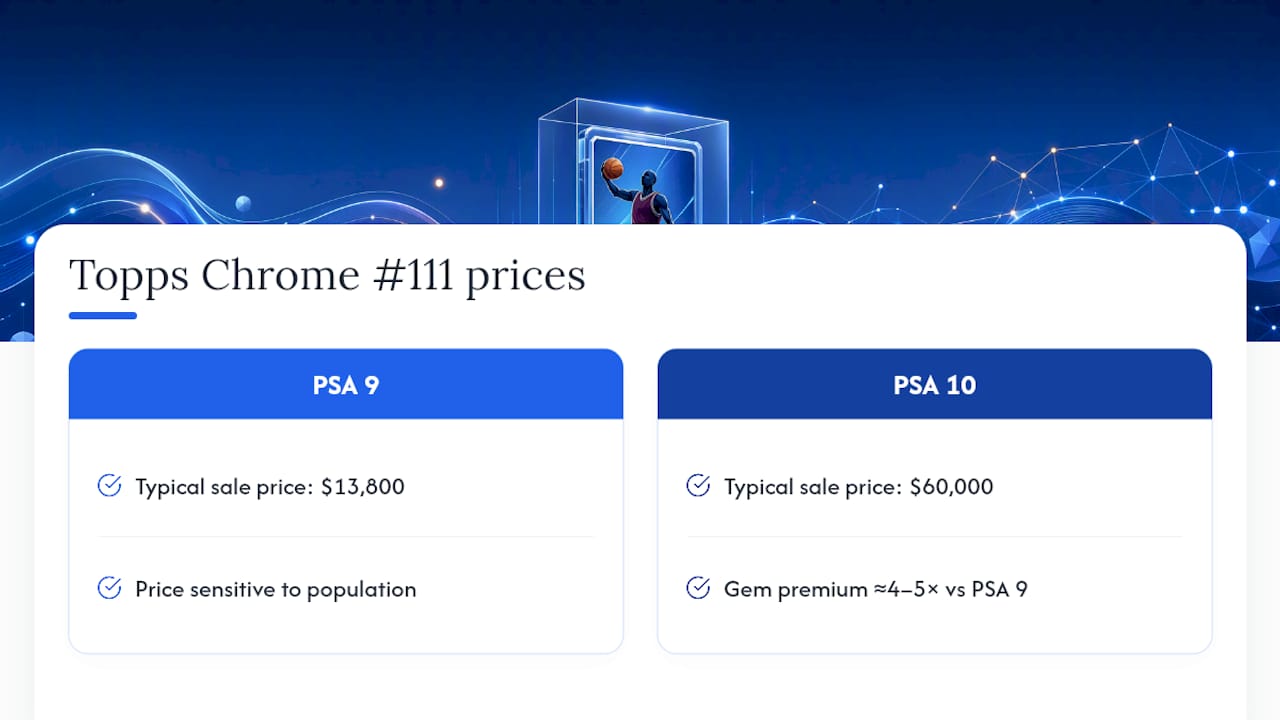
Pro Tip: Before you assume a PSA 9 is “close enough” in value to a PSA 10, check the specific parallel’s population report. On low-population refractors, the price gap between grades widens rather than narrows, because the handful of PSA 10 copies become the only liquid supply serious buyers will consider.
Autograph subgrades complicate the picture further on patch autograph cards. A BGS 9 card with a 10 autograph subgrade, like the record Exquisite sale, can outsell a straight BGS 9.5 with a lower auto grade, because collectors weight autograph clarity heavily on signed cards. PSA does not currently break out a separate autograph subgrade the way BGS does, which is one reason serious autograph collectors often prefer BGS grading for signed rookie cards specifically, even though PSA dominates submission volume for unsigned cards.
Notice how the base Topps Chrome and the modern Prizm Silver land close to each other despite being fifteen years apart in issue date. That’s a reminder that print run and current population matter more than pure age when it comes to setting a price floor.
PSA and BGS don’t always move in lockstep on the same card, either. PSA grading tends to dominate submission volume for unsigned base and refractor cards, which means PSA population reports are more complete and PSA comps trade more frequently. BGS retains an edge on signed cards specifically because of that autograph subgrade breakout. A savvy buyer checks both grading companies’ population numbers before assuming one grade’s price applies universally.
How Do You Know If a LeBron Rookie Card Is Actually Worth Its Grade?
Grading solves the honesty problem in card collecting, but it doesn’t eliminate the homework. Here’s the sequence experienced buyers actually run through before paying grail or premium prices:
- Check the population report first, not the price guide. A card’s PSA or BGS population number tells you how many copies exist at each grade, and that number changes over time as more raw copies get submitted. A card that looked scarce two years ago might have a noticeably deeper PSA 10 population today.
- Confirm autograph type before assuming autograph value. An on-card autograph, signed directly on the card surface, generally commands more than a sticker autograph applied afterward, even within the same product and print run.
- Read the serial number against the parallel name. A card marked “/500” is a different animal than one marked “/23,” even if both say “refractor” on the front. Sellers occasionally blur this distinction in listing titles.
- Inspect centering and edges under strong light, especially on 2003 paper stock. The Topps #221 flagship rookie is notorious for centering issues and edge chipping that keep true PSA 10 copies scarce despite a healthy original print run, which is part of why gem copies hold value better than their raw print numbers would suggest.
- Demand provenance on anything above five figures. A card with a documented chain of ownership, prior grading submission history, or a named auction house record is safer than one appearing with no history attached.
Pro Tip: Cross-shopping a chrome parallel? Pull the population reports for both PSA and BGS side by side. A card with a shallow PSA population but a deep BGS population (or vice versa) usually signals which grading company collectors have historically preferred submitting to for that specific parallel, and that preference often tracks liquidity.
Authentication matters more on autographed cards than on any other category, because a convincing forged signature is far easier to produce than a convincing forged patch or a forged serial number. Reputable grading companies authenticate the autograph as part of the grading process, which is exactly why an ungraded “raw” signed LeBron card, regardless of how good it looks in photos, should be priced and treated with real caution until it’s been through third-party review.
What Do LeBron’s Record Sales Tell You About the Market?
The $5.2 million Exquisite RPA sale is the number every LeBron collector knows, but it’s a private sale, not an auction result. That distinction matters for how you interpret it. Private sales establish what a highly motivated buyer was willing to pay a highly motivated seller outside any competitive bidding process. Public auction records, by contrast, reflect real-time competition between multiple bidders, which is why hobby analysts generally treat auction results as the more reliable signal for where a broader market actually sits.
That doesn’t make the private sale meaningless. It does mean smart collectors treat it as a ceiling reference rather than a market average. A separate high-profile public auction sale of an autographed LeBron Cavaliers rookie card, reported in 2026, gives a competing data point that’s arguably more useful for benchmarking, precisely because it emerged from open bidding rather than a private negotiation.
Beyond that single grail sale, hobby trackers have documented a steady string of six-figure and seven-figure LeBron transactions across 2021 through 2025, including reported sales in the $2.4 million and $2.1 million range for other Exquisite RPA variants and premium patch autograph cards. Several patterns emerge when you line these sales up chronologically:
- Headline grail sales tend to trigger renewed buying interest in the Chrome Refractor ladder within weeks, a trickle-down effect that shows up clearly in sold-comp data if you watch it closely.
- Public auction results carry more weight for verification purposes than private sales, because the bidding process itself confirms multiple parties actually valued the card at that level.
- A single record sale doesn’t always predict where the next comp lands. Grail-tier cards trade infrequently enough that one outlier bidder, driven by a personal milestone or rivalry with another collector, can distort a single data point without shifting the underlying market.
- Watch for single-bidder spikes specifically on cards with thin auction history. If a card jumps 40% above its last comp with no clear population change or grading update behind it, that’s a signal to wait for a second confirming sale before treating the new number as the real market price.
The practical lesson: one price is not a market. Serious buyers and sellers look for at least two or three comparable sales, ideally split between private reporting and public auction records, before committing real capital to a purchase or accepting an offer on a card they’re ready to sell.
Where Should You Buy, Sell, or Verify a LeBron Card’s Value?
LeBron rookie cards move through four main channels, and each one trades convenience against cost differently. Major auction houses handle the grail and premium tiers well because they attract the deep-pocketed bidders those cards need, but they charge buyer’s and seller’s premiums that can run into double-digit percentages combined. Specialist card marketplaces offer faster turnaround and lower fees than a full auction house, though liquidity for six-figure cards can be thinner. Consignment services split the difference, handling authentication and listing on your behalf for a cut of the final sale. Peer-to-peer marketplaces offer the lowest friction for mid-tier and entry-level cards, but they put more authentication responsibility on the buyer.
Before listing anything or making an offer, pull the most recent sold comps for that exact card, grade, and parallel rather than relying on a general price guide that might be months out of date. This is where a live sold-comps database earns its keep: A platform that tracks real market data across a large number of cards can show actual recent transaction prices rather than a static estimate. Scanning a card through the platform can return an instant value assessment pulled from live sales data, and a personal collection locker can let users track how their LeBron holdings move as new comps come in.
Transaction safety matters regardless of which channel you choose. A few non-negotiables:
- Never send payment before confirming the grading company’s certification number matches the card in hand, checkable directly on PSA’s or BGS’s own lookup tools.
- Use escrow or a platform with built-in buyer protection for any single transaction above a few thousand dollars.
- Request photos of the card under multiple lighting angles, not just the seller’s standard listing photo, especially on chrome parallels where surface flaws hide in flat lighting.
- Confirm population count and grade date on any card claimed to be “recently graded,” since a fresh grading date on an old card can sometimes signal a recent crack-and-resubmit attempt.
Pro Tip: *If you’re deciding between listing a mid-tier gem yourself or consigning it, run the math on fees both ways using actual recent comps for your exact grade.
Should LeBron Rookie Cards Be Part of Your Investment Portfolio?
Liquidity is the first thing to understand before treating LeBron cards as an investment rather than a collection. Grail-tier cards like the Exquisite RPA are genuinely illiquid. There may be only a handful of qualified buyers worldwide at any given time, and finding one willing to transact at your target price can take months. Mid-tier chrome gems trade far more frequently, with active sold-comp history updating weekly on the most popular parallels. Entry-tier paper rookies are the most liquid of all, simply because more buyers can afford to enter that price range on short notice.
Volatility in this market comes from three overlapping sources. Hobby-wide interest cycles push demand up when a broader wave of new collectors enters the market, then cool when attention shifts elsewhere. LeBron’s own on-court and off-court milestones, like career scoring records or major retirement speculation, tend to spike short-term demand for his cards specifically. And broader macro liquidity conditions affect how much disposable capital collectors have available for discretionary purchases in any given stretch, which shows up in slower auction activity during tighter economic periods.
For holding horizons, most experienced collectors treat grail and premium tier cards as multi-year holds rather than short-term trades, given how thin the buyer pool is at those price points. Mid-tier and entry-tier cards support more flexible timelines because liquidity supports faster exits if needed. Diversification matters here the same way it does in any collectible asset class:
- Spread exposure across at least two or three different parallels rather than concentrating entirely in one card, since a single population update or grading trend can move one specific parallel disproportionately.
- Balance a genuinely illiquid grail purchase with more liquid mid-tier holdings if you might need to access capital on short notice.
- Track sold comps regularly rather than checking values only when you’re ready to sell, since price shifts on gem-grade chrome parallels can happen faster than casual collectors expect.
On taxes: profits from selling collectible cards are generally treated as capital gains for tax purposes in the United States, and the holding period typically affects the rate applied. The specifics depend on your individual situation, so consult a qualified tax advisor before assuming any particular treatment applies to your sales. Resources like Ripbin’s sports card investing guide can help frame portfolio strategy, but tax guidance should always come from a licensed professional.
Reading the 2026 Tape: What Collectors Should Watch Next
The LeBron market in 2026 looks less like a single trend and more like two separate markets running in parallel. Grail-tier RPAs trade on scarcity and legacy narrative, largely insulated from short-term hobby sentiment because the buyer pool is so small and so motivated. The Chrome Refractor ladder, meanwhile, behaves like an actual liquid market, complete with weekly price discovery, visible gem-premium math, and enough transaction volume to trust the comps.
That split is worth internalizing before you buy anything. A lot of newer collectors price their mid-tier chrome cards off headline grail sales, and that’s a mistake. Those two segments don’t move together nearly as often as the excitement around a record sale suggests.
Two things worth watching heading into the rest of 2026: any anniversary-driven attention around LeBron’s rookie season, which has historically produced short-term demand spikes on the Chrome and Bowman Chrome ladder specifically, and whether any additional Exquisite RPA variants surface at public auction rather than private sale, which would give the market its clearest verification point yet against that $5.2 million private benchmark.
— Saad
Track Your LeBron Rookie Cards With Real Sold Data
If you’re trying to figure out what your Topps Chrome Refractor is actually worth right now, not what a price guide said six months ago, you need sold comps updated to the current week. Ripbin pulls live market values from over 78,000 cards using real completed sales, not asking prices, so a scan of your card returns a number grounded in what buyers are actually paying today.

There is no browsing fee to check a value, and no subscription wall blocks access to sold-comp history needed to price a card accurately. Cards can be scanned to get an instant valuation, then added to a personal locker to track movement as new comps roll in. If you’re building out a broader LeBron collection or comparing where the Chrome ladder sits against other rookie-era cards, browse LeBron rookie values on Ripbin and see exactly where your cards land against real recent sales.
Sources
- LeBron James rookie card sells for record $5.2 million - ESPN
- The Best LeBron James Cards to Invest In (2026): Real PSA 10 Pricing & Charts | Graded.World
- The most expensive LeBron James NBA trading card sales ever | Hoopshype
- The Best LeBron James Cards to Invest In (2026) | CardboardSniper
- LeBron James autographed Cavs rookie card sells record price at public auction | Bleacher Report