Invest With Ripbin's 78,000+ Live Sales: A 2026 Sports Card Playbook
By Ripbin Research · Published 2026-08-27

Invest With Ripbin’s 78,000+ Live Sales: A 2026 Sports Card Playbook
Sports cards can be a viable alternative asset in 2026, but only for buyers who treat this like an investment class rather than a hobby with upside. The evidence favors scarcity-focused, disciplined buying over chasing hype. Start with a modest monthly budget, buy liquid and scarce cards, and check sold comps and population reports before every purchase. Ripbin’s live pricing and grading data make that first step measurable instead of guesswork.
TL;DR:
- Focus on scarcity, including vintage blue-chips and low-population parallels, as demand for fewer, rare cards grows in 2026.
- Always verify pop report figures and sold sale prices within the last 60 days to assess genuine rarity and market demand before buying.
- Diversify your card portfolio across different tiers and set sell targets, considering market liquidity and transaction costs from grading and fees.
- Avoid mass-produced base cards and questionable seller claims, especially for high-value vintage or autographed cards, by checking high-resolution condition photos.
- Use live sales data and buy reports to identify undervalued cards and track your holdings’ value over time through platforms like Ripbin.
Table of Contents
- What to Buy When Investing in Sports Cards in 2026
- How Do You Evaluate a Single Card Before Buying?
- How Should You Structure a Sports Card Portfolio?
- Where and How to Buy and Sell Sports Cards
- Common Mistakes and Red Flags to Avoid
- Data-Driven Investing: Using Ripbin’s Live Sales Data and Buy Reports
- How Do You Verify Authenticity and Spot Counterfeits?
- How Should You Store and Preserve Cards to Protect Their Value?
- What Insurance Options Exist for High-Value Card Collections?
- Author Perspective: What I Would Do With $2,000 Today
- Put This Plan Into Action With Ripbin
- Sources
What to Buy When Investing in Sports Cards in 2026
Not every card deserves a spot in your portfolio, and the categories that hold value share one trait: scarcity that outpaces demand. Vintage blue-chips (think pre-1980s Hall of Famers in graded holders), numbered parallels under a print run of 25, and second-year stars with a proven track record all behave differently than mass-produced rookies flooding the market.
High-grade GOAT-tier cards have posted dramatic price appreciation in 2026, with some collectors now treating them the way art buyers treat a limited print run. Low population counts and one-of-one parallels create the same scarcity dynamic on a smaller budget.
A reasonable starter allocation for a $1,000 entry point looks like this:
- 40% in one graded vintage blue-chip card (PSA 7 or higher)
- 30% in a numbered parallel with a print run under 99
- 20% in a second-year star with strong on-field metrics
- 10% held as cash for opportunistic buys during price dips
Statistic Callout: The shift industry watchers describe isn’t toward more cards. It’s toward fewer, scarcer ones. Yardbarker’s 2026 coverage found that collectors increasingly favor low-population assets over base rookies, which have flooded secondary markets for decades without appreciating.
How Do You Evaluate a Single Card Before Buying?
Grading changes everything about a card’s price, and the gap between a PSA 9 and a PSA 10 can run 5 to 10 times on modern cards with tight centering standards. That gap is where most buyers overpay: they see “PSA 9” and assume it’s close enough to a 10, when population reports often show the 10 is genuinely rare and the 9 population is enormous by comparison.
Here’s a practical evaluation sequence before you commit money:
- Pull the population report. A low pop count for the top grade signals real scarcity; a high pop count means the “rare” grade isn’t actually rare.
- Check sold comps, not asking prices. Completed eBay sales tell you what buyers actually paid in the last 30 to 60 days.
- Weigh performance signals for active players. Exit Velocity and Barrel Rate for MLB prospects, Usage Rate for NBA rookies, and career WAR for established players all correlate with long-term card demand better than hype alone.
- Inspect centering, surface, and autograph authenticity in high-resolution photos before bidding, since these are the traits graders penalize hardest.
Pro Tip: Cross-reference a card’s pop report against its sold comps from the last 90 days. If the population is climbing faster than sale prices, the grading pipeline is catching up to demand, and that card’s ceiling may already be priced in.
How Should You Structure a Sports Card Portfolio?
Treat card allocation like any other alternative asset class: spread risk across tiers instead of betting big on one grail card.
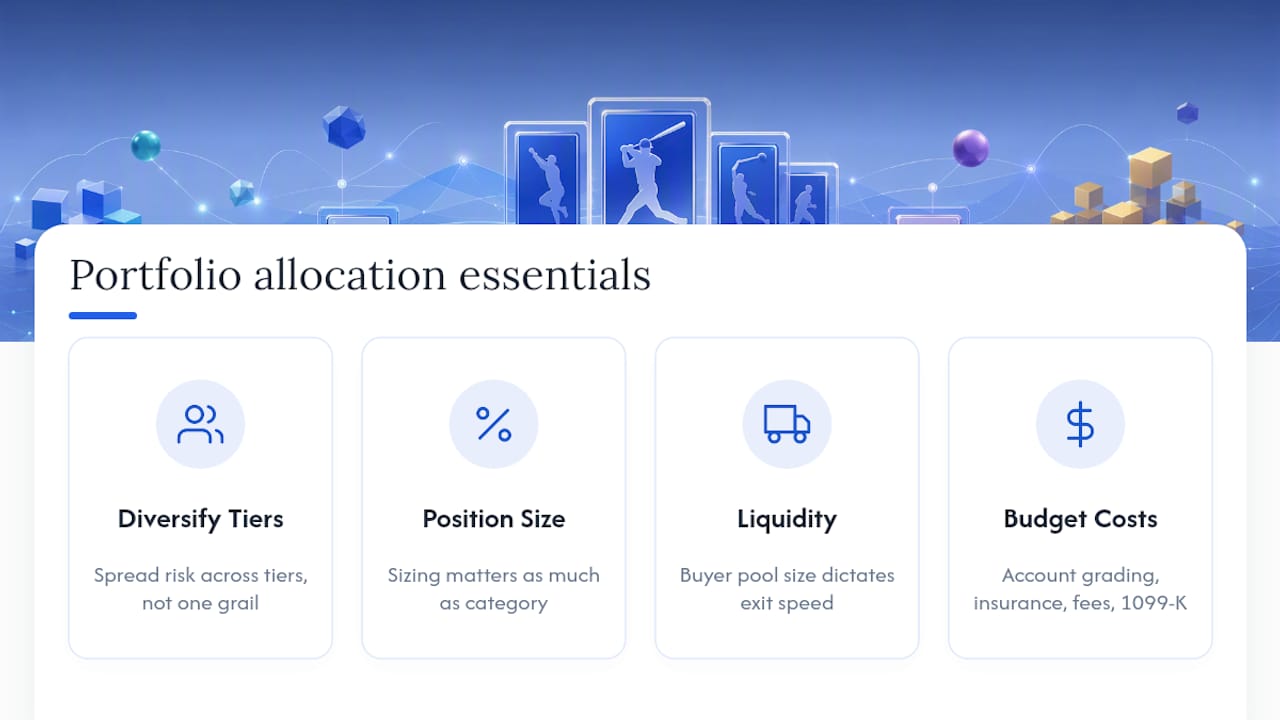
Position sizing matters as much as category. That way, one bad grading result or one player’s career-ending injury doesn’t wipe out months of gains.
Liquidity planning is the part most new investors skip. Buyer pool size, not the number on a price-tracking app, determines how fast you can actually exit a position. Set a sell trigger price before you buy, and know roughly how many similar cards sold in the past quarter.
Statistic Callout: Grading costs, shipping insurance, marketplace fees, and potential 1099-K reporting on cumulative sales all eat into returns before you ever calculate profit. Budget those costs into your break-even math from day one, not after the sale closes.
Where and How to Buy and Sell Sports Cards
Marketplaces, auction houses, and private forums each serve a different purpose, as explained in this wholesale sourcing guide. Marketplaces work best for liquid, actively traded cards where sold comps are plentiful. Auction houses fit high-value vintage and GOAT-tier pieces where a bidding war can push price above the last comp.
Checking completed listings, timing bids near auction close, and negotiating through Best Offer all shave real dollars off acquisition cost. Grading submission timing matters too: standard turnaround can stretch during peak season, and a card sitting at the grading company for months is a card you can’t sell.
- Check sold comps across the last 60 to 90 days before setting a target price.
- Factor grading fees ($20 to $150 depending on tier and speed) and marketplace fees (often 10% to 13%) into your minimum acceptable sale price.
- Submit for grading during off-peak months to avoid multi-month bottlenecks.
| Cost Type | Typical Range | Impact on Break-Even |
|---|---|---|
| Grading fee (standard tier) | $20–$50 | Raises minimum resale price |
| Grading fee (expedited) | $20 to $150 | Only worth it for time-sensitive flips |
| Marketplace/auction fee | 10%–13% of sale | Must be added to target markup |
| Shipping and insurance | $10–$30 per transaction | Often overlooked in profit math |
Common Mistakes and Red Flags to Avoid
Most losses in this hobby trace back to a handful of repeatable errors, and they’re avoidable once you know to look for them.
- Buying mass-produced base cards from oversaturated modern sets, sometimes called “junk wax 2.0,” expecting scarcity that never arrives.
- Overpaying for a PSA 9 when the population report shows the 9 tier is common and only the 10 tier is genuinely scarce.
- Holding obscure parallels with a thin buyer pool, where a rising price on paper means nothing without a buyer at that price.
- Trusting a seller’s condition claims without cross-checking high-resolution photos against grading standards.
Pro Tip: Before buying from an unfamiliar seller, ask for timestamped photos under natural light showing all four corners and both surfaces. A seller who hesitates is a red flag worth walking away from.
Data-Driven Investing: Using Ripbin’s Live Sales Data and Buy Reports
Ripbin’s core value for investors comes down to three connected tools: live market values pulled from actual completed sales, an instant scan feature that identifies and prices a card from a photo, and a personal locker that tracks your holdings against real-time value shifts. The platform’s monthly buy reports flag specific undervalued cards using sold-comp data rather than speculation.
A practical workflow looks like this:
- Scan a candidate card or browse Ripbin’s monthly buy report for a starting shortlist.
- Check its population report and recent sold comps side by side.
- Set a target buy price below the median comp and a target sell price with a defined margin.
- Log the purchase in your locker and track its value monthly against new sales data.
Live sales data beats a static price guide because card values shift week to week with grading pop changes and player performance. A number that’s three months old can already be wrong.
How Do You Verify Authenticity and Spot Counterfeits?
Counterfeit and altered cards are a real risk once a player’s cards start commanding four or five figures, and the fakes have gotten more convincing than most new buyers expect. The most common manipulation isn’t an outright forgery. It’s trimming, where a seller shaves fractions of a millimeter off the edges of a lower-grade card to improve centering and resubmit it for a higher grade.

Third-party grading from PSA, BGS, or SGC remains the strongest authenticity signal available, since each company examines surface, centering, corners, and autograph authenticity under controlled conditions before sealing a card in a tamper-evident holder. Buying raw (ungraded) cards carries meaningfully more risk, particularly for high-value vintage or autographed pieces where forged signatures circulate.
A few checks reduce exposure meaningfully. Compare the holder’s serial number against the grading company’s public certification lookup tool before finalizing a purchase, since a mismatched or unlisted cert number is an immediate red flag. Look closely at edge consistency in high-resolution photos. Trimmed cards often show subtly uneven borders that don’t match the manufacturer’s original cut pattern. For autographed cards, cross-reference the signature against known exemplars from the same signing event, since some forgeries copy an athlete’s general signature style without matching the specific pen pressure or slant from that particular autograph session.
Buying only graded cards from established platforms, and avoiding raw high-value cards from unfamiliar sellers entirely, eliminates most of this risk before it starts.
How Should You Store and Preserve Cards to Protect Their Value?
Condition is the single variable most within your control after purchase, and poor storage can turn a PSA 9 candidate into a PSA 7 within a year. Humidity, light exposure, and physical pressure are the three enemies of long-term card preservation.
Raw cards belong in rigid holders, not soft penny sleeves alone. A semi-rigid or magnetic one-touch holder prevents corner dings and surface scuffs during handling, and it’s a cheap upgrade compared to the value it protects. Graded cards already sit in tamper-evident slabs, but those slabs still need protection from drops and pressure, so a padded storage box designed for slabbed cards is worth the modest cost.
Climate control matters more than most collectors realize. Humidity above roughly 50% accelerates card stock warping and can promote mold growth on decades-old cardboard, while direct sunlight fades ink and causes noticeable discoloration within months, not years. Store high-value cards in a climate-controlled space, away from windows, basements prone to moisture, and attics that swing in temperature.
For a collection with real dollar value, a fireproof and waterproof safe rated for paper documents offers a meaningful layer of protection against the two disasters that destroy collections outright: fire and flooding. Keep an inventory list with photos stored separately from the physical collection, ideally in a digital locker, so you have documentation even in a worst-case scenario.
What Insurance Options Exist for High-Value Card Collections?
Most standard homeowners or renters insurance policies cap collectibles coverage at a few thousand dollars total, far below what a serious card portfolio is worth once vintage blue-chips and graded rookies start accumulating. That gap catches collectors off guard the first time they file a claim.
A scheduled personal property endorsement, sometimes called a rider, adds specific high-value items to an existing homeowners or renters policy at an appraised value. This works well for a handful of standout cards but becomes cumbersome once a collection spans dozens of graded pieces.
Specialty collectibles insurers that focus on trading cards, comics, and memorabilia offer policies built specifically for this asset class, typically covering theft, fire, flood, and accidental damage at a percentage of the collection’s documented value. These policies usually require an itemized inventory with grading certification numbers and recent appraisals or sold-comp documentation, which is exactly the kind of record a value-tracking locker makes simple to maintain.
Whichever route you choose, keep receipts, grading certificates, and dated photos for every card above a few hundred dollars in value. Insurers settle claims faster and more fairly when documentation exists before a loss happens, not after.
Author Perspective: What I Would Do With $2,000 Today
With $2,000, I’d split it three ways: $1,000 into one graded vintage blue-chip card with a documented sales history, $600 into a numbered parallel of an established star with a print run under 50, and $400 held back for a second-year player whose performance metrics are trending up but whose card price hasn’t caught up yet.
I’d spend more time researching than buying, at least a few hours per candidate checking pop reports and sold comps, because that homework is what separates a good entry price from an overpay. Before any purchase, I’d write down my exit price and log every transaction, since that habit pays off twice: once when it’s time to sell, and again at tax season when you need a clean record of cost basis.
— Saad
Put This Plan Into Action With Ripbin
Everything in this guide, checking pop reports, comparing sold comps, sizing positions, tracking exit prices, gets easier when the data lives in one place instead of six browser tabs. Ripbin pulls live market values from actual completed sales across more than 78,000 cards, so the price you see reflects what buyers are really paying right now, not a stale guide number.

Scan a card to get an instant valuation, log it in your personal locker to track it against future sales, and check the latest monthly buy report for specific picks backed by real sold-comp data. There are no browsing fees, and Ripbin’s marketplace keeps transaction costs low compared to traditional auction routes. Start by browsing current card listings and checklists to build your first watchlist, or open the full investing guide if you want the step-by-step version of everything covered here.
Sources
- Sports Card Investing in 2026: How to Start, What to Buy, and What to Avoid | Yardbarker
- Explosion of sports card values for players dubbed the GOAT on display at the National
- Rawrsportscards