Avoid 6–10 Week Consignments: Best Card Auction Sites for Collectors
By Ripbin Research · Published 2026-09-22

Avoid 6–10 Week Consignments: Best Card Auction Sites for Collectors
For most collectors, Ripbin is the smartest starting point among the best card auction sites because it pairs live sales data with low-friction listing, which matters more than raw platform size once you’re pricing a specific card. Rare, high-grade vintage still belongs at a specialist auction house. Everything else, from modern parallels to mid-tier vintage, sells faster and cheaper on a data-backed marketplace. The sections below walk through exactly how to tell which bucket your card falls into.
TL;DR:
- Cards under a few hundred dollars are best suited for broad marketplaces due to their quick turnover and lower fees, while high-value vintage cards benefit from auction house presentation and bidding competition.
- Estimated market value, rarity sensitivity, and urgency of sale should guide your choice between marketplace, specialist auction, or integrated platforms.
- Always calculate net proceeds by factoring in seller fees, buyer premiums, grading costs, and shipping before listing or consigning a card.
- Timelines vary from days for marketplaces to several months for auctions, especially if grading or vault custody is involved; confirm dates in writing beforehand.
- Using Ripbin’s live market data and value tools helps collectors accurately price cards and avoid common mistakes of overestimating value or choosing the wrong selling channel.
Table of Contents
- Which Card Auction Sites Fit Which Kind of Card?
- How Do You Choose the Right Auction Channel for Your Card?
- How Long Does It Take to Sell a Card at Auction?
- Practical Checklist for Selling and Bidding on Cards
- What Ripbin Brings to the Table for Card Sellers
- The Real Mistake Collectors Make With Channel Choice
- Get Real Card Values Before You List or Consign
- Sources
- FAQ
Which Card Auction Sites Fit Which Kind of Card?
Not every card belongs in the same channel, and treating a $40,000 vintage rookie the same way you’d treat a $60 modern parallel is one of the most common mistakes new sellers make. Three broad channel types dominate the hobby right now, and each one serves a different job.
Broad marketplaces are built for volume. They connect the widest possible pool of buyers and sellers, and they’re where most day-to-day card trading happens. For the broadest buyer reach and routine buying or selling, broad marketplaces remain the default comparison point, while specialist auction houses are generally the better fit for rare, high-value cards where catalog presentation and a concentrated bidder pool justify the wait.
Specialist auction houses run on a slower cadence, built around consignment, cataloging, and a scheduled close. They exist because certain cards, a 1952 Mantle, a graded Charizard from the original base set, need a curated audience willing to pay a premium for provenance and presentation. That audience doesn’t materialize on a general marketplace search page.
Integrated platforms that combine auction-house pedigree with vault and marketplace features occupy a middle lane. They can be genuinely powerful for vaulted, authenticated premium cards, letting a card move from grading to vault storage to sale without ever-changing hands physically. But these integrated services often carry higher buyer premiums and seller fees, and pulling a card out of the vault later can trigger removal and shipping costs.
Here’s how the three stack up on the factors that actually affect your outcome:
- Fees: Broad marketplaces tend to charge the lowest combined seller and buyer fees; specialist houses and vault-integrated platforms charge more for their concentrated buyer pool and presentation.
- Buyer depth: Marketplaces win on volume; specialist houses win on depth of serious, well-funded bidders for a narrow category.
- Timeline: Marketplaces can close in days; specialist auctions run on weeks-to-months consignment cycles.
- Authentication and vault options: Specialist and integrated platforms typically build in grading verification and vault custody; open marketplaces leave more of that burden on the seller.
Channel-market fit beats platform loyalty. A card sells best where its actual buyers already shop, not wherever you happen to have an account.
How Do You Choose the Right Auction Channel for Your Card?
Picking a channel isn’t a gut call. It’s a three-question filter, and running through it takes less time than photographing the card.
- What’s the card’s estimated market value? Pull a current price from a live database rather than an old sale you remember. A card worth under a few hundred dollars rarely justifies a specialist house’s consignment minimums and timeline. A card worth five figures or more usually does.
- How sensitive is the value to grade and rarity? A raw common from a recent set barely moves based on presentation. A PSA 10 rookie in a scarce print run is exactly the kind of item where catalog placement and bidder competition at a specialist house can add real dollars.
- Do you need speed or maximum exposure? If you need cash in a week, a marketplace listing beats a two-month consignment cycle every time. If you can wait for the right auction calendar slot, exposure to a concentrated buyer pool can outweigh the delay.
Once you know the channel, calculate what you’ll actually walk away with. Sellers consistently underestimate how much a buyer premium and grading costs eat into a headline hammer price. Build your net proceeds estimate from these line items:
- Seller or consignment fee (a percentage the platform takes off the sale price)
- Buyer premium, if the venue charges one on top of the bid (this doesn’t come out of your pocket directly, but it affects what buyers are willing to bid)
- Grading fees, if the card needs to be graded before listing
- Shipping and insurance to get the card to the platform or buyer safely
- Vault or storage fees, if the channel requires custody before sale
Subtract all of that from the expected hammer price, and you get the number that actually matters.
Before you consign anything, run a few trust checks. Confirm the platform’s authentication process for graded cards, ask how disputes get resolved if a buyer claims the card doesn’t match the listing, and get payout terms in writing, not a verbal promise from a rep. Red flags include vague timelines, no clear return or dispute policy, and reluctance to specify who holds the card between intake and sale.
Pro Tip: Photograph your card under neutral lighting from at least three angles, front, back, and a close-up of any corner or surface flaw, before you ever request a quote. Auction houses and marketplace buyers both move faster on listings with complete documentation up front, and it protects you if a condition dispute comes up later.

Have your grading certificate number, any provenance documentation, and clear photos ready before you approach any channel. It’s the single fastest way to speed up intake.
How Long Does It Take to Sell a Card at Auction?
Timelines vary more than most first-time sellers expect, and the gap between channels is the biggest factor in whether an auction site fits your situation.
On a broad marketplace, listing to payout can take anywhere from a few days to two weeks, depending on your listing format and how quickly a buyer commits. You control most of that timeline yourself.
Specialist auction houses run on a longer, more structured clock. Trophy items typically require consignment intake, cataloging, and a scheduled auction close before payout, which usually stretches into weeks or a couple of months from the day you hand over the card. That delay buys you catalog placement and a curated bidder pool, but it means your capital sits tied up longer.
Here’s roughly what each path looks like end to end:
- Marketplace listing: List, sell, ship, get paid. Often one to two weeks total.
- Specialist auction consignment: Intake and grading verification, cataloging and photography, a preview window, the auction event itself, then remittance. Often six to ten weeks, sometimes longer for major seasonal sales.
- Vault-integrated platforms: Similar to specialist houses on the auction side, but a vaulted card that later needs to move can add extra days for withdrawal and shipping logistics.
Grading adds its own delay if the card isn’t already certified. A raw card sent for grading before listing can add weeks depending on the grading company’s turnaround tier, and that clock runs before any of the auction timeline even starts.
Get the expected schedule in writing before you consign anything. Ask specifically for dates on cataloging, preview, sale, and remittance, and follow up if any of those dates slip without explanation. A reputable house will give you a real answer, not a shrug.
Practical Checklist for Selling and Bidding on Cards
Good execution matters as much as picking the right channel. A well-presented listing on the right platform can outsell a poorly documented one on a “better” platform every time.
For photography and condition disclosure, shoot in even, diffused light with no glare, capture both sides plus close-ups of any corner wear or surface scratches, and describe flaws in the listing text even if they’re visible in photos. Buyers reward honesty with higher bids and fewer disputes.
For packaging and shipping, use a rigid card holder inside a bubble mailer or small box, never a bare card in a plain envelope, and insure anything over roughly $100 in value. Get tracking on every shipment and photograph the package before you seal it.
For bidders, verify a seller’s history and feedback before placing a serious bid, read the full item description rather than just the photos, and confirm the platform’s authentication process before bidding on anything graded. After the auction closes, verify the card matches the listing the moment it arrives, and report discrepancies immediately rather than waiting.
A simple day-of-listing checklist covers most of what trips up first-time sellers:
- Confirm the card’s current market value using a live price database.
- Verify grading certification number and condition notes match the physical card.
- Photograph front, back, and any flaw areas in neutral lighting.
- Write an honest, specific condition description.
- Choose your channel based on the value and speed decisions covered above.
- Confirm fee structure and estimated net proceeds before submitting.
- Save all correspondence and payout confirmations until the transaction fully closes.
What Ripbin Brings to the Table for Card Sellers
Ripbin exists to solve the exact problem this article keeps circling back to: knowing what a card is actually worth right now, not what it sold for six months ago.
Live market data for a large catalog of sports and Pokémon cards lets collectors scan an item, get an instant value read, and track it inside a personal collection locker, turning what used to be guesswork into actionable numbers.
That data coverage matters most in the moment before you list or consign anything. Instead of relying on a stale comp or a gut feeling, you can check current market values pulled from actual recent sales, which is the foundation of every net-proceeds calculation covered earlier in this article.
Ripbin’s broader feature set supports the full decision process a serious seller needs:
- Scan and value tools that give an instant worth assessment from a photo, useful for triaging a large collection before deciding what goes where.
- A collection locker that tracks value changes over time, so you know when a card’s price has moved enough to justify selling.
- Data-driven investment recommendations and monthly buy reports that flag cards worth watching.
- No browsing fees, which keeps the cost of research low while you’re comparing channels and prices.
Collectors weighing a Pokémon-specific sale, in particular, can lean on the Pokémon card investing guide for category-specific pricing context before choosing between a marketplace listing and a specialist consignment.
The Real Mistake Collectors Make With Channel Choice
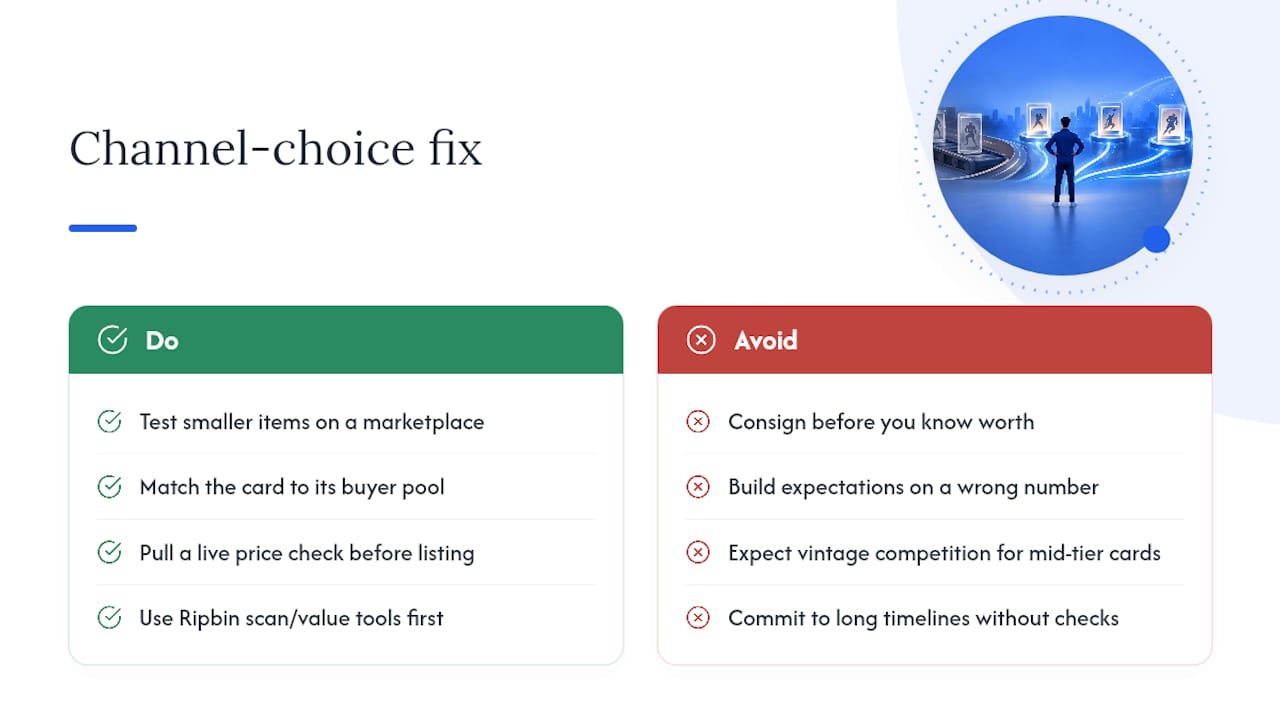
Most sellers don’t lose money because they pick a bad platform. They lose money because they pick a platform before they know what the card is actually worth, then build their expectations around the wrong number.
I’ve seen the pattern repeat across message boards and comment sections for years: someone consigns a mid-tier card to a specialist house expecting vintage-level bidder competition, waits two months, and nets less after fees than a same-week marketplace sale would have delivered. The fix isn’t complicated. Test smaller items on a marketplace first to get a feel for real demand, match the card to a buyer pool that actually wants it, and pull a live price check before you commit to any timeline. Ripbin’s scan and value tools exist for exactly that gut check, and using them before you list costs nothing but a few minutes.
— Saad
Get Real Card Values Before You List or Consign
Ripbin fixes the guessing part of selling. Every price on the platform comes from actual sales data across a large number of cards, and there are no browsing fees standing between you and the number you need before you consign or list anything.

That data advantage matters most in the gap between “I think this card is worth something” and “here’s the number, and here’s where it should sell.” A trophy-tier vintage card with real provenance still belongs at a specialist auction house, where catalog presentation and a concentrated bidder pool earn their premium. But for the vast majority of cards moving through the hobby, from modern parallels to mid-tier vintage, checking a live valuation first and listing on a platform that keeps fees low beats guessing and hoping.
Start by browsing current card values for anything sitting in your collection, or dig into the sports card investing guide if you’re building a longer-term buying and selling strategy. Collectors looking for specific opportunities can also check the monthly picks report for cards the data flags as undervalued right now.
Sources
- eBay, Collectors Enter into Commercial Agreement; Sign Deals for Acquisition of Goldin by eBay and Acquisition of the eBay Vault by PSA
- Fanatics Collect Review: Marketplace, Vault, and the Goldin Acquisition Era | CardSense AI
- Ebay Acquires Goldin Auctions From Collectors Holdings
FAQ
Does Ken Goldin Still Own Goldin?
No. Goldin was acquired as part of a broader set of transactions involving eBay and Collectors Holdings, including eBay’s acquisition of Goldin and PSA’s acquisition of the eBay Vault. Ownership has consolidated as major platforms in the hobby merge their auction, marketplace, and vault operations.
What Is the Best Card Pricing Site?
For live, sales-based pricing across a large card catalog, Ripbin is built specifically for that job, tracking market data across more than 78,000 sports and Pokémon cards. It also lets users scan a card for an instant value read rather than manually searching old comps.
What Is the Most Legit Auction Site?
Legitimacy comes down to clear authentication practices, transparent fee disclosure, and payout terms you can get in writing, not any single platform name. Broad marketplaces suit routine, high-volume trading, while specialist auction houses with established cataloging and grading verification processes tend to be the safer choice for high-value, rare cards.
What Is the Best Website to Sell Cards On?
The right site depends on the card. Routine and modern cards generally sell fastest and cheapest on broad marketplaces, while rare, high-value vintage cards often net more through a specialist auction house willing to catalog and present them to a concentrated bidder pool. Checking a live valuation on Ripbin before choosing either path helps you set realistic expectations for both.