Pokémon Card Values: How to Check What Your Cards Are Worth
By Ripbin Research · Published 2026-08-23
Pokémon Card Values: How to Check What Your Cards Are Worth
Check completed sales on a live price database, filtered by grade, and you’ll have a real number in under a minute. Three things move that number more than anything else: grading, condition, and rarity. A raw copy of a chase card can sit at a fraction of what the same card fetches once graded.
- Grading (PSA, BGS, CGC) can push value up dramatically depending on the card
- Condition (surface, edges, centering) decides which grade you’ll actually get
- Rarity and print variant (first edition, shadowless, alternate art) set the ceiling
The multiplier effect: Iconic vintage cards have shown raw-to-PSA10 jumps of roughly 10x to 50x, depending on the specific card and era.
Your next move: scan or search the card by set and number on a live price database, filter to its grade, and see what actually sold, not what someone’s hoping to get.
Key Takeaways
Reliable Pokémon card values come from completed sales filtered by grade, not from asking prices, and grading only pays off when a card’s rarity and demand can absorb the fee.
| Point | Details |
|---|---|
| Check completed sales first | Filter by grade and recent sale date rather than trusting active listings or asking prices. |
| Grading multipliers vary widely | Iconic vintage cards can see roughly 10x to 50x jumps from raw to PSA 10, but commons often see little uplift. |
| Triage before you research | Pull holos, rares, and alternate art in a five-minute sort so you know which cards deserve deeper lookup. |
| Most cards are bulk | A small share of chase and graded cards drives most high-dollar sales; the rest trade for cents. |
| Use live data to decide and track | Ripbin’s scanning tool and collection locker turn completed-sale data into a fast keep, sell, or grade decision. |
Table of Contents
- What Determines Pokémon Card Values: 5 Key Factors
- Where to Check Real-Time Pokémon Sold Prices
- How Grading Changes Rare Pokémon Card Prices
- Rare Pokémon Card Prices by Era: What to Expect
- How to Check Pokémon Card Value: A Step-by-Step Workflow
- Selling and Listing Tips That Protect Your Realized Price
- The Impact of Recent Market Trends on Pokémon Card Values
- How the First Edition Charizard Shaped the Whole Market
- Common Mistakes People Make When Appraising Card Value
- What the Data Actually Tells Collectors
- Get Live Pokémon Card Values Without the Guesswork
- Sources
What Determines Pokémon Card Values: 5 Key Factors
Condition sets the ceiling before anything else does. Graders look at surface scratches, whitening on the edges, and centering, front and back. A card that’s 60/40 off-center rarely climbs past a PSA 7, no matter how clean it looks otherwise.
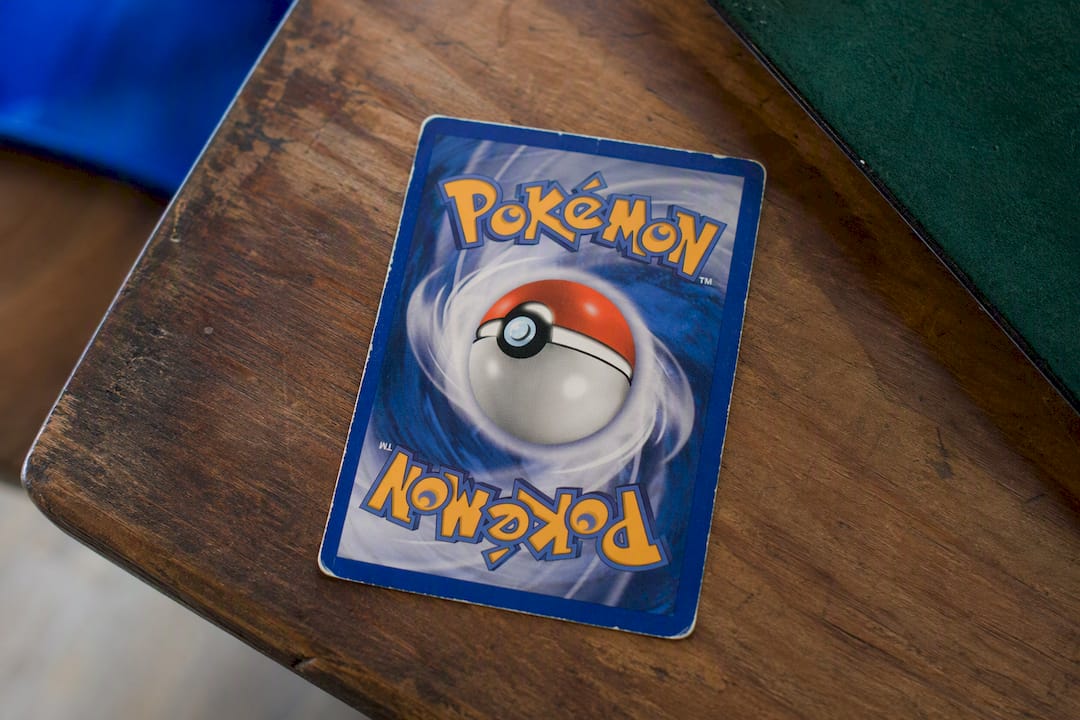
Rarity and print variant come next. First edition stamps, shadowless print runs, holo patterns, and alternate art chases all carry different demand curves, and buyers pay accordingly. Era matters too: vintage WOTC-era cards (1998 to 2003) trade on scarcity and nostalgia, while modern alternate-art chases trade on hype and short print windows.
Population also drives price. A card with thousands of PSA 10 copies in circulation behaves differently than one where only a handful exist in top grade. Fewer surviving mint examples means fewer comps and often wider price swings.
- Condition: surface, edges, centering
- Rarity: first edition, shadowless, holo, alternate art
- Era and demand: vintage WOTC vs. modern chase
- Population: how many mint copies actually survive
- Authenticity: counterfeit risk drags real value to zero
Most cards from a typical collection fall outside these five factors entirely, a pattern common in many collectibles markets as detailed in LEGO Cars Disney : le guide pour collectionneurs (sets retirés, valeurs, où acheter) | brickInsiders. A small percentage of chase or graded cards accounts for the bulk of high-dollar transactions, while everything else trades for cents in bulk lots.
Where to Check Real-Time Pokémon Sold Prices
Realized prices beat asking prices every time. A listing tells you what a seller wants; a completed sale tells you what a buyer actually paid. That distinction sounds obvious until you’re staring at three “Buy It Now” listings that are 40% higher than anything that’s actually closed recently.
- Search by exact set name and card number, not just the Pokémon’s name.
- Filter results by grade (raw, PSA 9, PSA 10, BGS 9.5, and so on) and by sale date, favoring the last 30 to 90 days.
- Cross-check a handful of completed sales rather than trusting a single outlier.
- Read the price chart for trend direction, not just the current number.
Price guides built on completed sales with frequent updates give you a far more honest signal than static listing pages that only get refreshed occasionally. Watch out for thin sales volume on rarer cards. If only two copies sold this year, one auction with an aggressive bidder can distort the whole chart. Currency and region matter too. A card sold at a UK auction house isn’t directly comparable to a US eBay sale without accounting for the difference.
Pro Tip: If a chart shows a sudden spike, check the sale date against major release news or a viral social post. Hype spikes correct fast, and buying at the peak is how new collectors overpay.
How Grading Changes Rare Pokémon Card Prices
Grading exists to solve a trust problem. A raw card is only as valuable as the buyer’s confidence in your description, and that confidence has a price ceiling. Once a third-party grader authenticates and encapsulates a card, that uncertainty disappears, and liquidity improves along with it.
The uplift from raw to graded varies enormously by card. On desirable vintage chases, completed sales show multipliers between roughly 10x and 50x once a card lands a PSA 10. On common cards from recent sets, that same PSA 10 might only add a few dollars over the raw price, sometimes not even enough to cover the grading fee.
- Grading pays off best on iconic, high-demand, or vintage cards
- It rarely pays off on bulk commons or low-demand modern cards
- Turnaround time and fees eat into the math, so factor those in before submitting
PSA tends to carry the strongest general market premium in Pokémon specifically, while Beckett’s Black Label can command major premiums on modern cards that land perfect subgrades across the board. That’s a narrower audience, but a real one.
Rare Pokémon Card Prices by Era: What to Expect
Base Set headliners like Charizard, Blastoise, and Venusaur anchor most people’s mental image of card values, and for good reason. A raw, played-condition Base Set Charizard might sell for a modest amount, while a PSA 10 first edition copy occupies an entirely different price tier, often into five or six figures depending on the market moment.
WOTC and Neo era holos follow a similar shape. Shining Pokemon and early secret rares from that stretch (1999 to 2003) command real premiums in high grade, though nowhere near the ceiling of the flagship Base Set chases. Raw copies of these cards often sell for tens of dollars; graded gems can run into the hundreds or beyond.
Modern alternate-art chases behave differently. These cards can debut hot, cool off once supply catches up, then stabilize. Raw copies of a hot alternate art might sell for $50 to $150 shortly after release, with PSA 10 copies commanding several multiples of that during peak demand.
- Base Set icons: modest raw prices, dramatic graded premiums
- Neo/WOTC chase holos: moderate raw, solid graded uplift
- Modern alternate art: volatile early, more stable later
- Everything else: bulk pricing, cents per card, not worth individual listing
That last point matters more than any single example above. Most of what’s in a shoebox isn’t a chase card, and pricing it like one wastes time.
How to Check Pokémon Card Value: A Step-by-Step Workflow
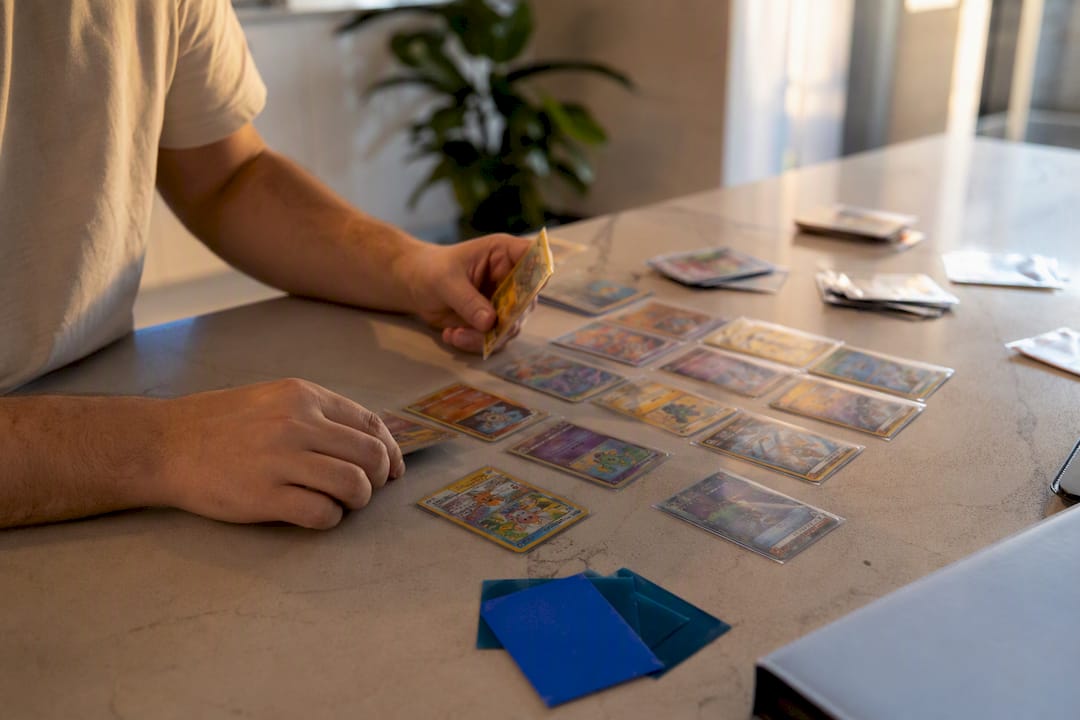
Start with a five-minute visual sort before you look anything up. Pull every holo, every rare symbol, every alternate art, and anything featuring a popular Pokemon. Set the rest aside as probable bulk. This triage step alone eliminates 90% of the guesswork because most collections concentrate their value in a small handful of cards.
- Triage: separate holos, rares, and popular characters from everything else.
- Lookup: search each candidate by exact set and card number on a live database or scanning tool.
- Filter: narrow results to the card’s actual condition or grade, and check only recent completed sales.
- Decide: list it raw, bundle it into a bulk lot, or submit it for grading, based on the numbers you just pulled.
- Track: log the card and its estimated value, and set an alert if you’re waiting for a better market window.
Before submitting anything for grading, run the break-even math. If grading costs $20 to $30 per card and current turnaround times run several weeks, that only makes sense when the graded price realistically clears raw value by a wide enough margin to cover fees, shipping, and the wait.
Pro Tip: Keep a simple spreadsheet or a collection tracker with purchase price, current estimated value, and grading status. It turns “I think I have some good ones” into an actual decision-making tool.
Selling and Listing Tips That Protect Your Realized Price
Auction format tends to work better for high-demand chase cards where competing bidders drive the price up. Fixed-price listings work better for common cards where buyers just want a fair, predictable price and won’t chase a bidding war.
- Use clear, well-lit photos showing the exact card, front and back, including any grading label
- State the exact set, print variant, and card number, not just the Pokémon’s name
- Disclose condition honestly, including any whitening, scratches, or off-centering
- Price in shipping insurance and marketplace fees before setting your number, not after
- Avoid listing during known oversupply windows, like right after a set gets reprinted
Listing quality and honest condition notes consistently correlate with higher realized prices and fewer disputes after the sale closes. A vague description costs you money even when the card itself is genuinely valuable.
The Impact of Recent Market Trends on Pokémon Card Values
Pokémon card values move in cycles tied to nostalgia waves, new set releases, and broader collectibles sentiment. The 2020 to 2021 boom pushed vintage prices to levels that took years to fully settle, and while the market corrected afterward, it corrected to a floor well above pre-boom pricing on iconic cards.
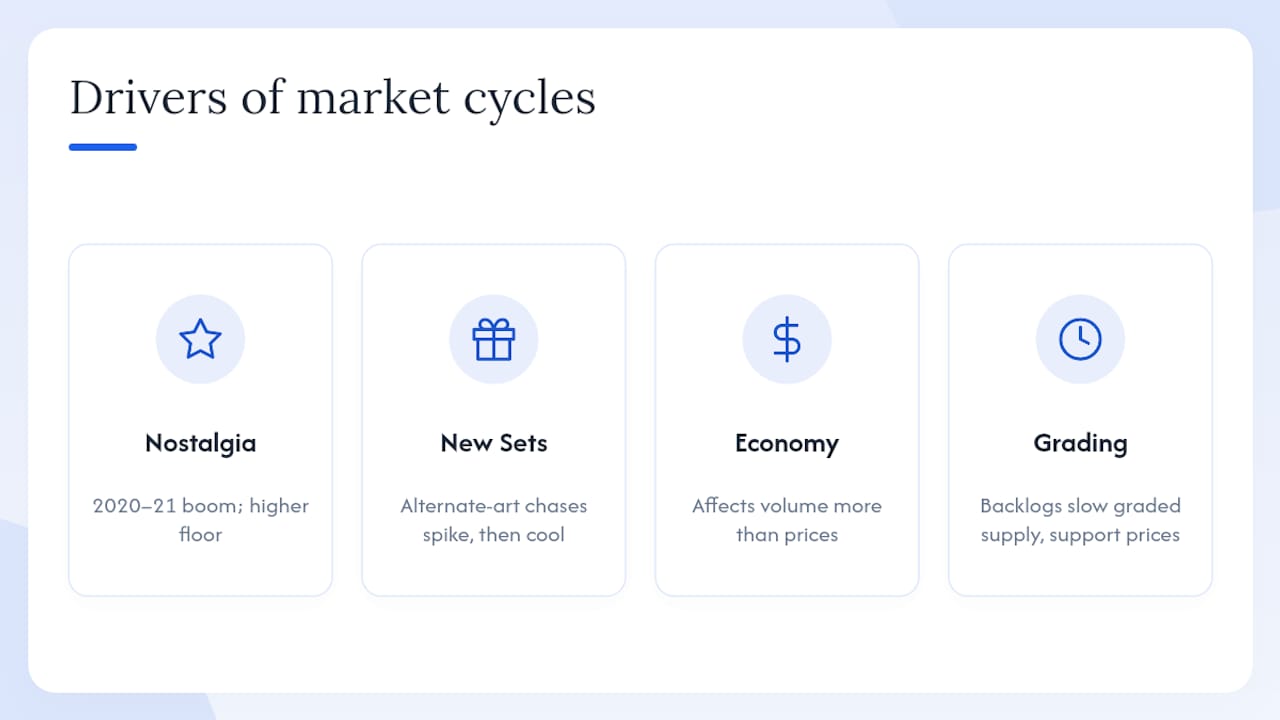
Modern set releases now shape short-term price swings almost as much as vintage nostalgia does. A hyped alternate-art chase can debut at aggressive prices, spike further if a streamer or influencer features it, then cool once print supply catches up with demand. That cooling isn’t necessarily a bad sign. It’s often just the market finding its real level after an artificial spike.
Broader economic conditions play a role too. Collectibles as an asset class tend to see more speculative buying when other investment options feel uncertain, and less when disposable income tightens. That correlation isn’t perfect, but it shows up in trading volume more than in headline prices.
Grading company turnaround times and fee changes also ripple into values indirectly. When submission backlogs grow, fewer graded copies enter the market in the short term, which can support prices on already-scarce cards simply because supply of graded copies slows down even while raw supply stays the same.
The practical takeaway: don’t anchor your price expectations to a screenshot from a boom year. Check what’s actually selling now, not what sold at the market’s peak.
How the First Edition Charizard Shaped the Whole Market
No single card did more to define collector expectations than the first edition Base Set Charizard. Its price trajectory over the past decade became the reference point every other vintage card gets measured against, fairly or not.
That outsized attention created a useful side effect: because Charizard sales get tracked and discussed so heavily, they generate an unusually deep well of completed-sale data across every grade tier. Collectors researching almost any other vintage card end up comparing print runs, grading population reports, and price behavior against the Charizard benchmark, even when the card in question has nothing to do with it.
The downside is that headline Charizard prices distort expectations for everything else. A new collector who sees a PSA 10 first edition Charizard sell for a huge number can walk away assuming every holo rare from that era carries similar upside. It doesn’t. Charizard’s combination of character popularity, print scarcity in top grade, and cultural nostalgia is close to unique. Most cards, even genuinely rare ones, don’t share that combination.
Understanding why Charizard commands what it does, rather than just what it commands, is the more useful lesson. Popularity of the character, scarcity in high grade, and the depth of nostalgia around the original 1998 to 1999 release all stack together. Look for that same stacking, not just a similar-looking card, when judging whether another vintage holo deserves similar confidence.
Common Mistakes People Make When Appraising Card Value
The most frequent mistake is pricing off listings instead of completed sales. Asking prices reflect hope, not reality, and using them as your benchmark inflates every estimate downstream.
A close second is ignoring condition nuance. Two cards that look identical to an untrained eye can grade three points apart once centering and edge wear get measured properly, and that gap can be the difference between a modest sale and a genuinely strong one.
Collectors also tend to overweight small sample sizes. Seeing one recent sale at a high price doesn’t establish a market; it establishes one data point. Check multiple completed sales across a reasonable window before trusting a number.
Skipping authenticity checks is another costly error. Counterfeit and reprinted cards circulate more than most new collectors expect, and pricing a fake as if it’s genuine wastes real research time on a card worth nothing. Check card stock texture, print quality, and holo pattern against known genuine examples before assuming a rare find is real.
Finally, many people forget currency and regional differences when comparing sales across marketplaces, and they forget that grading fees, shipping, and marketplace commissions eat into any “profit” they calculate on paper. The number on a sold listing isn’t the number that ends up in your pocket.
What the Data Actually Tells Collectors
The biggest gap between conventional card-collecting advice and what the numbers show is this: most people spend far too much time researching individual cards and not nearly enough time triaging their whole collection first. The five-minute sort matters more than any single lookup, because it tells you where to spend your research time in the first place.
Conventional wisdom also oversells grading as a universal move. It’s not. Grading is a bet that only pays off when a card’s demand and rarity profile can absorb the fee and the wait. Applying that bet to bulk commons is how new sellers lose money on cards that were never going to clear a meaningful premium.
What actually works is treating valuation as an ongoing habit, not a one-time appraisal. Prices shift with hype cycles, print reprints, and grading population changes, so a number you checked six months ago may already be stale. Collectors who check completed sales regularly, rather than relying on memory or an old screenshot, consistently make better keep-or-sell decisions.
Prioritize the cards most likely to matter, verify with real completed sales, and revisit your numbers before you act on them.
— Saad
Get Live Pokémon Card Values Without the Guesswork
Checking sold prices card by card across scattered marketplaces eats hours you don’t have, and static price guides go stale fast. Ripbin pulls live market data across more than 78,000 cards, sourced directly from actual completed sales rather than asking prices, so the number you see reflects what buyers are really paying right now.
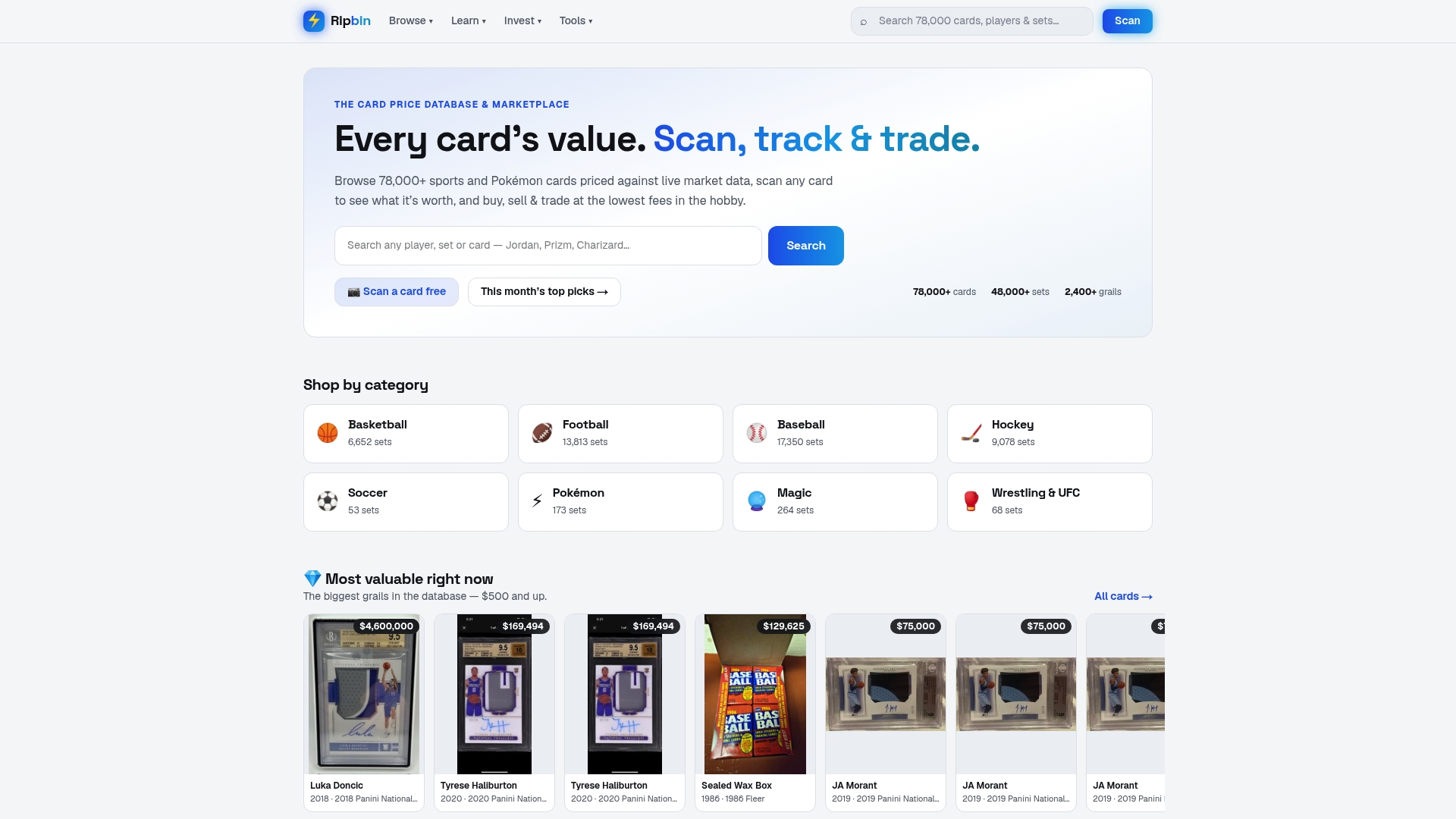
Scan a card with your phone and get an instant value read, no manual set-and-number lookup required. Every card you own can live in a personal collection locker, where you track value changes over time and set alerts for the ones you’re watching before a grading decision or a sale. There’s no browsing fee to search the database, and transaction fees only apply when you actually buy or sell through the marketplace. For readers weighing whether to grade a specific card, Ripbin’s Pokémon card investing guide breaks down when that bet tends to pay off.
Start by scanning your top finds and checking their live values on Ripbin’s card database.