Stop Chasing Hype. Data First Modern Pokémon Set Values for Collectors
By Ripbin Research · Published 2026-09-19
Stop Chasing Hype. Data First Modern Pokémon Set Values for Collectors
Modern sealed product is broadly correcting while vintage graded singles and a handful of low-population modern chase cards keep climbing. If you’re buying booster boxes hoping for quick appreciation, most modern sealed products have moved the wrong way since early 2025. The better move right now: prioritize graded singles with tight populations, buy sealed only at MSRP if you intend to open it or hold three-plus years, and use a live-data tool to track set-level moves before you commit cash.
TL;DR:
- Modern sealed products have declined by 15% to 25% since March 2025, especially for high-population booster boxes, while vintage boxes and high-grade singles continue to rise.
- Cards with low PSA populations, strong pull-rate scarcity, and artist or IP relevance resist price drops better than mass-produced chase cards.
- Reprint announcements and spikes in graded population growth are immediate signals to be cautious with set value and demand.
- Focus on graded singles over sealed packs for precision, especially when the population of a card is rapidly increasing or nearing saturation.
- Tracking live sales data and population reports is essential, as social media hype often causes short-term price moves that may not hold long-term value.
Table of Contents
- Current Modern Pokémon Set Values: A Market Snapshot
- What Actually Moves Modern Pokémon Card Values?
- The Hottest Modern Pokémon Sets Worth Watching
- How to Value a Modern Pokémon Set: A Quick Framework
- What Ripbin’s Live Data Shows Right Now
- Does Card Condition Still Matter Beyond the Grade?
- How Much Does Social Media Hype Actually Move Prices?
- Turning This Framework Into Your Own Strategy
- Track Every Modern Set’s Value Without the Guesswork
- Sources
- FAQ
Current Modern Pokémon Set Values: A Market Snapshot
The market has split cleanly into two camps. Vintage sealed and high-grade vintage singles keep grinding upward, while a large share of modern English sealed product has been sliding since roughly March 2025. Average modern sealed declines over that stretch have landed in the 15–25% range, with some sets falling harder than others.
The set-by-set spread makes the point better than any average. Chaos Rising booster boxes are down around 17%. Meanwhile, Prismatic Evolutions has held relative sealed strength even as its top singles corrected sharply after reprint waves hit in 2025 and 2026.
Graded singles tell a more mixed story than sealed product. Modern graded singles as a category have softened too, but not uniformly. Cards with genuinely low PSA populations and strong pull-rate scarcity have resisted the slide better than mass-pulled chase cards from high-print sets.
Three signals matter more than any single price point right now:
- Sell-through rate: if a set’s sealed listings sit unsold for weeks, that’s a supply glut, not a floor.
- Reprint chatter: any official reprint announcement typically triggers an immediate correction, often before the reprinted cards even ship.
- Monthly index swings: a greater than 5% single-month move on Ripbin’s set index is worth investigating before you buy or sell.
Market snapshot: Modern sealed product has dropped 15% to 25% on average since March 2025, while vintage sealed and high-grade vintage singles have continued to strengthen over the same window, according to PokeInsider’s market analysis.
What Actually Moves Modern Pokémon Card Values?
Six factors decide whether a modern set holds value or bleeds it out, and most collectors only track one or two of them.
- Reprint risk. This is the single biggest threat to modern chase cards. Prismatic Evolutions’ Umbreon ex illustration rare fell roughly 40% after multiple reprint waves in 2025 and 2026, even though the card remains one of the set’s most recognizable pulls.
- Pull-rate tiers. Modern rarity now runs through several layers, from illustration rares (IR) to special illustration rares (SIR) up through special art rares (SAR) and Mega Hyper-tier cards. Mega Evolution series top chases run roughly 15% to 25% rarer than average Scarlet & Violet sets, with SAR and SIR odds landing around 1 in 78 to 92 packs. Tighter odds compress supply and support premiums, at least until reprints arrive.
- Graded population growth. Every fresh wave of submissions to PSA or CGC pushes the population count up, and population growth mechanically lowers the multiple a PSA 10 commands over a raw card. This effect hits modern cards harder than vintage ones simply because more copies exist to submit.
- Playability and regulation marks. A card legal in Standard or Expanded play has a demand floor that pure chase cards lack. Once a card rotates out, that floor often disappears with it.
- Artist and IP equity. Cards tied to a beloved illustrator or a fan-favorite Pokémon tend to hold bid longer even as the broader set corrects.
- Sealed SKU scarcity. Elite Trainer Boxes and special collections with lower print runs tend to outperform standard booster boxes from the same set.
Pro Tip: Track PSA and CGC population reports monthly, not once. A card that looks scarce today can look common in six months if submissions spike after a price surge.
The Hottest Modern Pokémon Sets Worth Watching
Some modern sets are earning their attention. Others are riding hype that’s already fading. Here’s where the real signal sits right now.
- Ascended Heroes stands out for its Mega Evolution mechanic and tighter pull structure, with Mega Gengar ex acting as the set’s headline chase and a genuine test case for how scarce Mega-tier cards behave once submission volume ramps up.
- Perfect Order has drawn steady collector interest thanks to a mix of playable staples and chase-tier singles that haven’t been flooded with reprints yet. Watch grading population growth here closely; it’s still early.
- Chaos Rising sits on the weaker end of sealed performance, down roughly 17% on booster boxes, but its chase singles have been more resilient than the sealed numbers suggest.
- Prismatic Evolutions remains the most talked-about modern set of the past year, anchored by Umbreon ex, even after its reprint-driven correction. Sealed product has held up better than the singles that made it famous.
- Pokémon 151 continues to pull strong sell-through on nostalgia alone, with older-generation Pokémon reimagined in modern rarity tiers keeping demand steady across both sealed and singles.
The short-term watch list is simple: track reprint announcements on Prismatic Evolutions, watch graded population counts on Ascended Heroes chases, and monitor sell-through velocity on Chaos Rising and Pitch Black before assuming either has bottomed out.
How to Value a Modern Pokémon Set: A Quick Framework
Run through this checklist before buying sealed product or a graded single from any modern set:
- Check reprint risk first. Search for any official reprint news on the set or the specific card. This single factor can erase a chase card’s premium overnight.
- Confirm pull-rate evidence. Look up the actual odds for the rarity tier you’re chasing, not just the set’s marketing copy.
- Pull the graded population. A PSA 10 population under a few hundred copies behaves very differently from one climbing past several thousand.
- Verify playability. Check whether the card carries a current regulation mark for Standard or Expanded formats.
- Weigh artist and IP equity. A card tied to a fan-favorite Pokémon or illustrator tends to hold demand longer during a correction.
- Assess sealed SKU scarcity. Elite Trainer Boxes and special collections with capped print runs often outperform standard boosters from the same release.
Three rules of thumb make the checklist actionable. Buy modern sealed at MSRP only if you plan to open it or hold for three or more years; sealed-hold economics tend to beat opening because pack odds make the expected value of opening negative once grading costs enter the picture, with sealed early-week resale premiums for some Mega-series products running 17% to 42% above launch price. Prefer low-population graded singles over sealed boxes when you want precision rather than broad exposure. And when a graded population is already climbing fast, assume the current PSA 10 multiple will keep shrinking rather than hold.
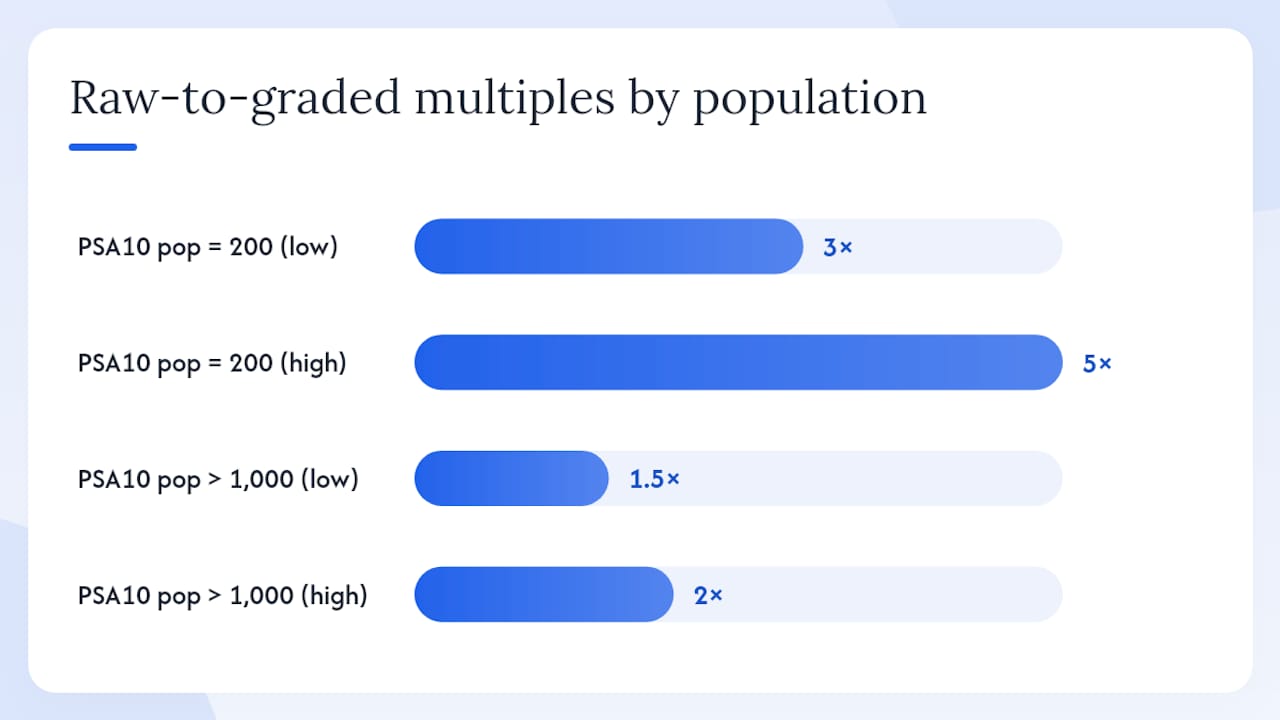
Quick math: a card with a 200-copy PSA 10 population and strong pull-rate scarcity might command a 3x to 5x raw-to-graded multiple. Once that population passes 1,000, expect the multiple to compress toward 1.5x to 2x, all else equal.
What Ripbin’s Live Data Shows Right Now
This platform tracks live values across a large number of cards, including set-level indices and graded population counts, which lets you see a price move within hours instead of guessing from stale listings. That speed matters most during a reprint scare or a sudden sell-off, when prices on other platforms can lag reality by days.
Saad’s read on the current split is direct: hold your vintage graded singles, trim exposure to modern sealed product unless you’re opening it yourself, and if you want upside with real precision, target low-population PSA 10 modern singles rather than broad sealed bets. That’s a narrower strategy than chasing every hyped set, but it’s the one the population data supports.
To operationalize this checklist, use Ripbin’s scan feature to instantly value a card in hand, build a collection locker to track holdings against live prices, and set alerts around the sets you’re watching so a population spike or price swing doesn’t slip past you.
Does Card Condition Still Matter Beyond the Grade?
A PSA 10 label doesn’t freeze a card in time. Storage conditions after grading still affect long-term resale value, sometimes by more than collectors expect.
Slab cases can crack, yellow, or develop internal haze from UV exposure and humidity, and a damaged slab drags down buyer confidence even when the card inside remains flawless. Cards stored in direct sunlight or fluctuating humidity for years can also show edge whitening or color shift severe enough to trigger a resubmission concern, even under an existing grade.

For raw cards, the gap is even wider. Corner wear, surface scratches from careless sleeving, and print lines from factory defects all shape resale value independent of any grading company’s number. A raw near-mint card stored in a soft sleeve inside a cardboard box for a few years frequently grades a full point lower than the same card stored in a rigid case with a UV-protective sleeve from day one.
The practical fix is simple and cheap: use rigid card savers or magnetic one-touch holders for anything you intend to grade later, store binders and boxes away from direct light and humidity swings, and avoid PVC-based sleeves that degrade and can leave residue on card surfaces over time. None of this shows up in a set’s headline value, but it decides whether your specific copy sells at the top or bottom of that set’s price range.
How Much Does Social Media Hype Actually Move Prices?
Influencer content moves modern card prices faster than almost anything except reprint news, and it moves them in both directions. A single viral pack-opening video or a popular collector’s “this card is undervalued” post can spike demand for a specific card within days, well before any structural factor like pull rate or population catches up.
The problem is that hype-driven price spikes rarely hold. Cards that surge on social attention often correct back toward their pre-hype baseline once the content cycle moves on, because the underlying scarcity and playability haven’t actually changed. Chasing a card because it’s trending on video platforms usually means buying near a local peak rather than catching a genuine long-term mover.
That doesn’t mean social attention is noise to ignore entirely. A sustained increase in mentions, sell-through, and search interest around a specific card, sitting apart from a single viral spike, can be an early signal that a card is building real collector demand rather than momentary buzz. The distinction is duration: a one-week spike is hype, a three-month climb backed by rising sell-through is a trend worth taking seriously.
Treat any price move that coincides with a trending post or a celebrity collector reveal as suspect until it’s held for at least a few weeks. If the price gives back most of its gain once the video stops circulating, that’s your answer.
Turning This Framework Into Your Own Strategy
Your goals decide which parts of this guide matter most. A short-term flipper should weight pull rates, reprint risk, and sell-through velocity above everything else, since those move fastest. A long-term investor should lean on graded population trends and playability, favoring patience over reaction. A hobby-first collector chasing nostalgia can mostly ignore all of it and buy what they love, though tracking population data still helps avoid overpaying. Whatever your priority, set alerts and reassess quarterly rather than reacting to every headline.
— Saad
Track Every Modern Set’s Value Without the Guesswork
This platform gives you what most price guides can’t: live values pulled from actual sales, not stale list prices, across a large card database. That matters most right now, when modern sealed is correcting in real time and a static price guide simply can’t keep up.

Every checklist item in this guide maps directly to a Ripbin feature. Scan a card to get an instant value read, drop it into your collection locker to track it against live market moves, and set alerts so a graded population spike or a reprint scare shows up the moment it happens rather than weeks later. Ripbin’s monthly buy reports also flag which sets and singles are showing genuine strength versus hype-driven noise, so you’re not relying on social media timing to make a call.
If you’re managing a modern collection right now, start by browsing current set values and checklists to see where your holdings actually stand today.
Sources
- The Pokémon card market just split in two — here’s which half to buy (PokeInsider)
- Best Pokémon Pack to Buy in 2026: Every Set Scored (Pullmarket)
FAQ
Which Modern Pokémon Cards Are Likely To Increase In Value?
Low-population graded singles with genuine pull-rate scarcity and strong playability tend to hold value best, especially cards tied to popular Pokémon or illustrators. Watch graded population growth closely, since a card with a shrinking PSA 10 pool while demand holds steady is the clearest setup for continued appreciation.
What Is The Hottest Modern Pokémon Set Right Now?
Prismatic Evolutions remains the most discussed modern set, largely on the strength of Umbreon ex, even after reprint waves pulled that card’s price down roughly 40%. Pokémon 151 and Ascended Heroes are also drawing steady attention for nostalgia and Mega Evolution mechanics, respectively.
What Are The Best Modern Pokémon Sets To Collect Right Now?
Ascended Heroes, Perfect Order, Prismatic Evolutions, and Pokémon 151 currently offer the strongest mix of chase-card scarcity, playability, and sustained collector demand. Chaos Rising and Pitch Black have weaker sealed performance but still hold pockets of resilient chase-single value.
Are Any 2026 Pokémon Cards Actually Worth Money?
Yes, but selectively. Cards with tight pull rates, low graded populations, and confirmed Standard-format legality are holding real value in 2026, while heavily reprinted or mass-pulled chase cards from the same sets have corrected sharply.
How Do I Check Current Modern Pokémon Set Values?
The fastest way is checking live, sales-based pricing rather than static list prices, since modern set values can shift within days on reprint news or hype cycles. Ripbin tracks live values across sets and singles, including graded population data, so you can compare current pricing against the checklist in this guide before buying or selling.