Price Kobe Bryant Card Values Instantly With Ripbin Live Sold Comps
By Ripbin Research · Published 2026-08-30
Price Kobe Bryant Card Values Instantly With Ripbin Live Sold Comps
The 1996 Topps Chrome Refractor #138 sits at the top of the Kobe Bryant card market, with true one-of-one patch autographs from Exquisite and National Treasures pushing past it in isolated sales. Values swing hard on grade: a PSA 10 refractor and a PSA 8 of the same card can differ by tens of thousands of dollars. Before you buy or sell anything, confirm the exact grade and pull recent sold comps rather than trusting an asking price.
TL;DR:
- The highest-value Kobe Bryant card is the 1996 Topps Chrome Refractor #138, with PSA 10 copies trading in the high six-figure range.
- One-of-one patch autographs from National Treasures and Exquisite Collection can sell for ten to twenty times more than top-grade refractors due to extreme rarity.
- Grade dramatically impacts value, with PSA 10 copies typically priced several times more than PSA 9 or lower, especially for the Chrome variants.
- Authenticity verification, especially for autographs and slabs, relies on clear labeling, reputable third-party authentication, and comparison to verified images.
- Accurately pricing involves confirming specific card variants, analyzing recent sold comps at the same grade, and adjusting for condition, extras, and fees.
Table of Contents
- What Are the Most Valuable Kobe Bryant Cards Today?
- What Do Kobe Rookie Cards Cost by Grade?
- What Are the Biggest Kobe Bryant Card Sales on Record?
- How Do Grade and Condition Actually Change the Price?
- How Do You Set a Fair Price Using Recent Sold Comps?
- How Ripbin Tracks Live Kobe Bryant Card Prices
- Which Kobe Bryant Card Sets Matter Most?
- Have Kobe Bryant Card Values Changed Over Time?
- What Drives Demand Beyond Grade?
- Where Should You Buy and Sell Kobe Bryant Cards Safely?
- How Do You Spot a Fake or Altered Kobe Card?
- How I’d Position Kobe Cards in a Collection Right Now
- Track Every Kobe Card’s Real Value With Ripbin
- Sources
What Are the Most Valuable Kobe Bryant Cards Today?
Kobe Bryant card values break into four distinct tiers, and mixing them up is the fastest way to overpay or undersell. At the top sit the one-of-one trophy pieces. Below that, high-end patch and autograph inserts from premium modern sets. Then the core rookie chrome cards that most collectors actually chase. Finally, the liquid mid-tier rookies that trade constantly but rarely make headlines.
Here’s how the market currently stacks up, ranked from the rarest and most expensive down to the most accessible entry points.
Tier 1: Grail and trophy pieces
- 1996 Topps Chrome Refractor #138 — Widely considered the Kobe grail among rookie issues. Graded PSA 10 copies have traded in the high six figures, and CardboardSniper’s fair-market analysis tracks a deep, active sold-comp tape at that grade. Lower grades still command strong premiums over the base version.
- National Treasures patch autograph 1/1s — True one-of-one game-used patches with an on-card autograph. These rarely trade publicly, so pricing depends almost entirely on private negotiation and auction house estimates rather than a stable comp set.
- Exquisite Collection rookie patch autographs — Serial numbered to extremely low counts, often under 100 copies, with patch quality and autograph placement swinging value substantially within the same print run.
Tier 2: High-end patch and autograph inserts
- Logoman-level patch cards — Cards featuring the NBA logo patch variant command a distinct premium over standard jersey-tag patches, sometimes multiples higher even within the same product line.
- Exquisite base rookie patch autos (non-Logoman) — Still elite, still low-population, but priced a tier below the Logoman variants.
- National Treasures rookie-era reprints and memorabilia autos — Modern reprint sets built around Kobe’s rookie season carry collector demand thanks to strong on-card autograph programs, even without period-correct rookie status.
Tier 3: Core rookie chrome
- 1996 Topps Chrome #138 (base, non-refractor) — The standard version of the defining Kobe rookie. CardSZN’s player data shows this card carries steep grade-to-price spreads, with PSA 10 copies commanding a large multiple over PSA 9.
- 1997 Metal Universe Precious Metal Gems (PMG) — Serial numbered inserts with a distinctive rainbow foil design that collectors treat as a cult favorite. Low print runs and a devoted following keep this insert’s values well above typical late-90s inserts.
- 1996 E-X2000 #30 — A holographic-style rookie card with a smaller print run than the flagship Topps Chrome release, giving it scarcity that shows up in grade-sensitive pricing.
Tier 4: Liquid mid-tier rookies
- 1996 Topps #138 (paper base rookie) — The most affordable true rookie card, and the one most new collectors start with. High liquidity, deep comp history, but far lower ceiling than the chrome parallels.
- 1996 SP #134 — A mid-tier rookie from Upper Deck’s premium SP line, priced between the flagship Topps Chrome rookie and the base paper rookie.
- 1996 Topps Chrome Refractor #138, lower grades (PSA 7-8) — Still the refractor variant, still desirable, but priced a fraction of the PSA 9-10 range, making it one of the more accessible ways into the grail card’s design.
According to HoopsHype’s tracking of the highest recorded Kobe card sales, the gap between tier one and tier three isn’t linear. It’s exponential. A one-of-one patch auto can sell for ten or twenty times what a PSA 10 Topps Chrome Refractor brings, simply because there’s only one buyer competing against zero substitutes.
What Do Kobe Rookie Cards Cost by Grade?
Grade is the single biggest lever on Kobe Bryant card values, and the jump from one grade to the next isn’t a steady climb. It’s a series of cliffs. Here’s how the five most-discussed rookie issues typically ladder by condition.
- 1996 Topps Chrome Refractor #138: PSA 10 commands a steep premium over PSA 9, often several multiples higher, reflecting the small population of gem-mint refractors and the deep pool of buyers chasing them, per CardboardSniper’s tracking.
- 1996 Topps Chrome #138 (base): Follows a similar shape to the refractor but at a lower price ceiling throughout every grade tier, based on CardSZN’s grade-spread data.
- 1996 Topps #138 (paper base): The flattest ladder of the group. PSA 10 still costs more than PSA 8, but the gap is far smaller than on the chrome parallels, making this the entry point for budget-conscious collectors.
- 1996 E-X2000 #30: A smaller overall population than the Topps Chrome line means fewer sold comps at any given grade, so pricing here tends to move in bigger jumps between available sales.
- 1996 SP #134: Sits between the paper base and the Chrome parallels in both price and grade sensitivity, a genuine mid-tier hold.
Pro Tip: Never assume “Chrome #138” means refractor. The base Topps Chrome and the Refractor parallel share the exact same checklist number, but the label on a graded slab is the only reliable way to tell them apart. Sellers who list a base Chrome as “Chrome #138” without specifying refractor status are either careless or hoping you won’t check.
That’s the single most expensive mistake new buyers make in this entire market. A base Chrome #138 and its Refractor sibling can be worlds apart in value despite an identical card number, and the difference only shows up in the fine print on the slab. Always confirm “Refractor” appears explicitly on the label before paying refractor prices. When in doubt, count the sold comps at your target grade. A thin comp history for a specific grade means the pricing you’re seeing is based on guesswork, not a real market.
What Are the Biggest Kobe Bryant Card Sales on Record?
Headline sales get the attention, but they tell you less about fair market value than most buyers assume. A single trophy sale sets a ceiling. It doesn’t set the market.
- One-of-one Exquisite and National Treasures patch autographs have sold for very high prices at major auction houses, representing the extreme top of what a Kobe card can fetch.
- High-grade 1996 Topps Chrome Refractor #138 copies have traded in the high five and six figure range at auction, with HoopsHype’s compilation of record Kobe sales documenting several of the standout results.
- Logoman patch autographs from premium modern sets have posted sales well above comparable non-Logoman patches from the same product, underscoring how a single design detail can multiply value.
Here’s the catch with headline numbers: a one-off private sale or a single auction result for a one-of-one card can’t be averaged against anything, because there’s nothing else to average it against. That’s fine for a trophy piece, but it becomes a problem when someone tries to use a single six-figure refractor sale to justify a price on a card that hasn’t traded in that condition in over a year. Before you let one big number reset your expectations, check whether it’s backed by a pattern of similar sales or whether it’s an outlier that happened to hit at the right auction, in front of the right two bidders, on the right day.
How Do Grade and Condition Actually Change the Price?
Grading isn’t a formality on Kobe cards. It’s the entire pricing mechanism. The same physical card can be worth radically different amounts depending on four things graders look at closely.
- Centering — Off-center prints get capped at lower grades regardless of how clean the surface looks, and centering issues are especially common on the 1996 Topps Chrome print run.
- Corners — Even microscopic fraying that’s invisible to the naked eye shows up under a grader’s loupe and can be the difference between a 9 and a 10.
- Surface — Chrome and refractor stock show print lines and surface scratches more visibly than paper stock, which is part of why refractor grading tends to run stricter in practice.
- Edges — Whitening along the edges is one of the most common reasons a submitted card comes back lower than the submitter expected.
- Eye appeal — Two cards with the same numeric grade can sell for different amounts if one simply looks better under light, a nuance CollectorsPrice’s condition guide points to as an underrated price driver.
The jump from PSA 9 to PSA 10 (or BGS 9.5 to a true Black Label 10) is rarely proportional. A small surviving population at the top grade creates a bidding dynamic where collectors compete hard for the “perfect” copy, pushing gem-mint prices to several multiples of the grade just below it.
Authentication matters just as much on signed cards. On-card autographs carry more weight than stickered autographs in most collector circles, and provenance matters. Beckett Authentication Services and similar third-party authenticators exist specifically because forged signatures and altered slabs are a real problem in the vintage and modern autograph market alike.
Pro Tip: If a seller can’t show you a clear photo of both sides of the slab, including the label text, walk away. A blurry or cropped label photo is one of the most common ways altered or mislabeled slabs get passed off in online listings.
How Do You Set a Fair Price Using Recent Sold Comps?
Setting an accurate value on any Kobe card comes down to a five-step process, and skipping any one of these steps is how collectors end up overpaying or leaving money on the table.
- Confirm the exact variant. Check the slab label, not just the card number, to rule out the #138 base-versus-refractor trap and any other parallel confusion.
- Pull sold comps in the same grade. Look specifically at completed sales, not active listings. Asking prices reflect hope; sold prices reflect reality.
- Widen the window if comps are thin. If you can’t find at least three or four sales in the exact grade within the past few months, expand your date range or look at the grade just above and below to interpolate.
- Adjust for eye appeal and extras. A serial-numbered parallel, a clean centering note on the label, or a first-ballot Hall of Fame signature can all justify a premium over the raw comp average.
- Subtract for fees before you commit. Marketplace commissions and payment processing fees eat into net proceeds, so price your listing (or your offer) with that spread already factored in.
Pro Tip: Decide before you list whether you’re pricing for speed or for maximum return. A price set at the top of the comp range might sit for months; a price set at the middle of the range often sells within days. Neither is wrong, but know which game you’re playing before you commit to a number.
How Ripbin Tracks Live Kobe Bryant Card Prices
Manually pulling sold comps across multiple platforms is tedious, and it’s easy to miss a recent sale that would have changed your price target. Ripbin solves that by aggregating sold-comp data and grade-by-grade ladders in one place, so you can browse Kobe cards, sets, and current values without stitching together data from five different sources.
- Scan a physical card and get an instant value estimate based on live market data, rather than guessing from memory or an old price guide.
- Build a Kobe-specific watchlist and set alerts for a target grade, so you know the moment a comp lands that shifts your price target.
- Use the collection locker to track your holdings across grades and variants, giving you a running view of your portfolio’s total value rather than a spreadsheet you have to update by hand.
Saad, who covers the trading card market for Ripbin, built this guide around exactly the kind of grade-sensitive analysis collectors need before making a five-figure decision on a single card. Live data beats stale price guides every time a hot comp lands.
Which Kobe Bryant Card Sets Matter Most?
Not every Kobe set carries equal weight in the market, and understanding why helps explain the ranking above.
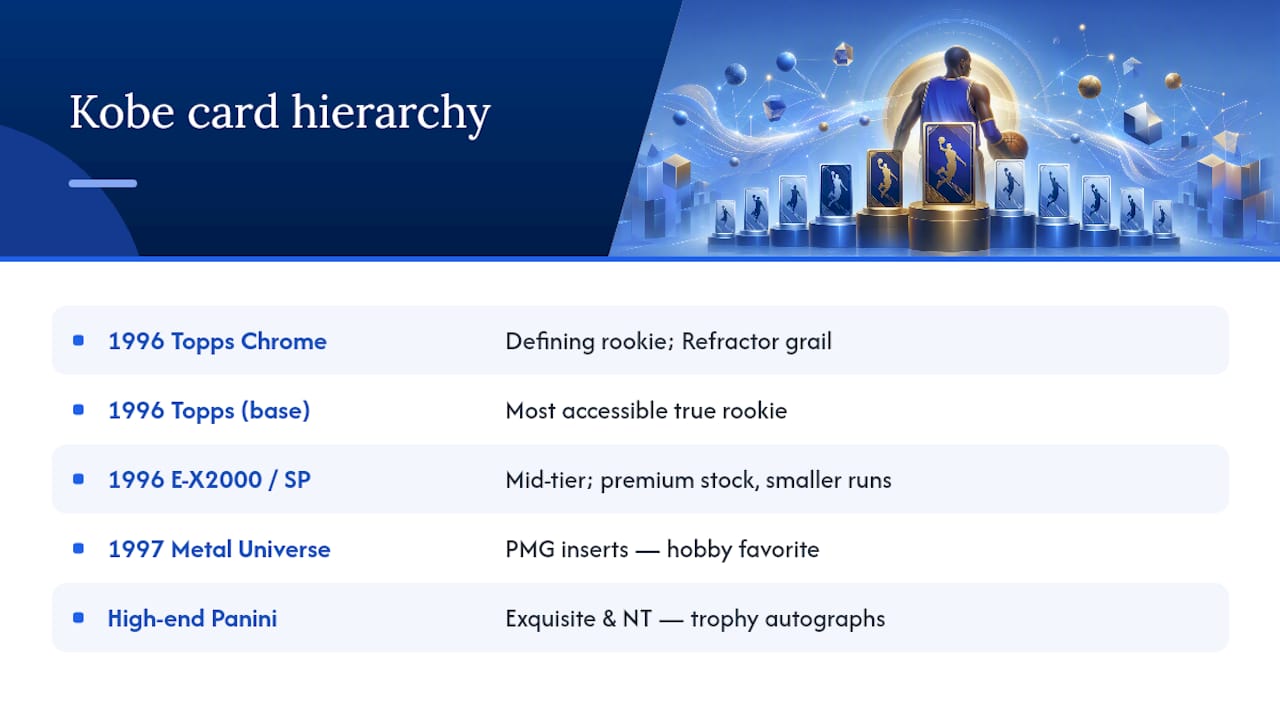
1996 Topps Chrome is the defining Kobe rookie set, full stop. Its refractor parallel created the entire “grail” tier of the market almost single-handedly, and Beckett’s rookie card power rankings consistently place it at or near the top of any Kobe rookie discussion.
1996 Topps (base paper) matters because it’s the most accessible true rookie, giving budget collectors a way into rookie-year ownership without the chrome premium.
1996 E-X2000 and 1996 SP occupy the mid-tier because both used premium stock and smaller print runs than the flagship Topps release, without ever capturing the same design-cult status as the Chrome Refractor.
1997 Metal Universe stands apart because its Precious Metal Gems insert became a hobby favorite almost independent of Kobe himself. Collectors chase PMG inserts across many players, and Kobe’s rookie-year PMG rides that broader demand.
Exquisite Collection and National Treasures, both Panini products released well after Kobe’s playing career began, represent a different category entirely: high-end memorabilia and autograph products rather than rookie cards. They matter because they’re where the true one-of-one trophy pieces live, and they’re often the cards that set the absolute ceiling on Kobe Bryant collectible card worth.
Have Kobe Bryant Card Values Changed Over Time?
Kobe’s card market moved in three distinct phases. During his playing career, values tracked his on-court performance and championship runs, with spikes around MVP seasons and title wins. After his 2020 death, the market saw an intense, emotion-driven surge across nearly every issue, chrome and paper alike, as collectors and casual buyers rushed to acquire anything connected to his legacy.
Since that initial surge, the market has settled into something more typical of an all-time great’s memorabilia: steady, grade-driven appreciation rather than sudden across-the-board spikes. The gap between top-grade and lower-grade copies has widened rather than narrowed, meaning population scarcity at PSA 10 now matters more to price than it did in the immediate aftermath of his death, when almost any Kobe card saw a bump regardless of condition.
That shift matters for anyone timing a purchase or sale today. Buying a mid-grade card hoping for a broad market rally is a weaker bet than it was during the initial surge. The stronger long-term play has consistently been top-grade copies of the cards that already have deep, established comp histories, since that’s where scarcity and demand compound rather than cancel each other out.
What Drives Demand Beyond Grade?
Grade sets the price ceiling within a specific card, but several other factors decide which cards get chased in the first place.
Rarity and print run matter as much as condition. A card serial numbered to 25 copies will command a premium over a similar card with no serial numbering, even at the same grade, simply because fewer people can ever own one.
Autograph presence changes everything. An unsigned rookie card and a signed version of a similar-era card occupy entirely different price tiers, and on-card signatures (versus stickered autographs applied later) consistently draw stronger collector interest.
Limited editions and parallels create their own micro-markets. A refractor, an X-fractor, or a Superfractor of the same base card can trade at wildly different multiples, driven purely by how few copies exist in that specific finish.
Nostalgia and milestone timing also move the needle. Anniversary years tied to championships or career milestones tend to see renewed buying interest, even without any change in a card’s physical scarcity.
Where Should You Buy and Sell Kobe Bryant Cards Safely?
Marketplace choice affects both the price you get and how exposed you are to fraud. Established online marketplaces with buyer and seller protections remain the most common route for everyday transactions, while major auction houses handle the high-end trophy pieces where six and seven-figure sales require more formal bidding processes and authentication.
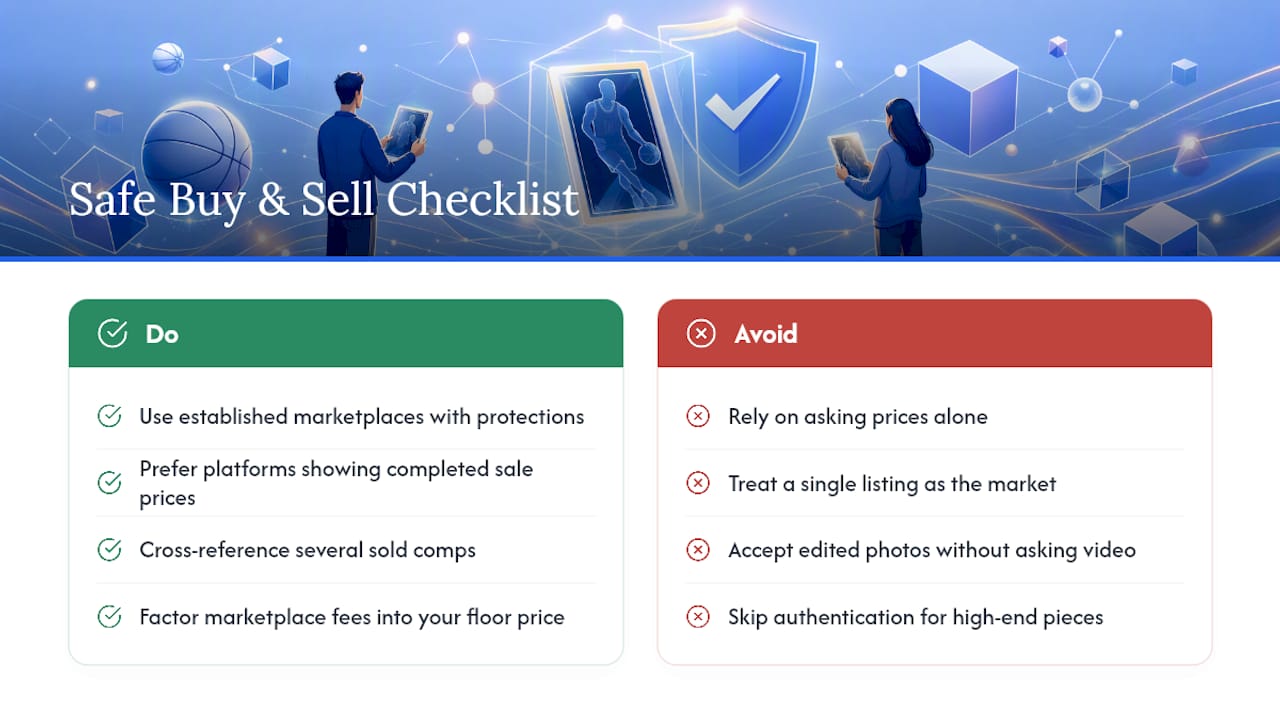
Whichever route you choose, prioritize platforms that show completed sale prices, not just current asking prices. Asking prices are aspirational; they tell you what a seller wants, not what a buyer will actually pay. The gap between the two can be significant, especially on cards that don’t trade often. Cross-reference several sold comps before settling on a number, and treat any single listing price as one data point, not the market.
For sellers, factor in marketplace fees before setting your floor price, since those fees can meaningfully change what a listing price actually nets you. For buyers, request clear photos of the slab label and both card surfaces before committing to any five-figure purchase, and don’t hesitate to ask for a video if the listing photos look edited or overly filtered.
How Do You Spot a Fake or Altered Kobe Card?
Counterfeiting and slab tampering are real problems at every price point in this market, and a few checks can catch most attempts before you commit money.
Check the slab itself first. Reputable grading companies use tamper-evident cases, and a slab that looks re-glued, has a mismatched label font, or shows a certification number that doesn’t match the grading company’s public lookup tool is an immediate red flag. Always verify a cert number directly through the grading company’s own database rather than trusting a screenshot.
For raw, ungraded cards, print quality is your best clue. Chrome and refractor cards from the 1990s have specific surface textures and print patterns that are difficult to fake convincingly, and side-by-side comparison against confirmed authentic images can reveal inconsistencies in color saturation or surface reflectivity.
For autographed cards, third-party authentication from an established service like Beckett Authentication adds a layer of protection that on-card signatures alone don’t provide. Photo-matching, where available, lets you confirm a signature was applied at a documented event rather than added later.
How I’d Position Kobe Cards in a Collection Right Now
If you’re building around Kobe for the long haul, I’d weight your money toward graded, high-population-consensus cards like the Topps Chrome Refractor #138 rather than chasing one-of-one trophy pieces you can’t easily resell. Trophy patches are legacy trophies, not liquid holdings; you might wait years for the right buyer.
For a working portfolio, I’d cap Kobe exposure at a meaningful but not dominant slice of a broader vintage or modern legend allocation. Concentrating too heavily in a single player, even one this significant, leaves you exposed if sentiment or grading population shifts unexpectedly.
Sell into strength when a card you hold hits a fresh high backed by multiple recent comps, not just one auction spike. Hold through quiet stretches if your comp history stays stable. Above all, never trade on a single headline sale. Check the grade, check the comps, then decide.
— Saad
Track Every Kobe Card’s Real Value With Ripbin
Ripbin gives you the one thing every Kobe collector actually needs before making a move: live sold-comp data instead of a stale price guide or a hopeful asking price. Instead of stitching together completed listings across multiple sites, you scan a card or search a set and see current, grade-specific values pulled from real sales.

Build a locker to track your Kobe holdings alongside the rest of your collection, and set alerts on specific grades so you know the moment a comp shifts your price target up or down. Ripbin charges no browsing fees, so checking values costs you nothing whether you’re pricing a single Topps Chrome rookie or auditing an entire portfolio. If you’re ready to see where your cards actually stand, browse current Kobe Bryant card values on Ripbin and start your first locker today.
Sources
- The most expensive Kobe Bryant NBA trading card sales ever — HoopsHype
- The Best Kobe Bryant Cards to Invest In (2026) — CardboardSniper
- Kobe Bryant Cards | CardSZN
- How Kobe Bryant values change by condition — CollectorsPrice
- Beckett Authentication Services