Charizard Card Values: Prints That Reach $1.7M
By Ripbin Research · Published 2026-08-28
Charizard Card Values: Prints That Reach $1.7M
Only a handful of Charizard prints carry serious money: the Japanese No Rarity Base Set, the Base Set 1st Edition, Topsun’s no-number holo, Skyridge Crystal, and select Gold Star, Shining, and Crystal variants. Everything else, print date and edition determine baseline value, then grade and condition decide the final number. Most Charizards in circulation are common; find out which one you have before you assume it’s rare.
TL;DR:
- The Japanese No Rarity Base Set Charizard can sell for around $1.7 million, with rare gem-quality copies approaching art auction prices.
- Identifying the specific edition and print details, such as set symbol and rarity stamp, is crucial to accurately assessing a Charizard card’s value.
- Grading vintage Charizards with PSA 10 can increase their value by 5 to 20 times, but small differences in centering or condition significantly affect the grade.
- Modern Charizard cards generally trade for under $10, and market values depend heavily on the exact variant and grade; recent sales provide the most reliable benchmarks.
- Using live sale data from tools like Ripbin ensures more accurate valuation and tracking of Charizard’s market trends, avoiding overreliance on outdated or listing prices.
Table of Contents
- Charizard Card Values: The Most Expensive Variants Ranked
- How Do You Identify Which Charizard Card You Own?
- Why Grading Changes a Charizard’s Price So Much
- Charizard Price Ranges at a Glance
- Where Should You Check Live Charizard Market Values?
- Should You Grade, Sell Raw, or Hold?
- How Ripbin Helps You Value and Track Your Charizard
- Charizard Is a Great Card. It’s Not a Great Portfolio.
- Scan, Value, and Track Your Charizard Cards With Ripbin
- Sources
Charizard Card Values: The Most Expensive Variants Ranked
Not every Charizard belongs in the same conversation. The market splits sharply between a small group of vintage and special-print cards that regularly clear five and six figures, and the much larger pool of modern reprints that trade for pocket change. Here’s how the top tier stacks up right now.
The 1996 Japanese No Rarity Base Set Charizard sits at the top of the food chain. It’s the earliest Japanese print, made before Pokémon added rarity symbols to cards, and a top graded copy has sold for around $1.7 million. Raw copies in strong condition trade in the low thousands, but gem-quality examples are scarce enough that pricing them is closer to art auction territory than card collecting.
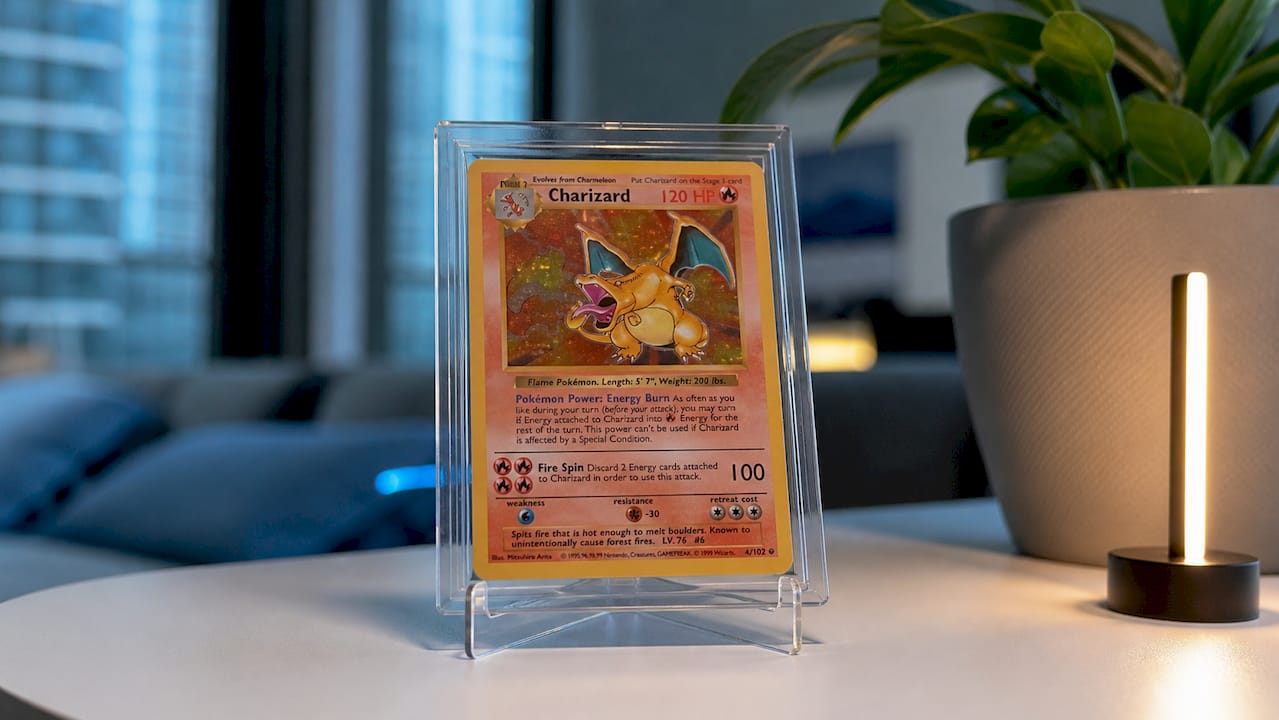
The 1999 Base Set 1st Edition Charizard (Base Set #4) is the card most people mean when they say “the Charizard.” Look for the black “1st Edition” stamp on the left side of the card face. A PSA 10 copy sold for as much as $550,000 through Heritage Auctions in December 2025, while raw near-mint copies still fetch a few thousand dollars. Sotheby’s has also cataloged CGC 10 Pristine examples in the $450,000 to $550,000 range, confirming these aren’t one-off flukes.
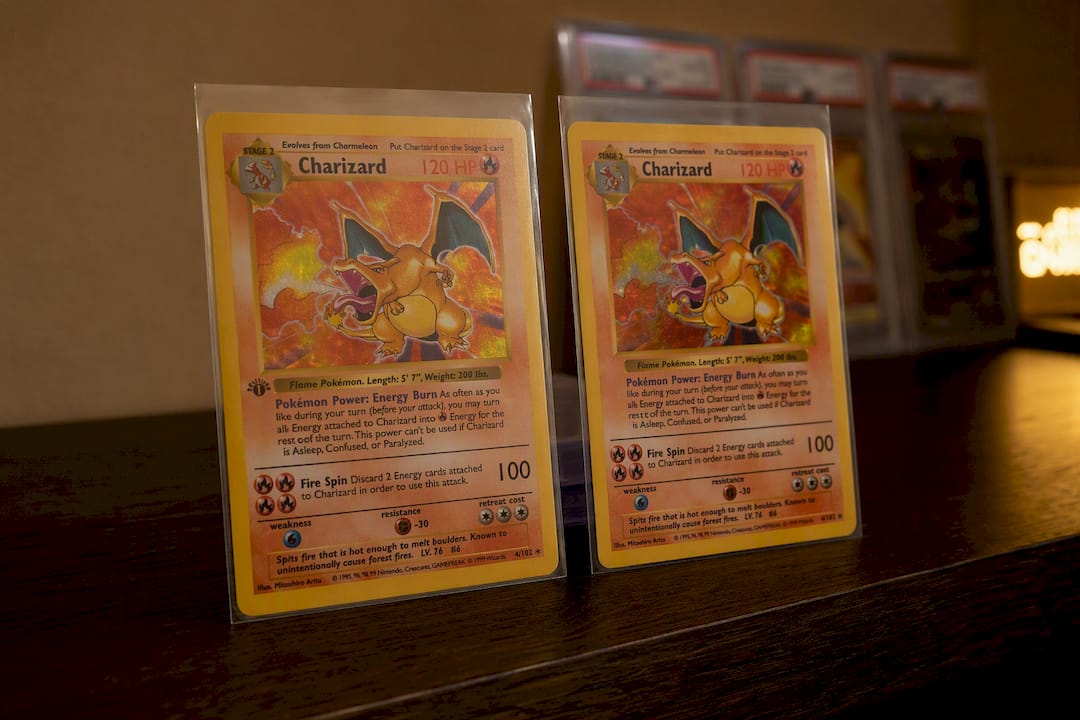
The 1999 Base Set Shadowless Charizard lacks the drop shadow behind the artwork box found on later Unlimited prints, but it also lacks the 1st Edition stamp. It sits in the middle of the value spectrum. Same artwork, same set, a fraction of the price.
Skyridge Crystal Charizard brings a holographic full-art treatment from the Skyridge expansion, one of the hardest-to-pull cards of the early 2000s due to Skyridge’s notoriously low print run.
Neo Destiny Shining Charizard was among the first “Shining” holo Pokémon ever printed, and its scarcity has aged well.
Dragon Frontiers Gold Star Charizard commands attention because Gold Star cards had absurdly limited print runs even for their era.
Scarlet & Violet 151 Charizard ex (Special Illustration Rare) is the modern entry, and while it doesn’t touch vintage pricing, it’s the most sought-after pull from a recent set built specifically around Charizard nostalgia.
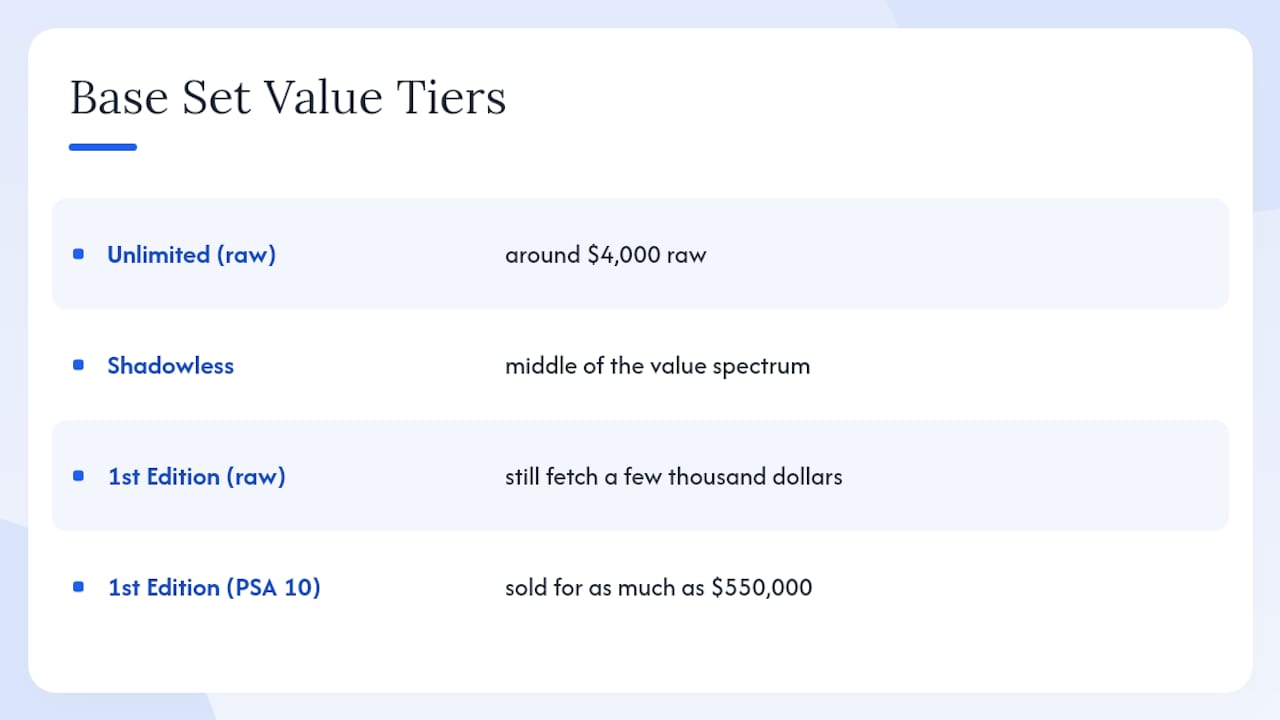
A print variant swing matters more than most collectors realize. The same Base Set artwork can run from around $4,000 raw in Unlimited condition to six figures in 1st Edition PSA 10, according to Polkastarter’s valuation data. That’s not a grading difference. That’s an edition difference on an identical picture.
Statistic to remember: The gap between a Base Set Unlimited raw copy and a Base Set 1st Edition PSA 10 isn’t incremental. It’s a multiple in the hundreds, driven almost entirely by print run size and grading population.
How Do You Identify Which Charizard Card You Own?
Before you check a price guide, confirm exactly what’s in your hand. Misidentifying edition or print is the single most common reason collectors overvalue (or undervalue) a Charizard.
- Check the bottom corner of the card face for the set symbol. Base Set has no symbol at all on early prints; later reprints add one.
- Look for a “1st Edition” stamp on the left side, below the artwork box. If it’s not there, check for a drop shadow behind the box, which indicates Unlimited rather than Shadowless.
- For Japanese cards, check for a rarity symbol near the card number. No symbol at all signals the ultra-early No Rarity print.
- For Topsun cards, confirm there’s no printed card number in the corner. That’s the giveaway for the “no number” variant collectors chase.
- For Shining, Gold Star, and Crystal variants, cross-reference the set logo and card number against a checklist, since holo treatments can look similar across different expansions.
- For modern Special Illustration Rares like the Scarlet & Violet 151 Charizard ex, confirm the full-art border and the “SIR” rarity marking in the corner.
Pro Tip: Photograph your card flat, under even light, with no flash and no glare, straight overhead. Angled or shadowed photos are the top reason online appraisals or grading pre-screens get a card’s condition wrong.
Why Grading Changes a Charizard’s Price So Much
Grading is where theoretical value becomes real money, and it’s also where most owners either leave cash on the table or waste it on submission fees for a card that never had a shot at gem mint.
PSA remains the dominant grader for vintage Pokémon, largely because population reports and buyer trust are deepest there. BGS carries strong recognition too, especially among collectors who want subgrades broken out. CGC has gained ground fast in the last few years and is increasingly accepted for high-end consignments.
Grading works off four inspection zones: corners, edges, surface, and centering. Centering is usually the deciding factor for whether a card clears the gem-mint bar. In 2026, the general benchmark for PSA 10 viability is centering around 60/40 or better front to back, with the reverse side often surprisingly overlooked by sellers.
Statistic to remember: Vintage Charizard PSA 10 grades sell for 5 to 20 times more than PSA 9 copies of the same card. Modern prints show a much smaller gap, typically 2 to 4 times.
That gap changes the math on whether grading is worth it. Submission fees and months-long turnarounds only make sense when the expected PSA 10 premium clearly outweighs the cost and the risk of coming back a grade lower. For a card worth $50 raw, grading rarely pays off. For a vintage Charizard worth thousands raw, even a modest chance at a 10 can justify the wait.
Charizard Price Ranges at a Glance
These bands reflect typical market activity rather than any single sale, except where marked as a verified record.
The Base Set 1st Edition and Japanese No Rarity rows carry the only fully verified auction figures here, drawn from Polkastarter’s reporting and Sotheby’s own catalog notes. Everything else reflects typical market ranges pulled from active listing and sales data, not a single confirmed sale, so treat those figures as a starting point rather than gospel.
Statistic to remember: Modern Charizard prints, including plenty of commons, trade for under $10, which is worth remembering before assuming any Charizard is automatically valuable.
Where Should You Check Live Charizard Market Values?
Current listings tell you what a seller hopes to get. Sold comps tell you what a buyer actually paid, and that distinction matters more than almost anything else in this hobby.
Build a comp the right way:
- Match the exact variant first, not just “Charizard” as a general search term.
- Match the grade and grading company, since a PSA 9 and a BGS 9 don’t always sell at the same price.
- Weight recent sales from the last six to twelve months heavier than older data, since the market moves fast.
- Watch for outlier sales, a single inflated price from an emotional bidder doesn’t set the market.
- Be skeptical of suspiciously round numbers on private listings, and check seller feedback and provenance before trusting a “graded” claim without a certification number.
Pricing guides consistently recommend filtering by exact variant and grade rather than eyeballing a general price range, and that discipline is exactly what separates a realistic asking price from wishful thinking.
Should You Grade, Sell Raw, or Hold?
The decision tree here isn’t complicated once you accept one rule: grade only when the expected PSA 10 premium clearly beats the fees, the wait, and the risk of a lower grade coming back.
- Estimate your card’s raw value using recent sold comps for your exact variant.
- Check the PSA 10 premium for that same variant. If it’s a vintage Charizard worth low thousands raw, a 5 to 20 times multiplier often justifies grading. If it’s a modern SIR worth $100 raw, a 2 to 4 times multiplier usually doesn’t cover the fees and wait.
- Choose your channel by price tier. Lower-value raw cards do fine through private sale or local shops. Higher-value graded singles perform better through major marketplaces or auction houses, where serious buyers actually shop.
- Document everything before listing: clear photos in daylight, an honest condition description, the certification number if graded, and any prior auction or sale history that proves provenance.
Pro Tip: Buyers pay a premium for a card with a paper trail. A screenshot of a prior sale or a certification lookup link in your listing description can push your final price up without costing you anything.
How Ripbin Helps You Value and Track Your Charizard
Identifying a variant is only half the job. The other half is knowing what it’s actually selling for right now, not what a five-year-old blog post claims. Ripbin pulls live pricing from real completed sales across more than 78,000 cards, which means the number you see reflects what buyers are actually paying for your exact variant and grade, not a listing price someone’s hoping to get.
The scan feature lets you photograph a card and get an instant identification and valuation, useful for sorting through a stack of vintage Charizards without manually cross-referencing set symbols. For grading decisions, Ripbin’s investing guides help you compare raw versus graded comps side by side, so you can run the ROI math from the section above with real numbers instead of estimates. The collection locker keeps a running record of what you own and what it’s worth over time.
Charizard Is a Great Card. It’s Not a Great Portfolio.
Here’s what conventional collecting advice gets wrong: it treats Charizard as a single asset. It isn’t. It’s dozens of separate markets wearing the same face, and most of them move independently. A Japanese No Rarity copy and a Scarlet & Violet 151 pull share nothing except the character on the front.
The pitfall I see most often is chasing a “hot” Charizard print after a viral sale, without checking whether that sale was a genuine market signal or a one-off bidding war between two collectors. Provenance and grading population matter more than headlines. Build around the handful of prints with a deep sales history, and treat everything else as a fun pickup, not an investment.
— Saad
Scan, Value, and Track Your Charizard Cards With Ripbin
Grading guides and price bands only help if you know what you’re actually holding and what it’s worth today, not what a forum thread claimed two years ago. Ripbin is built to close that gap: scan a card, get an instant identification, and see a value pulled from real completed sales, not a wish-list price on a current listing.

Unlike sites that charge just to browse pricing data, Ripbin gives you live, sale-sourced values with no browsing fees, so you can check your Base Set Charizard, your 151 pull, or anything else in your binder without hitting a paywall. Head to Ripbin’s card browser to look up your exact variant and grade, compare raw versus graded comps, and decide whether grading actually pencils out before you spend a dime on submission fees.