Sellers: 6-Step Checklist to Pick Auction or Buy It Now in 2 Minutes
By Ripbin Research · Published 2026-09-15

Sellers: 6-Step Checklist to Pick Auction or Buy It Now in 2 Minutes
For most sellers, Buy It Now should be the default listing format. Switch to an auction only when you’re selling something rare with thin recent sales data, or when demand is clearly outpacing supply and a bidding war could push the price past what a fixed price would ever capture. Check sold comps on Ripbin before you list either way.
TL;DR:
- Use solid recent sold data from tools like Ripbin to set realistic Buy It Now prices and avoid undervaluing or overpricing your items.
- Reserve auction listings for scarce or uncertain items when demand outpaces supply, or comps are unavailable or ambiguous.
- Schedule auction end times during high-traffic periods, such as Sunday evening, to maximize bidding activity and final prices.
- Stick with Buy It Now for re-stockable, high-demand categories like electronics and used household goods, which benefit from consistent visibility and search rankings.
- Avoid low starting bids on auctions unless you’re comfortable with the risk of a lower final price; consider using reserves for items with unknown value.
Table of Contents
- Auction vs Buy It Now: A 6-Step Decision Checklist
- Pros and Cons of Auction vs Buy It Now
- Auction Timing and Bidding Tactics That Boost Final Price
- Listing Durations, Best Offer, and What They Cost You
- Which Format Fits Your Item Type?
- Three Listing Templates You Can Copy Today
- What Selling Cards Taught Me About Auctions vs. Fixed Price
- Set Your Price With Real Sold Data, Not Guesswork
- Sources
- FAQ
Auction vs Buy It Now: A 6-Step Decision Checklist
Run any item through this before you list it. It takes about two minutes and saves you from guessing.
- Check sold comps first. Pull up recent sold listings on Ripbin or eBay’s completed listings. If three or more identical items sold in the last 30 days, you have real pricing data. If nothing sold recently, you’re in uncertain territory, which favors an auction.
- Count your supply. Is this a one-off, or do you have five more sitting in a box?
- Decide what matters more: ceiling or certainty. Auctions chase the highest possible price. Buy It Now guarantees a number you already agreed to.
- Factor in quantity. A single rare card behaves differently than a stack of 20 identical base cards.
- Think about your timeline. Auctions need 3 to 10 days to build momentum. If you need cash this week, that’s a point against them.
- Set your number. Pick a Buy It Now benchmark or a reserve threshold based on comps, then choose your listing duration to match.
Pros and Cons of Auction vs Buy It Now
Auctions and fixed-price listings solve different problems, and pretending one is universally better ignores how differently they behave under real market conditions.
Auction advantages:
- Price discovery lets true demand set the final number, sometimes well above what you’d have guessed.
- Scarcity creates urgency, and competing bidders can trigger emotional overbidding in the final minutes.
- Good for testing what an unfamiliar item is actually worth.
Auction risks:
- No floor. A slow auction week can end in a price that barely covers your cost.
- Timing mistakes (ending at 3 a.m. on a Tuesday) tank visibility.
Buy It Now advantages:
- Predictable proceeds. You know your number the moment someone clicks “buy.”
- Fixed-price listings build sales history that search algorithms tend to reward over time.
- Works around the clock, not just during a bidding window.
Buy It Now risks:
- You cap your own upside. If two buyers want it badly, you’ll never know.
The factor that usually tips the decision: how confident you are in your comps. Solid data points to Buy It Now. Thin or nonexistent data points to an auction.
Auction Timing and Bidding Tactics That Boost Final Price
Most winning bids land in the closing seconds, not the opening days. This behavior, often called sniping, happens because bidders wait until the last moment to avoid tipping off competitors, and eBay’s own bidding guidance confirms this is standard, expected activity rather than an edge case. Some sellers call the practical version of this the 3 minute rule: assume nothing that happens before the final three minutes matters much, because that’s when real bidding activity concentrates.
That timing detail changes how you should schedule an auction. End it when the most buyers are online and paying attention, and for collectibles that window is usually Sunday evening, when hobbyists are home and browsing rather than at work.
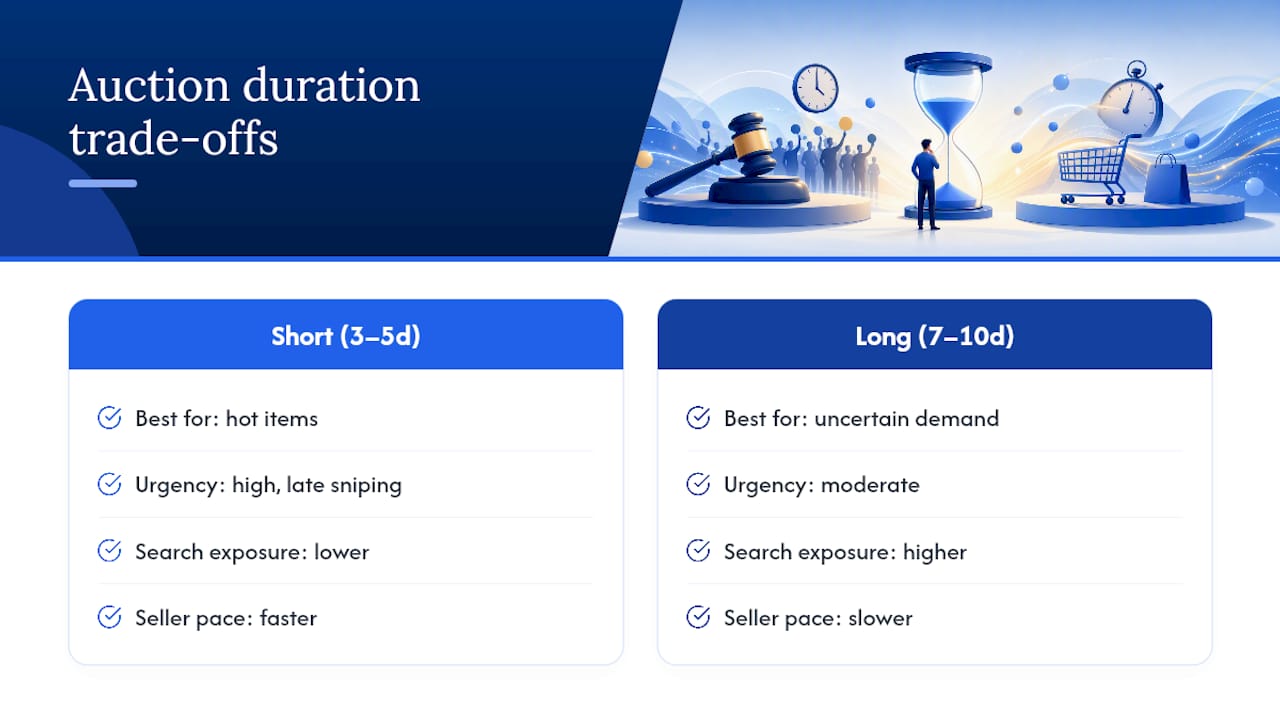
Duration matters too. A genuinely hot item with strong demand signals does fine in a short 3 or 5 day auction, since urgency compounds quickly. If you’re unsure how much attention the item will draw, a 7 or 10 day window gives it more chances to surface in search.
Pro Tip: Skip the tempting $0.99 starting bid unless you’re comfortable with the worst-case outcome. A low opener draws traffic, but if there is little bidding activity, the item could sell for a low price. Use a reserve instead when the item’s floor value actually matters to you.
Listing Durations, Best Offer, and What They Cost You
Buy It Now listings can run as Good 'Til Cancelled (GTC), meaning they auto-relist every 30 days without you lifting a finger. Auctions expire on a fixed schedule (1, 3, 5, 7, or 10 days) and don’t relist automatically, which means every ended auction resets your visibility clock.
- Final value fees run similarly across both formats, so the real cost difference comes from relisting frequency and insertion behavior at scale, not the percentage eBay takes.
- Best Offer works differently depending on format. On a Buy It Now listing, it stays active the whole time and lets hesitant buyers negotiate instead of walking away. On an auction, Best Offer disappears the moment someone places a bid.
- You cannot convert a live auction with bids into a Buy It Now listing. If you realize partway through that you priced it wrong, your workaround is to let the auction finish, then relist the next unit (if you have one) as Buy It Now.
- Seller-friendly return policies and complete listing details can also improve how often your item surfaces in search, regardless of format.
Which Format Fits Your Item Type?
Different inventory categories behave predictably enough that you can set a default rule and only override it when comps say otherwise.
- Graded cards and rare collectibles: Auction, or auction with a Buy It Now price attached, especially when comps are scarce and demand is genuinely unclear.
- Electronics and commodity goods: Buy It Now, priced competitively against current listings, since buyers comparison shop and rarely wait around for an auction to end.
- Clothing and used household goods: Buy It Now. These categories depend on search visibility more than bidding drama, and a GTC listing keeps showing up week after week.
- Multiple-quantity or restockable stock: Buy It Now, because it builds a sales history you can lean on for pricing the next batch. Sellers moving bulk inventory, like the volume listings you’ll see from Swift Dealers, typically run fixed pricing for exactly this reason.
Three Listing Templates You Can Copy Today
- Auction with Buy It Now (hedge template): Set your starting bid low enough to draw interest, then attach a Buy It Now price roughly 30% above that starting bid. This gives impatient buyers an exit while still letting the auction run if nobody bites immediately.
- Buy It Now plus Best Offer (speed template): List at your target comp price, turn on Best Offer, and accept anything within 10 to 15% of your ask. This closes hesitant buyers fast without you manually renegotiating.
- Reserve auction (unknown-value template): Use this when you genuinely don’t know what an item is worth but suspect it could be valuable. Set a reserve at your minimum acceptable price and let the market do the rest.
If your Buy It Now price gets hit mid-auction on a multi-quantity listing, fulfill that sale immediately and relist remaining units at the same or a slightly adjusted price based on how fast that one moved.
What Selling Cards Taught Me About Auctions vs. Fixed Price
I ran identical cards through both formats side by side more than once, expecting auctions to win more often than they did. They didn’t. Buy It Now, backed by real sold comps, consistently matched or beat auction outcomes on anything with decent sales history. Checking Ripbin’s sold data before listing cut my mispricing mistakes considerably. My advice: default to Buy It Now for anything restockable, and save auctions for the genuine unknowns.
— Saad
Set Your Price With Real Sold Data, Not Guesswork
Every decision in this checklist depends on one thing: knowing what your item actually sold for recently, not what you hope it’s worth. That’s the gap Ripbin closes. Scan a card, pull its live market value sourced from actual completed sales, and see grade-by-grade pricing before you commit to an auction or a fixed price number.

Instead of digging through eBay’s completed listings one at a time, browse cards on Ripbin and get sold comps, checklists, and current values in one place, then log the item in your collection locker so you’re not repricing from memory next time. If you’re building out a bigger card portfolio, the sports card investing guide walks through how timing and market signals affect what you list and when. Scan your next card, check the comps, and set your listing price with actual numbers behind it.
Sources
- eBay help: Bidding
- How to optimize your listings
- eBay auction vs Buy It Now comparison
- How to sell sports cards on eBay (and maximize your take) | CardSense AI
- eBay auction vs. Buy It Now (MakeUseOf)
FAQ
Is it better to sell on eBay using an auction or Buy It Now?
Buy It Now wins for most sellers because it delivers predictable proceeds and builds search-favored sales history over time. Auctions make more sense for rare items with limited comps where price discovery could push the final number higher.
Can I change a listing from Buy It Now to an auction, or the reverse?
You can edit a Buy It Now listing before it sells, but you cannot convert an active auction that already has bids into a Buy It Now listing. The workaround is to let the auction finish and relist any remaining stock in the format you actually want.
What is the 3 minute rule in auctions?
It’s the informal seller rule that meaningful bidding activity concentrates in the final three minutes of an auction, since most bidders wait until the last moment to place their bid and avoid tipping off competitors.
Is auction or Buy It Now better on platforms like Whatnot?
The same core logic applies across live-auction marketplaces: auctions suit scarce, high-demand items where a bidding war adds value, while fixed pricing suits repeatable stock where buyers want a known number upfront.
How do I know what price to set for a Buy It Now listing?
Check recent sold comps for the exact item and condition, ideally from the last 30 days, using a tool like Ripbin’s card database, then price at or slightly under the median sold price to stay competitive.